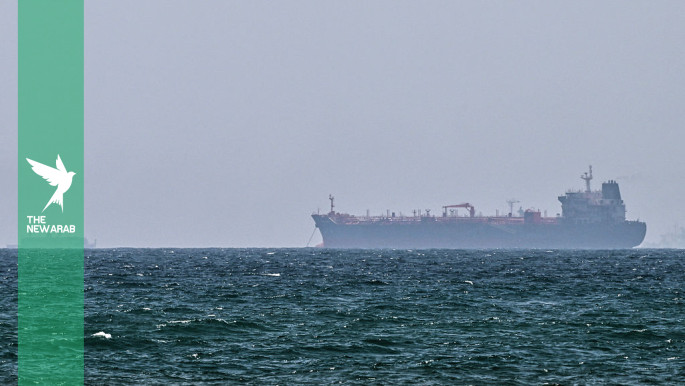
Thousands of seafarers have been stuck in the Gulf since the outbreak of the war [Photo by AFP via Getty Images]
International shipping companies welcomed the agreement between the US and Iran to end their war and reopen the Strait of Hormuz, but cautioned on Tuesday that it remains too early to resume normal operations through the vital waterway.
German shipping giant Hapag-Lloyd told The New Arab it is reassessing the security situation before sending vessels through the strait, despite expectations that conditions could improve in the coming days.
“Our vessels will be ready to transit the Strait of Hormuz from this weekend. However, we will only proceed when it is safe to do so,” Nils Haupt, the company’s Senior Director of Group Communications, said.
“Final transit dates remain dependent on decisions by the Iranian authorities and our continuous assessment of the security situation,” he added.
Denmark’s Maersk also welcomed the breakthrough but said it was too early to determine its practical impact on maritime trade.
“The announced agreement is a welcome and positive development, but publicly available details are still limited, and it is too early to assess how it will impact logistics and maritime operations in the Middle East,” the company told The New Arab.
“At this stage, there are no changes to our operations in the region.”
The comments come after Washington and Tehran signed a memorandum of understanding aimed at ending the conflict and reopening the Strait of Hormuz, one of the world’s most important energy chokepoints.
The closure of the strait, imposed by Iran during the conflict alongside missile and drone attacks on US military installations, Israel and regional targets, triggered a major shock to global energy markets by disrupting exports of oil, gas and refined products.
Around 20% of the world’s oil and gas supplies normally pass through the narrow waterway.
The resulting disruption was described by International Energy Agency Executive Director Fatih Birol earlier this year as “the largest supply disruption in the history of the global oil market”.
Speaking on Tuesday, Birol said it was essential that the Strait of Hormuz be reopened “unconditionally” to international shipping in order to ease the crisis.
Questions remain, however, over the exact terms governing the reopening.
While US President Donald Trump said the strait would be “completely open” from Friday, Iranian reports on the agreement have suggested that shipping will resume under what were described as “Iranian arrangements”.
The uncertainty has contributed to continued caution among international shipping firms.
The chief executive of Japanese shipping company Mitsui O.S.K. told the Financial Times that it could take up to a month before shipping traffic returns to normal levels.
Iranian state television, meanwhile, reported that the country’s own tankers had already resumed sailing through the strait.
According to the broadcaster, three Iranian oil tankers were operating in the northern Indian Ocean while two others were heading towards Iranian ports, with officials claiming that the US blockade on the country had been lifted.