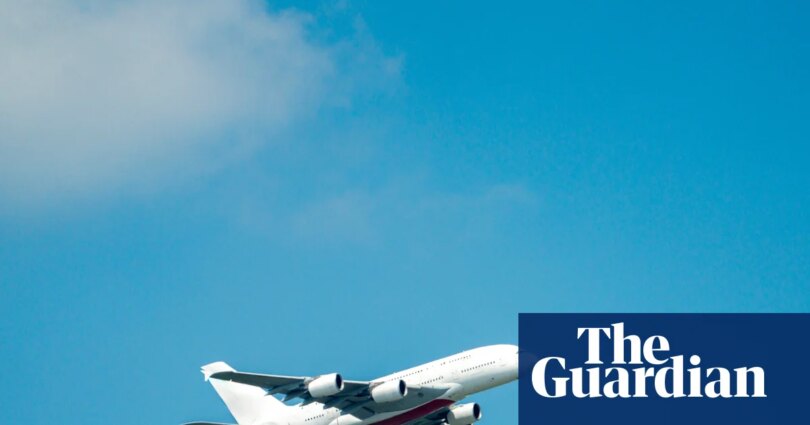
What happens to flights if the world runs out of oil? Well, obviously they will be grounded. To be more specific, is it possible, if the war in Iran does not resolve and the strait of Hormuz remains blocked, that airlines will simply run out of aviation fuel?
It’s not a question anyone has had to ask before. Air travel has hit some hurdles this century that nobody could have seen coming – Covid, of course, but also the Icelandic volcano in 2010, which closed much of European airspace for eight days, cost an estimated €3.75bn (£3.2bn) and caused untold supply chain chaos. There have been problems contained within a country or region – the Heathrow substation outage and the Iberian energy crisis, both last year, both closing airports – but since air travel began, it has never been globally impeded by a fuel shortage.
So how likely is it? What would it look like, to consumers, to governments, to economies? And could there be a silver lining, in the form of fewer carbon emissions in the short-term, and in the long-term, the ushering in of post-fossil-fuel air travel?
OK, to deflate some of the suspense, literally running out is not a thing. While 41% of European aviation fuel goes through the strait of Hormuz, and market analysts Kpler showed global shipments of jet fuel and kerosene fell below 2.3m tonnes last week, which is the lowest level on record, Richard Green, professor of sustainable energy business at Imperial College London, lays out the numbers. “The world uses about 100m barrels of oil a day, most of it from oilfields, a bit comes out alongside gas. In normal circumstances, about 15m barrels a day would go through Hormuz. Some of that can instead go through pipelines. The UAE has got coastline on the Indian Ocean, Saudi Arabia has coastline on the Red Sea, there’s a bit of production increase in other countries, the world was producing more than it was using last year … so the real drop is five or 10 out of 100.”
There is also some flex in how crude oil is broken down at refineries. “They can do a bit to vary the proportions of diesels, gasolines, petrols, aviation fuels,” Green explains, “although they can’t do it infinitely and probably couldn’t turn bitumen, the heaviest, stickiest part of the oil, into jet fuel, the lightest.”
But long before it runs out, fuel could get extremely expensive. If the war dragged on until the end of June, Amrita Sen, founder of consultancy Energy Aspects, told the FT that all stocks would be depleted, and “essentially you can pick a number when it comes to the oil price. We will just not have any buffers.” But even if it ended tomorrow, it would take months to return to pre-crisis flows. Prof Rafael Palacios, also at Imperial, where he is head of the aeronautics department, says: “Jet fuel has doubled in price over the last two months or so, which is horrendous. It is roughly the same cost as the petrol you use in your car was last year.”
That is already having an effect. On 22 April, Lufthansa announced that it was cutting 20,000 flights. By last weekend, Spirit airlines had gone bust, Virgin had announced that it couldn’t absorb higher fuel costs and would have to increase fares, and IAG, which owns British Airways, announced that it was also “making some pricing adjustments”. EasyJet has launched a “book with confidence” policy, guaranteeing no price increases after the fact, which is itself unnerving. It’s not really in the spirit of capitalism for a thing to get more expensive after you’ve bought it; though anyone with a student loan will know that it’s very much in the spirit of late capitalism. EasyJet has been able to offer its guarantee because it’s 70% hedged, though only until September. (In other words, it’s made financial deals to lock in a price for 70% of its fuel needs.)
Jenny Southan, founder of Globetrender, conducted a poll of travel industry executives as early as March, in which 49% said they were expecting week-to-week price fluctuations. “Travellers are reacting by delaying bookings and waiting for clarity,” she says. People with their ear to the ground (like my friend’s husband, a gas trader) say you should book to the largest airport in the vicinity of where you want to go, because small routes will be the first to get cancelled.
But to be picking up tips by word of mouth feels novel and weird. “The early phase of the war in Ukraine is the closest parallel in terms of uncertainty and rumour, but this feels more systemic,” says Southan. “The Middle East is central not just to geopolitics but to aviation infrastructure and energy flows, so the impact is more diffused – it affects routing, pricing and confidence all at once.”
However, when airlines make statements of confidence – as Ryanair’s Michael O’Leary has done, that’s not necessarily smoke and mirrors (though O’Leary seemed mainly to be taking the opportunity to trash talk competitors). Stefan Kreuzpaintner, a senior vice-president at Lufthansa, told me: “When we talk about fuel, there’s basically two things. One is that the price increases, which makes the cost base for airlines more challenging. How much you’re affected depends on whether you’ve hedged your fuel price into the future. The other part is fuel supply, because you refuel in your destination.” Aviation fuel is like the physical embodiment of the interconnectedness of the global economy. There’s no point having supply in Germany if – I don’t want to make up a hypothetical fuel-depleted country and start another rumour, so let’s just go with “your destination” – can’t refuel you. Lufthansa has 80% of its fuel price locked in for the rest of the year, so considers itself stable; the 20,000 cancellations were flights that were no longer profitable, so “from the commercial perspective, we wanted to take them out of the system anyway,” Kreuzpaintner says.
Ryanair claims to be the most hedged airline in Europe, while IAG released a statement saying: “Although we have a strong hedging strategy, we’re not immune to some of the impacts of these price increases.”
Leaving aside the likes of Ryanair and easyJet, low-cost carriers with short-haul-heavy networks are generally the most exposed, but then, at least if they go under and you’re stranded, you can get a train home. When the French airline Aigle Azur collapsed in 2019, at least one woman got stuck in São Paulo because she couldn’t afford the hiked fare back to Paris.
And yet, Palacios says, all this turmoil “forces us to think, dismantling the way we act and live, which in itself is good”. Green quotes Sheikh Ahmed Zaki Yamani, who was a highly influential figure in Opec during the 70s (choice headline from that oil crisis: “Yamani or your life”): “The cure for high oil prices is high oil prices.” People adapt: they buy electric cars, they install solar panels, they take trains, they stay home. This is already happening, Southan says. “People are still travelling, but they are choosing places that feel easier, safer or more predictable. Short-haul and regional travel are benefiting, while more complex long-haul routes are under greater scrutiny.”
Even though the US is insulated from shortages by being a net exporter, nowhere is insulated on price. “One person’s high price becomes the world’s high price because oil is quite good at being reshuffled,” Green says, describing a liquefied fossil gas ship that changed course on its way to Europe because someone in Asia was offering a better price.
There’s a heads-I-win-tails-you-lose element to this: even though price pressures are pretty standardised, some countries are much more exposed than others when it comes to supply. Goldman Sachs warned on Monday that the UK was the most exposed European country to shortages – a combination of its imports being predominantly through the strait and its low reserves.
More exciting than a globalised belt-tightening would be if this accelerated what they call “the long haul to jet zero”: post-fossil-fuel aviation. “If money was not an issue, the technology exists,” Palacios says. “But because money is an issue, the technology doesn’t exist.”
Jet fuel isn’t taxed – at the Chicago Convention on civil aviation in 1944, they decided that tax was national and flying was not, and because that was complicated, it was impossible (there’s some tax on fuel for domestic flights in some jurisdictions). “One of the big impediments for those of us looking into alternatives to fossil-fuel based aviation is that it’s very hard to compete with something which really is effectively subsidised indirectly,” Palacios says.
There are two alternatives to the kerosene that forms the basis of most jet fuel, both of them extraordinarily expensive. “The first is synthetic fuel,” Palacios says. “It’s a reverse process.” To recap, the normal process in combustion is that you burn hydrocarbons, and hydrogen goes one way, making water, and carbon goes the other, making CO2, which is the one we all worry about. “We can do it in reverse,” Palacios says. “Take carbon, hydrogen, mix them, build the fossil fuel; that is synthetic production. Nature works really nicely in one direction, and you’re fighting nature. It’s doable, but you need a huge amount of electricity. So it has to be out of renewables, otherwise you’re using kerosene to produce kerosene. It’s 10 times more expensive, but the knowledge exists.”
The alternative is that you burn hydrogen. “And we know how to do this,” Palacios continues. “Rolls-Royce was doing this a couple of years ago in a jet engine. The problem is, it’s a different fuel, and all the infrastructure of 100 years of aviation is built around a particular liquid, with a particular set of properties. Hydrogen has to be cryogenically treated [liquefied] to use as a jet fuel.”
It sounds hard, I say. “It is hard, but I’m an engineer: I love that.”
Something aviation has to do anyway, more expensive than fuel innovation in some ways, cheaper in others, is to revolutionise the world’s fleet, so that planes are much more fuel-efficient. There are prototypes with incredibly long, thin wings, too long to land, that would fold as they came in. But hardware ideas – indeed, all these ideas – require the whole world’s buy-in, and entail a “quantum change in cost, so of course we’re not going to do any of it until we have basically no alternative”, Palacios says. “It’s a 50-year order of magnitude for this transition. I think crises can be catalysts if we are at the right technology level. I believe, before I die, I will see these things at scale.”
The obvious consequence is that flying becomes an elite activity but, as Palacios points out, 50% of Britons take fewer than one flight a year and 80% of humans have never been on a plane. So it’s already an elite activity – it might just become an elite that you’re not in.
Green is “very conscious”, he says, “of the many sorts of damage [from high oil prices] to people in lower-income countries who are depending on commodities in the Gulf. Some African planting seasons are being seriously disrupted because they can’t get fertiliser. You can look for a silver lining, but the cloud itself is extremely dark.”
There’s another quote Yamani is famous for: “The stone age did not end for lack of stone, and the oil age will end long before the world runs out of oil.” Something has to hasten what comes next: it’s hard to see, short of a crisis, what that would be.