
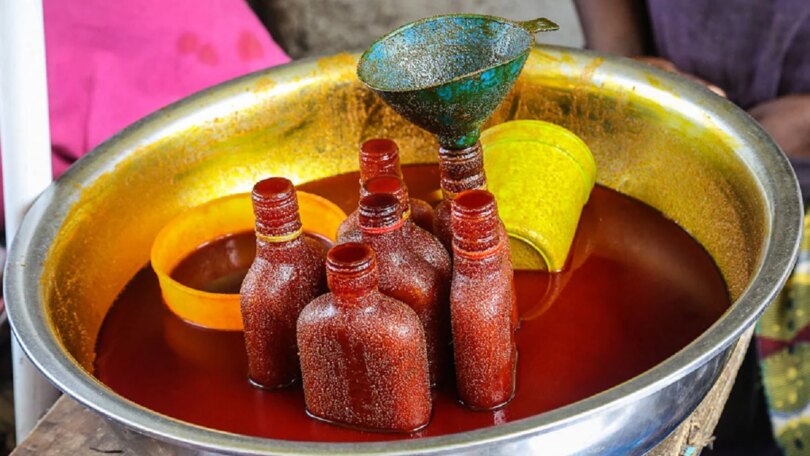
In millions of Nigerian homes, palm oil and ground pepper (ata gigun) are non-negotiable kitchen staples.
Unrefined palm oil is naturally rich in beta-carotene, which the body converts into essential vitamins A and E. It delivers vital energy alongside antioxidants that fight cell damage.
For ground red pepper, it gives daily meals their signature warmth and flavour. However, open-market stalls across the country are hiding a silent, dangerous secret.
To cope with rising prices and supply shortages, unscrupulous traders and processors have turned basic food preparation into a hazardous chemical trick. Low-grade, pale or diluted palm oil is being secretly mixed with non-edible industrial dyes such as Sudan III and Sudan IV (red oxide), candle wax, pap and heavy starches to give it a thick, rich crimson look.
The same deception has invaded the dry pepper market. Spoiled pepper remnants, dried stems, cassava flour and even fine sawdust are dumped into grinding machines, then laced with dark textile dyes and kolanut to manufacture fake, hot pepper.
Voices from the Market: How Traders Detect the Chemical Trap
According to an experienced palm oil seller in Lagos, popularly known as Mama Ochuko, differentiating between the original oil and the mixed one takes a careful look and a taste.
“If you see the real one, it’s not too red,” she stated.
She explained that the light part of the oil at the top is a bit darker, while for the mixed ones, “the colour looks like blood.”
According to her, real palm oil smells like fresh palm kernel, while fake oil feels sticky in the mouth, tastes heavy and often smells bad.
“To find them mixing it in the market is usually hard. They mix it before we get there, but once we see it, we are able to detect the difference. The coloured ones feel heavy in the mouth and, once it is added when cooking, it changes the colour of your fish and meat immediately.
“It’s the same with the coloured dried pepper. It changes the colour of your food. Some people use kolanut to grind the pepper in the market. I don’t know the reason, but maybe they want it to look more attractive.”
“The majority of people don’t know how to identify good palm oil or ground pepper. That is why it is advisable to stick to one trusted vendor instead of buying from different people in the market,” Mama Ochuko advised.
Wholesaler Greed and Supply Chain Fraud
According to another experienced palm oil trader based in Abeokuta, Fadairo Yusuf, wholesale distributors are now mixing raw palm oil with cooked cornstarch (pap) to artificially thicken the product and increase its volume.
He noted that, to protect his customers from buying spoiled or watery stock, he has to re-cook the oil at his own expense, using large pots and firewood at home to boil off the excess water.
He emphasised that farm producers in rural settlements are not responsible for the fraud, rather, greedy urban wholesalers buy genuine supplies at source and adulterate them upon reaching major city markets to maximise profits.
“We sometimes discover water in the oil and, for me to be able to sell, I have to re-cook all the gallons at home. There was a time I did that and lost about one and a half kegs after recooking it.
“It is the pap they put inside that causes it. They use pap to thicken and to make it swell. I can’t speak for everybody, but I know the oil is not mixed at where they are being produced. It’s wholesalers who go there to buy it and engage in all these dubious activities when they get to town.
“People buy something for N5,000 and want to earn N100,000,” Yusuf lamented, calling on government regulatory agencies to step up direct surveillance, track down wholesale operators in city centres and enforce strict penalties before contaminated food items destroy public health.
Corroborating him, Mr Francis Ikechukwu, another palm oil distributor in Ogun State, said, “The suppliers are the ones mixing it, not the producers themselves.
“Some people now add colour to palm oil, even ground pepper, to make it red, but once you put it in the pot, it will separate and turn your food to another colour.”
Mr Ikechukwu noted that quality palm oil does not have an offensive odour, unlike adulterated stock, adding that while standard jerrycans are marked for 25 litres, the content in them can get up to 30 litres.
High Prices Do Not Guarantee Pure Oil
A common misconception among consumers is that lower prices indicate fake products. However, a market survey by DAILY POST revealed a worrying reality: these adulterated food items are no longer sold as cheap alternatives.
Traders sell them at the exact same price, and sometimes even higher than pure, unadulterated products, exploiting buyers who mistake the artificial, glowing red colour for prime quality.
DAILY POST learnt that 25-litre jerrycans currently sell for between N47,000 and N51,000, depending on the vendor and the month.
Mama Ochuko disclosed that even the adulterated ones are sold at the same price as pure palm oil.
She said, “I don’t think it has anything to do with the price. Sometimes, the mixed ones are even more expensive than the original palm oil.
“Last week, I still bought 25 litres for N47,000. In August, it was sold for around N50,000 to N51,000. I buy my original oil directly from the Badagry market.”
Similarly, Mr Ikechukwu said, “It is sold at the same rate too. It sold for between N48,000 and N49,000, depending on who is selling. I don’t buy red oil anyhow; I buy it from outside Abeokuta.”

Regulatory Alarms and Security Crackdowns
In May, the Lagos State Consumer Protection Agency, LASCOPA, raised an alarm over the circulation of adulterated palm oil in some markets across the state and sealed a shop along Idutafa Lane, near Amodu Tijani Oluwa Mosque in Lagos Island Local Government Area, over the alleged sale of the oil.
The General Manager of LASCOPA, Afolabi Solebo, stated that some of the substances allegedly found in the adulterated palm oil include candle wax, chemicals, dyes and other impurities that the body cannot properly digest.
Solebo noted that consumption of such products could lead to food poisoning, stomach complications, tissue damage, liver problems and other long-term health conditions.
He warned traders and distributors involved in the sale of adulterated palm oil to stop the practice or face sanctions in line with the laws guiding consumer protection in Lagos State.
In August, a wave of public outcry hit Anambra State as residents raised alarms over chemically adulterated palm oil flooding major open markets, including Onitsha, Awka and Nnewi. Consumers reported buying palm oil with unnatural bright-red coloration, excessive thickness, offensive odours and strange bottom sediments.
Reacting to the developments, Joe Onyiuke, President of the Oil Palm Growers Association of Nigeria, OPGAN, and Vice Chairman of the National Association of Chambers of Commerce, Industry, Mines and Agriculture, NACCIMA, declared the widespread adulteration a “national disaster” and “national emergency.”
Onyiuke highlighted that, as Nigeria’s share of global palm oil production dropped from 40 per cent to roughly two per cent, a severe supply deficit opened up, giving criminal networks room to exploit unsuspecting buyers.
He also faulted regulatory bodies for poor market intelligence and failing to actively track down offenders.
“There is no market intelligence. Even if they have, they don’t care. They don’t go after them,” Onyiuke stated.
DAILY POST reported that in 2021, the Kano State Consumer Protection Council, KSCPC, uncovered illegal processing shops at the Galadima Market in the Sabon Gari area of Kano State, where adulterated palm oil was being produced and distributed to unsuspecting buyers.
In a statement by the Acting Managing Director of the council, Baffa Dan’agundi, operatives seized 11 full drums and 89 25-litre jerrycans of fake palm oil directly from the market stalls.
In August 2026, public fear over fake food found a loud voice on social media. Viral video clips showing palm oil mixing with water, leaving bright-red dye stains on cooking pots or turning soup into strange colours spread quickly across WhatsApp, TikTok and X (formerly Twitter).
For many scared buyers, these online videos were solid proof that toxic, chemically dyed oil and pepper had taken over local markets. The viral posts caused widespread panic, making families doubt the safety of the food they bought every day.
This growing noise on the internet eventually prompted the Director-General of the National Agency for Food and Drug Administration and Control, NAFDAC, Prof. Mojisola Adeyeye, to caution members of the public against relying on “emotionally driven” social media reports regarding fake palm oil and adulterated food items.
Mrs Adeyeye emphasised that determining whether a food product is contaminated requires rigorous laboratory analysis rather than unverified online narratives, which she noted can often be commercially motivated.
While dismissing social media hype, Adeyeye acknowledged that the adulteration of open-market staples, such as palm oil laced with hazardous azo dyes and fufu processed with chemical bleaches, remains a serious public health hazard.
She said allegations made on social media alone did not establish that a product was counterfeit, adulterated or unsafe, adding that the agency investigates credible complaints before taking enforcement action.
The DG urged the public to remain vigilant and report any suspicious activity, noting that once violations are confirmed, the agency carries out measures including product seizure, recall, disposal and enforcement against offenders.
“We received over 200 complaints from Nigerians monthly; in August, we received 225 calls through NAFDAC complaint channel,” she added.
Industrial Dyes Cause Cancer, Organ Failure — Medical Expert
A Chief Medical Officer and healthcare professional at the Federal Medical Centre, Abeokuta, Dr Kunle Ashimi, has described the adulteration of everyday cooking ingredients such as palm oil and dried pepper powder with industrial dyes as a serious public health concern.
He warned that eating these non-edible chemicals, even in tiny daily amounts, causes severe, irreversible damage inside the human body over time.
According to him, the practice is often driven by selfish economic interests, noting that substances such as Sudan dyes, Rhodamine B and Metanil Yellow have been associated with the adulteration of food products. He argued that some of these dyes are meant for industrial uses such as textiles, plastics and waxes, rather than for human consumption.
“Industrial azo dyes primarily used in the textile industry, waxes and plastics are fraudulently added to palm oil to impart a deep, vibrant red colour.
“Dyes like Rhodamine B, Metanil Yellow and non-food-grade red powders are added to pepper powder (ata gigun) or tomato paste to deceive people about colour changes from natural oxidation reactions that brighten the natural colour.
“Sometimes used as heavy bulking/colouring agents in ground spices to boost volume and colour intensity,” Ashimi stated.
The former Chairman of the Nigerian Medical Association, NMA, Ogun State Branch, explained that prolonged exposure to such chemicals can damage vital organs, particularly the liver and kidneys, and may also cause stomach problems, abdominal pain, skin reactions and other health problems in some people.
“Sudan dyes are classified as Group 3 carcinogens by the International Agency for Research on Cancer (IARC). Once they are ingested, the microbes in the gut and liver enzymes undergo chemical changes that cause genetic damage, which significantly elevates the long-term risk of hepatic, renal and bladder malignancies.
“Because the liver and kidneys are the primary organs for metabolism and excretion of drugs and other chemicals, prolonged low-dose exposure leads to their damage.
“These textile dyes act as potent irritants to the gastrointestinal internal layer. Short-term exposure frequently triggers intestinal disturbances like acute gastritis, abdominal cramping and severe enteritis.
“They cause hypersensitivity reactions, like some serious skin rashes, swelling of the skin, especially around the eyes, lips, hands and feet, or worsening asthmatic symptoms. It also introduces heavy metals like lead and cadmium into the body. Chronic ingestion contributes to neurological impairments/brain tissue damage, anaemia, hypertension and impaired mental development in children.”
Dr Ashimi called for greater public awareness, stronger food testing and better education on how suspected adulteration can be detected and reported, as well as strict enforcement against individuals who use industrial chemicals to adulterate food.
Unbranded Items Are Not Responsibilities of NAFDAC — Ogun State Coordinator
When contacted, Mr Akinwale Fagoroye, the Ogun State Coordinator of NAFDAC, told DAILY POST that unlabelled items sold in open basins or informal jerrycans fall outside the agency’s direct mandate, which primarily covers packaged and pre-labelled products.
Fagoroye argued that pure palm oil is naturally reddish due to its vitamin A content, making visual identification of chemical additives impossible without laboratory tests.
“Items that are not packaged and branded are not the responsibilities of NAFDAC. When I say branded, I mean if there is no label to it, it is not packaged, so it is not the direct mandate of NAFDAC.
“Now, when you have people adding all manners of unpermitted dyes, unless you see them adding it, you may not be able to categorically say that such red oils have been coloured with azo dyes.
“However, we try as much as possible to let people know that such practices are not permitted. They are not healthy, and they are not allowed,” he said.
Despite these jurisdictional limits on unbranded goods, he disclosed that NAFDAC maintains daily field operations to track down counterfeiters and mop up dangerous items across distribution hubs in the state.
“Our enforcement teams carry out market sweeps every day regardless of weather conditions. Recently, they conducted operations in heavy rain across Ifo to seal non-compliant shops and enforce safety bans,” he added.