
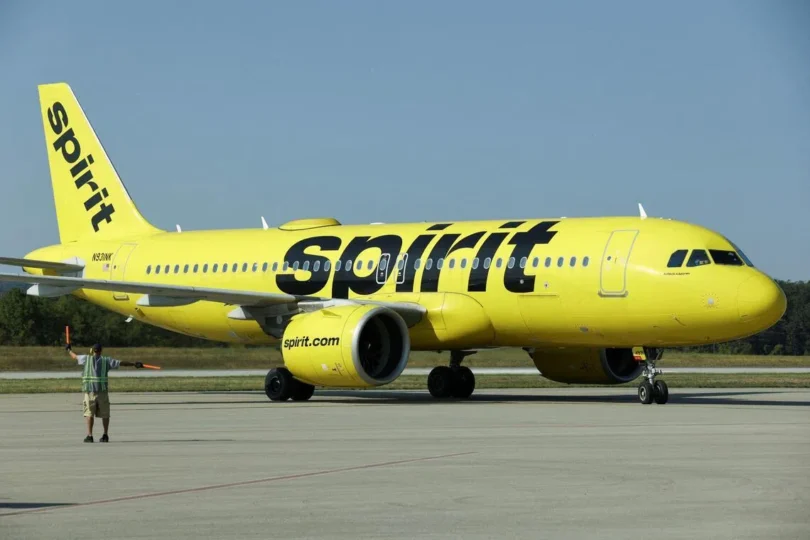
WASHINGTON – The Trump administration is in advanced talks about a potential rescue of low-cost carrier Spirit Airlines, which is struggling to exit bankruptcy, people familiar with the matter told Reuters.
The discussions underscore one of the unintended consequences of the Iran war launched by Washington: a surge in jet fuel prices that is rippling through the aviation industry, squeezing margins and pushing weaker airlines closer to the brink.
Fuel costs have roughly doubled since the conflict began, forcing carriers to raise fares, cut flights and scramble to preserve cash.
For Spirit, which was already struggling to turn a profit before the fuel shock, the spike has intensified doubts about whether it can survive on its own.
The US government is weighing a financing package that could include lending the airline up to US$500 million (S$630 million) in exchange for warrants, the Wall Street Journal reported.
A source familiar with the matter said Spirit and the federal government are in advanced discussions and hope to finalise terms soon, while a second source said Washington could receive warrants that could be exchanged for a significant equity stake as part of any deal.
It remains unclear what authority the administration would use to provide such support, and any intervention would be unusual outside of broader industry-wide relief programmes.
President Donald Trump told CNBC on April 21 that he would prefer to see Spirit acquired, but said government involvement was possible, signalling a willingness to intervene in a company that has become a test case for the industry’s fragility.
The Commerce and Transportation departments declined to comment.
White House spokesperson Kush Desai said the administration was monitoring the situation but did not confirm talks. He added that Spirit would have had a “much firmer financial footing” had the Biden administration not blocked its merger with JetBlue.
Airlines globally are grappling with a sharp rise in jet fuel prices after the US-Israeli war on Iran disrupted oil flows and traffic through the Strait of Hormuz, a critical energy chokepoint.
The spike has forced carriers to raise ticket prices and cut unprofitable routes as costs outpace their ability to pass them on to consumers.
Spirit is particularly exposed.
The airline built its turnaround plan assuming fuel costs of about US$2.24 a gallon in 2026 and US$2.14 in 2027, according to its March disclosures. By mid-April, prices were around US$4.24 a gallon – roughly double those levels.
That gap has undermined its restructuring strategy, which already relied on aggressive cost cuts and a smaller fleet. Spirit has said it plans to shrink to roughly 76 to 80 aircraft by the third quarter of 2026, about a third of its pre-bankruptcy size.
JP Morgan analysts said Spirit seeking government aid was a scenario they had been internally debating, noting that higher fuel prices were now “impeding its planned reorganisation” and raising the risk that liquidation could be imminent.
While the analysts said it made sense for Spirit to explore all possible sources of capital, they warned that any bailout could set a difficult precedent.
“Should the administration afford any sort of cash infusion, we believe JetBlue and Frontier would be inclined to quickly follow,” they said, adding that such a move could eventually draw in larger carriers and distort competition across the industry.
United Airlines chief executive officer Scott Kirby also struck a sceptical tone this week, calling Spirit’s business model fundamentally flawed and questioning whether it could cover its operating costs.
Transportation Secretary Sean Duffy raised similar concerns about using public funds to support the airline.
“What we don’t want to do is put good money after bad,” Mr Duffy said, in a Reuters interview. “Would we just forestall the inevitable and then own that?”
He added that it was unclear whether any buyer would emerge for Spirit.
“If no one else wants to buy them, why would we buy them?“ he said.
Analysts and industry officials also say Spirit’s potential collapse could reshape competition in key markets. Its exit would materially reduce capacity in places such as Fort Lauderdale, boosting fares and strengthening pricing power for surviving airlines, including rivals like JetBlue and Frontier.
Mr Duffy warned that rescuing one struggling airline could open the door to broader intervention. “If you do Spirit, who comes next?“ he said. “If Spirit goes away, it’s better for JetBlue. If we bail out Spirit, I can’t imagine that JetBlue would love that.”
Spirit declined to comment on the talks but said it continues to operate normally. REUTERS