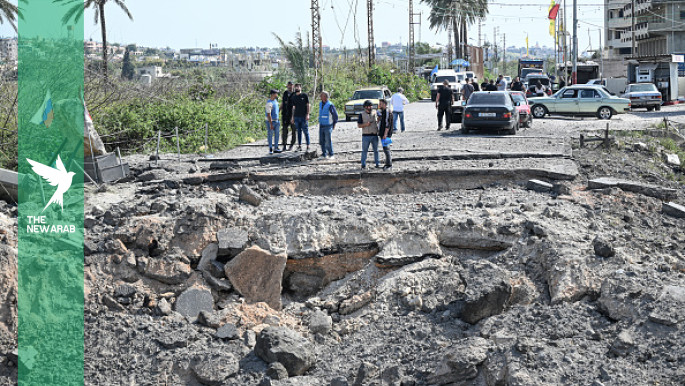
Israel’s latest offensive on Lebanon has killed more than 2,000 people and left swathes of the south in ruins [Getty]
US President Donald Trump announced on Truth Social that Lebanon’s President Joseph Aoun and Israeli Prime Minister Benjamin Netanyahu had agreed to a 10-day ceasefire, adding he would invite both leaders to the White House for the first meaningful talks between the two sides since 1983.
The announcement comes days after the Lebanese and Israeli ambassadors to Washington met at the US State Department and agreed to begin negotiations. The meeting was attended by US Secretary of State Marco Rubio and Washington’s ambassador to Lebanon Michel Issa.
“I just had excellent conversations… the two leaders have agreed that in order to achieve peace… they will formally begin a 10-day ceasefire,” Trump wrote, expressing confidence that an agreement could be reached “quickly.”
Once the ceasefire takes effect at 2100 GMT on Thursday, the Lebanese government will take steps to prevent Hezbollah and all other non-state armed groups in its territory from carrying out any attacks against Israel, according to the text of the ceasefire agreement released by the U.S. State Department.
“All parties recognise Lebanon’s security forces as having exclusive responsibility for Lebanon’s sovereignty and national defence; no other country or group has claim to be the guarantor of Lebanon’s sovereignty,” the agreement reads.
Israel can take necessary measures in “self-defence” against planned, imminent, or ongoing attacks during the ceasefire period, but it agreed not to carry out any offensive military operations in Lebanon during the ten days.
The two countries have requested the United States to facilitate further direct negotiations between them to resolve all remaining issues, including demarcation of the international land boundary, according to the ceasefire agreement.
“Israel and Lebanon affirm that the two countries are not at war and commit to engaging in good-faith direct negotiations, facilitated by the United States, with the objective of achieving a comprehensive agreement that ensures lasting security, stability, and peace between the two countries,” the text released by the U.S. State Department said.
The Department said the ceasefire period may be extended by mutual agreement.
Trump said he expected Aoun and Netanyahu to visit the White House in coming days, telling reporters, “they’ll be meeting – probably coming to the White House – over the next four or five days.”
Israel to keep ‘security zone’
Netanyahu said Thursday that the ten-day ceasefire with Lebanon offered an opportunity for a “historic peace agreement” with Beirut, but insisted that the disarmament of Hezbollah remained a precondition.
“We have an opportunity to make a historic peace agreement with Lebanon,” Netanyahu said in a televised speech.
He said Israel will maintain a 10-kilometre (6.2-mile) “security zone” along the border in southern Lebanon, amid an ongoing invasion and fierce clashes with Hezbollah. Many in Lebanon are worried that Hezbollah’s disarmament is being used as a pretext for a new Israeli occupation.
For days, fighting has concentrated in the key town of Bint Jbeil.
Israel occupied southern Lebanon between 1982 and 2000.
Netanyahu added that Israel maintained two conditions for the ceasefire: Hezbollah’s disarmament, and a lasting peace agreement “based on strength”.
He said he rejected the two conditions posed by Hezbollah: Israel’s full withdrawal from Lebanese territory, and a ceasefire based on the principle of “quiet in return for quiet.”
Aoun rejects call with Netanyahu
In Lebanon, Hezbollah has signalled caution, warning that any ceasefire must fully halt Israeli attacks on Lebanon and be adhered to by all parties. The Iran-backed militant group said the agreement must not give Israel the freedom of movement in Lebanon.
Sources in the group told The New Arab that it remains committed to defending Lebanon as long as Israeli attacks continue, stressing that any truce must include a full cessation of hostilities, Israeli withdrawal, and the release of prisoners.
Sources also told TNA that Aoun rejected any direct contact with Netanyahu, with Lebanon maintaining its position of not recognising Israel.
In a call with Trump earlier Thursday, Aoun urged Washington to intensify efforts to secure a ceasefire, before the agreement was announced.
“Aoun wished for Trump to continue these efforts for a ceasefire as soon as possible,” the Lebanese presidency said, adding that Trump reaffirmed his support for Lebanon and commitment to achieving a truce quickly.
The president had earlier received a call from Rubio, during which he thanked Washington for its efforts.
Sources said Aoun held internal consultations over the proposed contact with Netanyahu and was advised against it, including by Parliament Speaker Nabih Berri.
Israeli attacks continued on Thursday across southern Lebanon, and a strike even targeted a car along the busy Beirut-Damascus highway in the Dahr al-Baidar area.
Lebanese authorities say Israeli strikes have killed more than 2,100 people and displaced around a million people since fighting resumed on 2 March between Hezbollah and Israel. An 8 April strike on Beirut was the biggest Israeli attack on the capital in decades.
Over the past 24 hours, Israeli strikes across southern Lebanon and the eastern Beqaa region have killed dozens of people and wounded more.