OTTAWA – President Donald Trump on July 17 blamed Canada for wildfire smoke spreading across the United States and said he would add the “incalculable cost” of dealing with the pollution to existing tariffs on Canadian goods.
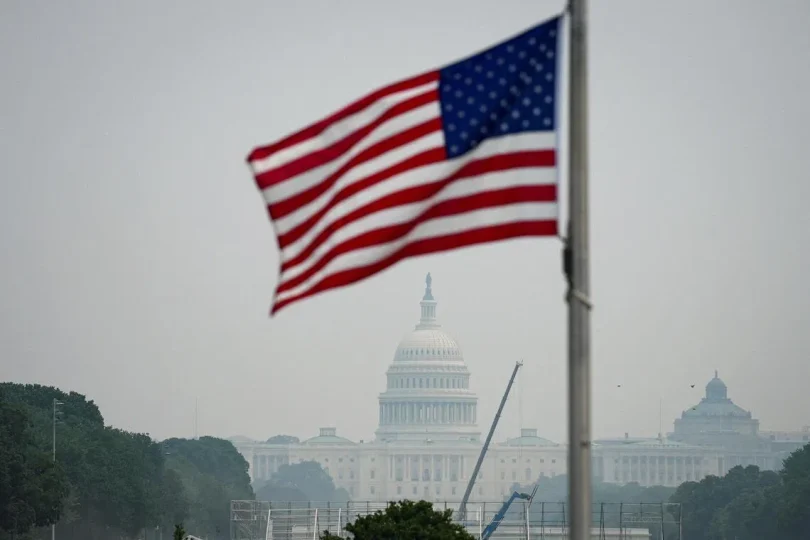
Heavy smoke from hundreds of Canadian fires enveloped a swathe of the US from the Midwest to the Northeast on July 16 and 17, prompting warnings to residents to stay indoors.
Trump, who has a combative relationship with Prime Minister Mark Carney, said he would be calling the Canadian leader to find out what he planned to do about the “totally unacceptable” situation.
“We are holding Canada responsible for the fact that they are not properly maintaining their Forests… and the United States is being unnecessarily invaded by filthy, polluted, and unhealthy air,” he said in a Truth Social post.
“This is Willful Negligence, and becoming a yearly occurrence, costing the United States Billions of Dollars, which cost of this pollution must of necessity be added to the TARIFFS Canada is currently paying.”
Shortly after taking office in 2025, Trump imposed tariffs on several key imports from Canada, prompting Carney to impose countermeasures.
Carney’s office did not immediately respond to a request for comment.
Carney said on July 16 the United States could do more to combat climate change that is leading to warmer and more extreme temperatures around the world.
The two men are likely to meet at the FIFA World Cup final in New Jersey on July 19.
Most of the blazes are in the giant province of Ontario and are concentrated in the remote and sparsely populated north-west, where the only mode of transport is aeroplanes. Thousands of people have been evacuated and at least one community has burned to the ground.
So far, 650,000 acres (2,630 sq km) are on fire, compared with 600,000 acres at the same time in 2025.
Premier Doug Ford on July 17 said the province would buy 11 new aircraft to help counter the fast-spreading wildfires and pushed back against US politicians who have criticised the campaign as inadequate.
The United States is experiencing an above-average fire year, with 3.7 million acres (1.5 million hectares) burned to date in 2026 compared with a 10-year average of 2.7 million acres (1 million hectares), according to the National Interagency Fire Centre.