
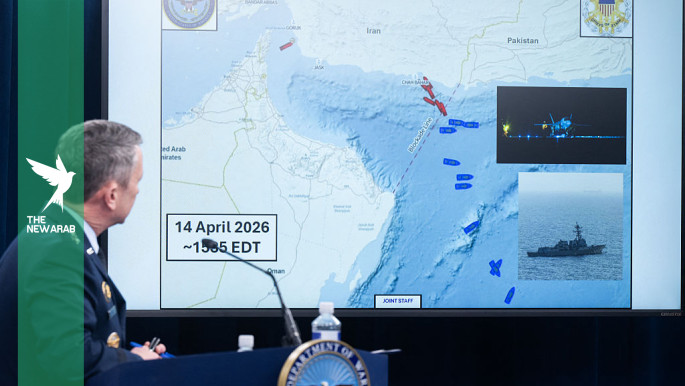
US Chairman of the Joint Chiefs of Staff General Dan Caine speaks as a map of the Strait of Hormuz is displayed during a press briefing at the Pentagon, 16 April 2026. [Getty]
Iran’s Foreign Minister Abbas Araghchi said on Friday that the Strait of Hormuz will be “completely open” to maritime traffic as long as a ceasefire in the Middle East lasts.
“The passage for all commercial vessels through Strait of Hormuz is declared completely open for the remaining period of ceasefire,” Araghchi announced on X.
The two-week ceasefire struck last week is due to expire on 22 April, though US and Iranian officials have suggested it could be extended while peace talks continue.
The strategic waterway has been largely closed to traffic for almost seven weeks following the US-Israeli attack on Iran, triggering a historic energy crisis across the world.
Trump lauded the move but said the US naval blockade of Iranian ports will remain in place until a final peace deal is reached.
“The Strait of Hormuz is completely open and ready for business and full passage, but the naval blockade will remain in full force and effect as it pertains to Iran, only, until such time as our transaction with Iran is 100% complete,” he wrote.
“This process should go very quickly in that most of the points are already negotiated,” he added.
The news broke as Britain and France prepared to chair a meeting of around 40 countries to discuss setting up an international task force aimed at re-opening the strait.
The strait, which carried a fifth of the world’s oil and gas before the war, fell under Iranian control in March after the US and Israel launched their attack. Tehran has since charged transit fees on passing vessels and has sought to leverage its control over maritime traffic in the ongoing peace negotiations with the US.
Western nations this week declined to join the US blockade on Iranian ports, which was announced by the US president after peace talks in Islamabad last weekend ended without an agreement.
Optimism grows for interim peace deal
Trump’s post was the latest in a string of optimistic messages about the prospects of a peace agreement, which Iranian officials have sought to downplay.
The two sides were unable to reach an agreement during marathon talks in Pakistan over the weekend. Pakistani officials, who are leading international efforts to broker an end to the conflict, are now racing to set up a second round of negotiations to prevent a return to the destructive six-week conflict.
“I think we’re very close to making a deal with Iran,” Trump told reporters outside the White House on Thursday after US officials brokered a 10-day truce in Lebanon.
He later added that the war “should be ending pretty soon” and said he may travel to Islamabad if a deal is reached.
Iranian and Pakistani officials have indicated that an interim agreement may be struck by the ceasefire deadline, paving the way for technical talks aimed at a final settlement.
A Pakistani official told Reuters that its mediation efforts are making progress and that the two countries could sign a memorandum of understanding at an upcoming meeting.
“Detailed agreement comes later. Both sides are agreeing in principle. And technical bits come later,” the source said.
Iranian officials have said that the focus is now on reaching a preliminary deal to end the war due to disagreements over the nuclear issue and that the ceasefire could be extended to make room for new talks.
“The fate of Iran’s highly enriched uranium and the duration of Iran’s nuclear restrictions are among the highly disputed issues for which no solution has yet been found,” one official told the news agency.
Speculation over a second round of talks has grown since the weekend, when 21 hours of discussions failed to yield an agreement. US Vice President JD Vance identified the nuclear issue as a key sticking point, saying in Islamabad that Tehran had not provided guarantees it would not pursue a nuclear weapon.
A Pakistani delegation led by the country’s powerful military chief travelled to Tehran this week to discuss follow-up talks. Prime Minister Shebaz Sharif is visiting Saudi Arabia, Qatar and Turkey this week in a bid to build momentum for renewed negotiations.
Despite the negotiations, the Trump administration is continuing to build up military forces in the Middle East, this week authorising the deployment of another 6,000 troops to the region.
An attempt by Democratic lawmakers to scale back the US military’s presence in the region was defeated on Thursday after the Republican-controlled House rejected a resolution to curb Trump’s war-making powers.