Pal Chaudhuri does not believe the ceasefire has fully collapsed. He said President Trump has declared the agreement dead “about 20 times” during past negotiations, only to re-engage days later, and expects Qatar to step back in as a mediator.
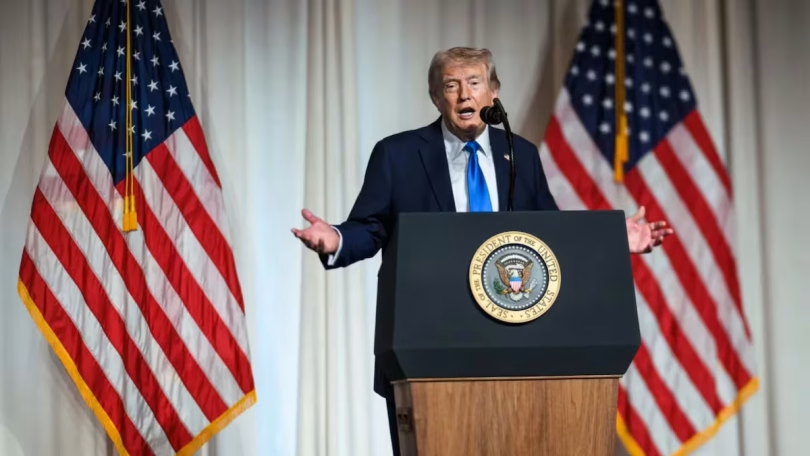
The comments come after US President Donald Trump said on Wednesday, July 8, that he believes the agreement between Washington and Tehran has effectively collapsed, calling further negotiations with Iran “a waste of time”.
Speaking at the NATO summit, Trump also reiterated that the United States would not allow Iran to develop a nuclear weapon, while sharply criticising the country’s leadership.
According to Pal Chaudhuri said the latest escalation does not necessarily signal the end of the broader understanding between the US and Iran.
He believes Qatar is likely to resume mediation efforts as both sides return to the negotiating table. He argued that the United States remains unwilling to use military force to guarantee free passage through the Strait of Hormuz, while Iran is likely to continue expanding its regional influence.
At the same time, he does not expect any significant change in Israel’s stance on Lebanon, suggesting that intermittent flare-ups are likely even as diplomatic efforts continue.
Pal Chaudhuri said the recent escalation reflects unresolved issues in the original understanding between the US, Iran and regional players rather than the failure of the overall agreement.
He said the memorandum that led to the ceasefire left several important issues open to interpretation, allowing both sides to push their respective positions. According to him, disputes over Lebanon, the Strait of Hormuz and sanctions on Iranian oil were always likely to create friction.
Chaudhuri said he expects financial markets to take a longer-term view of the latest flare-up rather than treat it as a full breakdown of the ceasefire. He cited an oversupplied global oil market, with Saudi Arabia and other producers ramping up output, as a reason crude prices are unlikely to spike sharply even if fighting continues intermittently.
“I would see oil prices rising a little bit, but not very much,” he said, adding that neither side appears to want a full-scale conflict.
For the entire discussion, watch the accompanying video