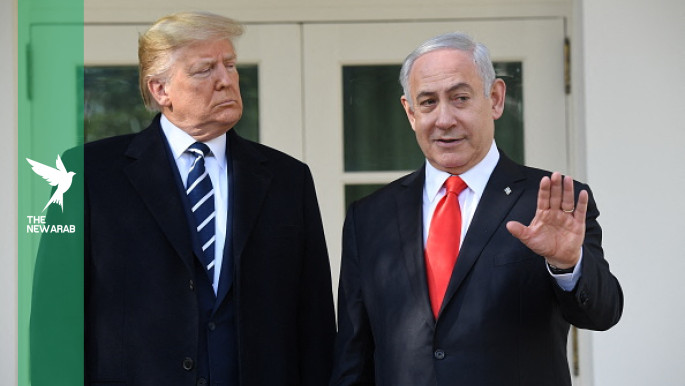
Trump had assured Israel that Iran’s stockpile of highly enriched uranium would be removed from the country under any future agreement, sources say [Getty]
Tensions have arisen between US President Donald Trump and Israeli Prime Minister Benjamin Netanyahu over a potential deal with Iran, as the Israeli premier reportedly pushes to resume the war.
Israel’s Channel 12 reported on Wednesday that a “difficult” phone call took place between Trump and Netanyahu the previous evening, focusing on a proposal backed by Arab and Islamic countries aimed at establishing a settlement framework between Washington and Tehran.
According to the report, Netanyahu emerged from the call “concerned” about the direction of the negotiations. Channel 12 also cited two informed Israeli sources as saying the conversation was “not easy,” with clear disagreements surfacing over how to handle the war on Iran in the coming phase.
Three sources familiar with the call told the channel that Trump informed Netanyahu that a “letter of intent” was being drafted ahead of a possible agreement between the United States and Iran.
Citing a US source, Channel 12 said the document could pave the way for ending the war and launching an additional 30 days of negotiations on several issues, including the Strait of Hormuz and Iran’s nuclear programme.
The source added that Netanyahu expressed deep skepticism toward the initiative, arguing that Washington should continue military pressure on Iran in order to further weaken its government.
Iran has largely blocked off access to the Strait of Hormuz, the strategic waterway through which around a fifth of the world’s oil supply passes, making it one of the central sticking points in negotiations. In response, the United States has imposed a blockade on Iranian ports.
The US and Israel began bombarding Iran on 28 February, immediately drawing much of the wider region into war. A shaky ceasefire has been held since 8 April.
Keeping the uranium
Citing two senior Iranian sources, Reuters reported Thursday that Iran’s Supreme Leader Ayatollah Mojtaba Khamenei has instructed officials not to send the country’s near-weapons-grade uranium stockpile abroad, hardening Tehran’s position on one of Washington’s key demands in the talks.
“The Supreme Leader’s directive, and the consensus within the establishment, is that the stockpile of enriched uranium should not leave the country,” one source told Reuters on condition of anonymity due to the sensitivity of the matter.
According to the sources, Iranian officials believe transferring the material abroad would leave the country more vulnerable to future attacks by the United States and Israel.
Russia’s defence ministry said on Thursday it was prepared to help bridge gaps over the issue.
Khamenei, whose condition remains unclear following reports that he was seriously wounded in a previous attack, has the final say over major state decisions.
Netanyahu has repeatedly said the war cannot be considered over unless Iran’s enriched uranium is removed, Tehran ends support for armed groups in the region, and its ballistic missile programme is dismantled.
Iran maintains that its nuclear programme is peaceful and says its missile arsenal is necessary for self-defence.
Israeli officials told Reuters that Trump had assured Israel that Iran’s stockpile of highly enriched uranium would be removed from the country under any future agreement.
Drone production
Meanwhile, Iran has reportedly accelerated efforts to rebuild its military capabilities damaged during the conflict.
Citing sources familiar with US intelligence assessments, CNN reported on Thursday that Iran has resumed parts of its drone production in the six weeks since the ceasefire took effect on 8 April.
According to four sources cited by the network, US intelligence believes Iran is rebuilding faster than initially expected, including by replacing missile sites and launch platforms and expanding production capacity for key weapons systems damaged during the war.
One US official told CNN that some intelligence assessments suggest Iran could fully restore its offensive drone capabilities within six months, adding that Tehran had “surpassed all the timelines” projected by intelligence agencies.
Sources cited by CNN attributed the accelerated rebuilding effort partly to support from Russia and China, as well as the more limited damage inflicted by US and Israeli strikes than initially expected.
Two sources familiar with the intelligence assessments said China continued supplying Iran with components that could be used in missile production during the conflict, although shipments may have declined due to the current US blockade on Iranian ports.
Netanyahu told CBS last week that China was providing Iran with “missile manufacturing components,” though he declined to provide further details. China’s foreign ministry denied the allegation, calling it “unsupported by facts.”
Despite sustaining significant damage in US and Israeli strikes, Iran still retains ballistic missile, drone and air defence capabilities, according to the latest US intelligence assessments, suggesting reconstruction efforts are not starting from scratch.
Iran relied heavily on drones during the war, launching attacks on Gulf states it accused of being used as launchpads for US attacks. Gulf countries condemned the attacks, saying Iranian drones and missiles struck not only military targets but also civilian and energy infrastructure.
Despite the ceasefire, several drone strikes have been reported this month on the United Arab Emirates, which bore the brunt of Iranian attacks during the conflict.