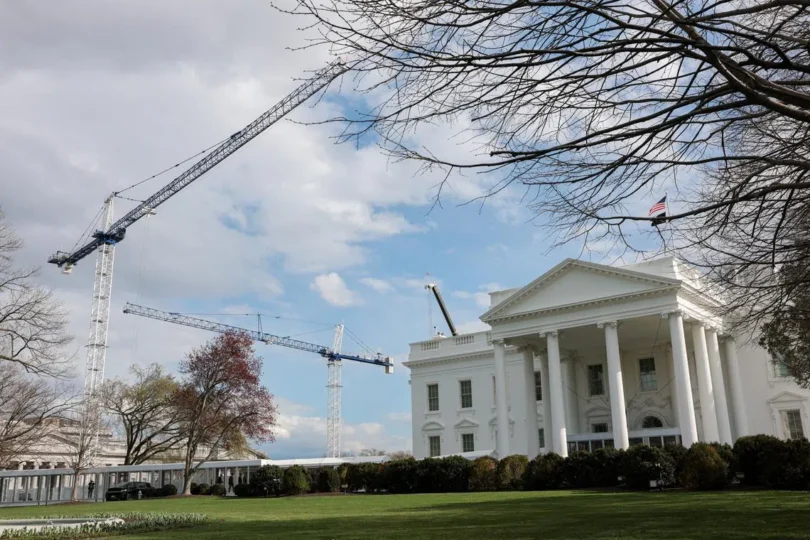
WASHINGTON – The Trump administration has transferred about US$350 million (S$451.6 million) from the Secret Service to White House security upgrades as US President Donald Trump builds a luxury ballroom on the grounds with a secure military bunker underneath.
Two transfers, of US$340.8 million and US$10.75 million, were made last week, according to the Office of Management and Budget. The Washington Post reported earlier on the transfer of funds.
Trump has tried to ward off criticism of his plans to build a ballroom by insisting that private donations – not taxpayer money – would be used to pay for it. But the reality is more complicated. The Secret Service has acknowledged that taxpayer money will be used for “security enhancements” of the ballroom and the bunker.
Rachel Cauley, the communications director for the White House Office of Management and Budget, said the funding was for security, not the construction of the ballroom itself. The White House has said that roughly US$400 million in private donations would pay for the ballroom.
“It’s all private donations,” Cauley said in an email.
Trump first pitched the ballroom as a way to properly entertain guests in a grand manner. But in recent months, he has also started speaking about the project as a matter of national security and linking it to the bunker beneath the ballroom.
When Trump tore down the East Wing to make way for the ballroom, he also began a taxpayer-funded project to upgrade the bunker.
The bunker, which was built during World War II to protect the president and other top officials in the event of an emergency, was where Vice President Dick Cheney was hustled after the 9/11 terrorist attacks. Trump was rushed there, too, during protests over the death of George Floyd in 2020.
The White House now refers to both the ballroom project and the bunker collectively as the “East Wing Modernisation Project,” which Davis Ingle, a White House spokesperson, said is “is inextricably tied to the security of the president, the White House grounds and the certain security infrastructure assets”.
In court documents, the Secret Service has repeatedly argued that any halt in the collective project could put lives in danger.
“The events over the weekend and the foiled attack on the historic UFC Freedom 250 event at the White House proves exactly why the East Wing Modernisation Project is severely needed for large-scale events,” Ingle said, referring to charges against a group of people accused of planning an attack on the UFC event at the White House on June 14.
In addition to building the ballroom, the Trump administration is at work on a number of security upgrades at the White House and plans to use taxpayer money for those projects.
The administration had asked Congress for US$1 billion to cover the cost of security enhancements, though that request was later dropped from a funding bill.
The Secret Service has said it plans to spend US$220 million to “harden” the partially built ballroom against attack, including the installation of bulletproof glass, drone detection technology, chemical and other threat filters and detectors. The taxpayer-funded upgrades also include a US$180 million visitor screening facility.
“The Ballroom is coming along fantastically well,” Trump wrote on social media early on June 18. The president claimed the project was “on time, and under budget.”
He said it would include a port for military drones and “ALL of the other many Military elements, which are all vital for National Security, that are being built throughout the whole integrated, cohesive Project.” NYTIMES
This article originally appeared in The New York Times.