Follow our live coverage here.
WASHINGTON – US President Donald Trump – promising an “amazing two days” – has indicated peace talks with Tehran could resume and end in a deal, even as the United States turned the screws with a naval blockade it said had cut off maritime trade with Iran.
Mr Trump told the New York Post on April 14 that a new round of talks with Iran could take place in Pakistan “over the next two days”, after a marathon first negotiating session ended without a breakthrough.
In a Fox Business interview due to be aired on April 15, he declared the war “very close to being over”. But he also warned it could last through the November midterm elections.
He also repeated his threats to attack Iranian civilian infrastructure, while saying he hoped it wouldn’t come to that.
“We could take out every one of their bridges in one hour. We could take out every one of their power plants in one hour,” he told the host, Ms Maria Bartiromo. “We don’t want to do that.”
With the prospect of US and Iranian officials returning to Pakistan for more talks, Vice-President J.D. Vance, who led negotiations that ended on April 12 with no breakthrough, said he felt positive about where things stood.
“I think you’re going to be watching an amazing two days ahead,” Mr Trump told ABC News reporter Jonathan Karl, adding he did not think it would be necessary to extend a two-week ceasefire that ends on April 21.
“It could end either way, but I think a deal is preferable because then they can rebuild,” Mr Trump said, according to a post by Mr Karl on X. “They really do have a different regime now. No matter what, we took out the radicals.”
Officials from Pakistan, Iran and several Gulf states also said negotiating teams from the US and Iran could return to Islamabad later this week.
Talks broke down on April 12 without an agreement to end the war, which erupted on Feb 28 with US-Israeli strikes on Iran, triggering Iranian attacks on its Gulf neighbours and reigniting a parallel conflict between Israel and Iran-backed Hezbollah in Lebanon.
Mr Trump’s optimism helped nudge global stocks higher with fresh record highs in view.
Benchmark oil prices – having fallen on April 14 and in early trade on April 15 – climbed to around US$96 (S$122) per barrel, after the US military said its blockade had completely halted trade going into and out of Iran by sea.
More vessels were being turned back under the US blockade, including the US-sanctioned Chinese-owned tanker Rich Starry that was making its way back to the Strait of Hormuz on April 15 after exiting the Persian Gulf.
The US military said it intercepted eight Iran-linked oil tankers since the start of the blockade on April 13, according to the Wall Street Journal.
A US destroyer stopped two oil tankers attempting to leave the Iranian port of Chabahar on the Gulf of Oman on April 14, a US official said.
Iran’s semi-official Mehr news agency reported that Iran would use alternative ports to those on its southern coastline to bypass the US blockade and expand import capacity across different regions of the country.
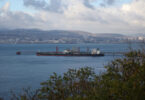
A ship is seen off the coast of Sharjah in the UAE a day after US-Iran peace talks ended without a deal.
PHOTO: AFP
Mr Trump, speaking to the New York Post on April 14, said his negotiators were likely to be back, thanks largely to the “great job” Pakistan’s army chief, Field Marshal Asim Munir, was doing to moderate the talks.
Later that day, at an event in Georgia, Mr Vance said Mr Trump wanted to make a “grand bargain” with Iran, but there was a lot of mistrust between the two countries.
Iran’s nuclear ambitions were a key sticking point at last weekend’s talks.
The US proposed a 20-year suspension of all nuclear activity by Iran, while Tehran suggested a halt of three to five years, according to people familiar with the proposals.
Speaking in Seoul, the head of the International Atomic Energy Agency, Mr Rafael Grossi, said the length of any moratorium on Iranian uranium enrichment was a political decision, and it was possible Tehran might accept a compromise as a confidence-building measure.
The US has also pressed for any enriched nuclear material to be removed from Iran, while Tehran has demanded that international sanctions against it be lifted.
One source involved in the negotiations in Pakistan said back-channel talks since the weekend made progress in narrowing gaps, bringing the two sides closer to a deal that could be put forward at a new round of talks.
However, complicating peace efforts, Israel has continued to attack Lebanon as it targets Hezbollah, an Iran-backed militant group. Israel and the US say that campaign is not covered by the ceasefire, while Iran insists it is.
The war has prompted Iran to effectively shut the Strait of Hormuz – a vital artery for global crude and gas shipments – to ships other than its own, sharply reducing exports from the Gulf, particularly to Asia and Europe, and leaving energy importers scrambling for alternative supplies.
The International Monetary Fund cut its growth outlook on April 14 due to energy price spikes driven by the conflict, warning that its worst-case scenario could push the global economy to the brink of recession.
The oil market also faces further supply losses, as the US does not plan to renew a 30-day waiver of sanctions on Iranian oil at sea that expires this week, according to two US officials, and quietly let a similar waiver on Russian oil run out on the weekend.
An estimated 5,000 people have been killed in the fighting, including about 3,000 in Iran and 2,000 in Lebanon.
The governor of Iran’s Tehran province said many of those killed were students, women, teachers and university professors. About 40,000 homes in the province were damaged, he said, while schools, clinics and emergency services were also targeted in the attacks, state media on Wednesday reported him as saying. REUTERS