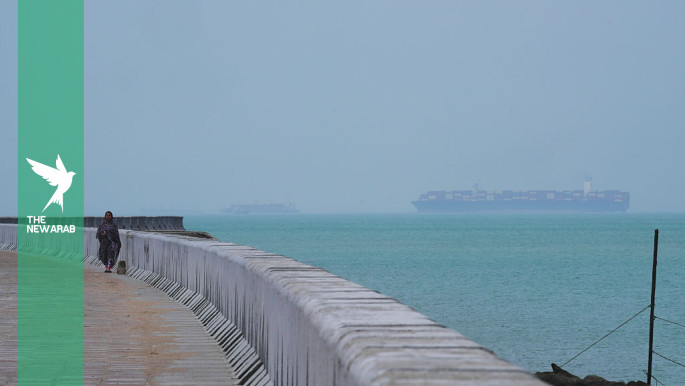
More than 2,000 ships have been trapped in the Gulf for almost 10 weeks since the US and Israel launched the war on Iran. [Getty]
US President Donald Trump on Sunday suggested he could deploy the US Navy to escort ships through the Strait of Hormuz, escalating tensions with Iran several days after it submitted a new proposal to end the war.
Iran’s military vowed to attack any US ships entering the area, raising the prospect of a return to the regional war paused by the 8 April ceasefire.
Writing on Truth Social, the president said that from Monday morning US warships would start helping commercial vessels exit the Gulf, though he did not specify whether this would amount to escorts through the strait.
“We have told these countries that we will guide their ships safely out of these restricted waterways, so that they can freely and ably get on with their business,” he wrote.
More than 2,000 ships have been trapped in the Gulf for almost 10 weeks after Iran locked down traffic through the strait following the US-Israel attack on 28 February. As many as 20,000 crew members are thought to be aboard the stranded vessels.
This came a day after Trump said he was reviewing the details of a 14-point Iranian proposal to resolve the crisis in the Strait and permanently end the war.
Iranian media said the plan would see Tehran reopen the waterway, Washington lift its naval blockade, and guarantees made that the US and Israel would not re-launch the war.
Trump had cast doubt on whether he would accept the proposal, saying on Sunday that Tehran had “not yet paid a big enough price” for him to agree to a deal.
But he reversed course on Monday, claiming that US negotiators were having “very positive discussions” with Iran.
Iran has repeatedly warned the US against deploying its navy to the Gulf and vowed to target them if they tried to break its grip over the strait.
“We warn that any foreign armed force – especially the aggressive US military – if they intend to approach or enter the Strait of Hormuz, will be targeted and attacked,” said Major General Ali Abdollahi, who leads the Iranian military’s central command, on Monday.
“We have repeatedly stated that the security of the Strait of Hormuz is under the control of the armed forces of the Islamic Republic of Iran, and under all circumstances, any safe passage must be coordinated with these forces,” he added.
Tanker struck near UAE
Iran has choked traffic through the strategic waterway since the beginning of the war and has tried to impose transit fees on ships exiting the Gulf.
The closure has shut in vital supplies of oil, gas and fertilisers and triggered a global energy crisis.
The US president has several times raised the prospect of renewed strikes against Iran if it refuses to reopen the strait. US military planners have briefed the president on a range of options, including large-scale strikes on Iran’s civilian infrastructure.
The US military has rushed new equipment to the region ahead of a potential resumption of the war.
Amid the rising tensions, a tanker reported being struck near the city of Fujairah in the United Arab Emirates on Monday morning.
The United Kingdom Maritime Trade Operations agency said the vessel had been hit by an unknown projectile while transiting north of the city in the Gulf of Oman.
This came hours after Iran’s Revolutionary Guard warned ships anchored in the UAE’s Ras al-Khaimah to move to Dubai.
Iranian crew members released
US warships have maintained a blockade on Iranian ports for three weeks in a bid to cripple the country’s oil and gas industry.
Dozens of ships have been prevented from leaving the Gulf and several have been detained by the US Navy.
The blockade threatens to force Iran to start shutting down oil production as storage capacity nears its limits.
In what it called a “confidence-building measure”, Pakistan said on Monday that the US had evacuated 22 crew members aboard a container ship seized near Iran’s Chabahar port at the end of April.
Pakistan has led efforts to mediate an end to the conflict and has scrambled to arrange new negotiations in its capital after a first round of talks earlier this month failed to break the stalemate.
The blockade has further complicated negotiations, with Iran refusing to loosen its control over the strait until the US stops cutting off its maritime trade.
French President Emmanuel Macron on Monday urged both countries to coordinate reopening the strait, calling it the “only solution” after Trump announced his plan for naval escorts.
France and the UK have led international efforts to keep the strait open and have held talks with dozens of countries about setting up a maritime taskforce in the Gulf.
Both countries have refused to deploy warships to the region until the war ends.
“We are not going to take part in any military operation in a framework that to me seems unclear,” Macron said.