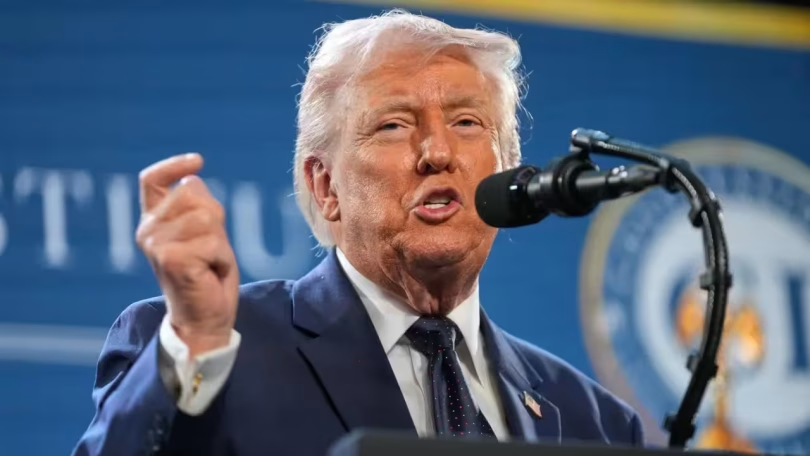
TOI correspondent from Washington: US President Donald Trump threatened to unleash “1000 missiles” on Iran and “completely decimate and destroy” the country if Tehran attempts to assassinate him, dramatically raising the temperature in a confrontation that has, within days, descended from a tentative understanding into renewed military exchanges and mutual accusations of betrayal.“1000 Missiles are Locked and Loaded and aimed at the Islamic Republic of Iran, with thousands of more to immediately follow, should the Iranian Government act on its threat … to assassinate … ME!” Trump wrote on social media. “Orders have already been given, and the US military is ready, willing, and able … to completely decimate and destroy all areas of Iran.”The extraordinary warning came as Washington and Tehran appeared to return to square one, trading heated rhetoric and even hotter missile strikes despite having recently reached a Memorandum of Understanding (MoU) intended to halt hostilities and safeguard maritime traffic through the Strait of Hormuz (SoH).Trump’s assassination allegation taps into a long-running American belief that Iran seeks revenge for the 2020 US killing of Iranian Revolutionary Guard commander Qassem Soleimani. US prosecutors and intelligence officials have previously alleged that Iranian-linked actors explored plots against former American officials associated with the operation.Yet the immediate credibility of an active Iranian plot against the sitting US President remains difficult to assess publicly. Analysts note that while Tehran has repeatedly vowed revenge, an actual assassination attempt against Trump would almost certainly invite overwhelming American retaliation and could endanger the survival of the Islamic Republic itself.That has not stopped Iranian rhetoric from hardening. Following reports of the death of Supreme Leader Ayatollah Ali Khamenei, a statement attributed to Iran’s leadership declared: “The revenge for Iran’s martyred leader is our nation’s demand, and it will certainly be carried out. These criminals, whose entire chain of command — from top to bottom — is known, will take to their graves the wish of dying a peaceful death in their beds.”Meanwhile, the gulf between the two sides appears to stem from sharply differing interpretations of Paragraph 5 of their MoU. According to reports, Iran believed the agreement granted it authority to manage the SoH shipping corridor for 60 days. The Trump administration, however, quietly backed an alternative route along Oman’s coast that bypassed Iranian supervision.Tehran reportedly fired warning shots at a vessel using the new corridor. Washington interpreted the incident as interference with freedom of navigation and used it to justify renewed military strikes against Iranian targets.The dispute underscores a deeper disagreement that has plagued US-Iran diplomacy for decades: Iran seeks recognition of its regional security role, while Washington remains unwilling to concede strategic control over one of the world’s most vital maritime chokepoints.According to Axios and other US media reports, the Trump administration now wants Tehran to publicly declare that all channels through the Strait are open and that tankers will no longer be targeted. Iran’s response so far has been promises of revenge rather than reassurance, leaving another US-Iran understanding in danger of collapsing under the weight of ambiguity, mistrust and competing interpretations.Referring to the deal struck with the help of Pakistani and Qatari mediation, Tehran’s UN ambassador said in remarks in New York on Friday “that if the United States continues to violate its obligations under the Islamabad Understanding, Iran will no longer consider itself bound by its commitments under that understanding”, according to a statement carried by state broadcaster IRIB.
Trump threatens Iran with '1000 missiles' as both sides shoot their mouth in Gulf spat