
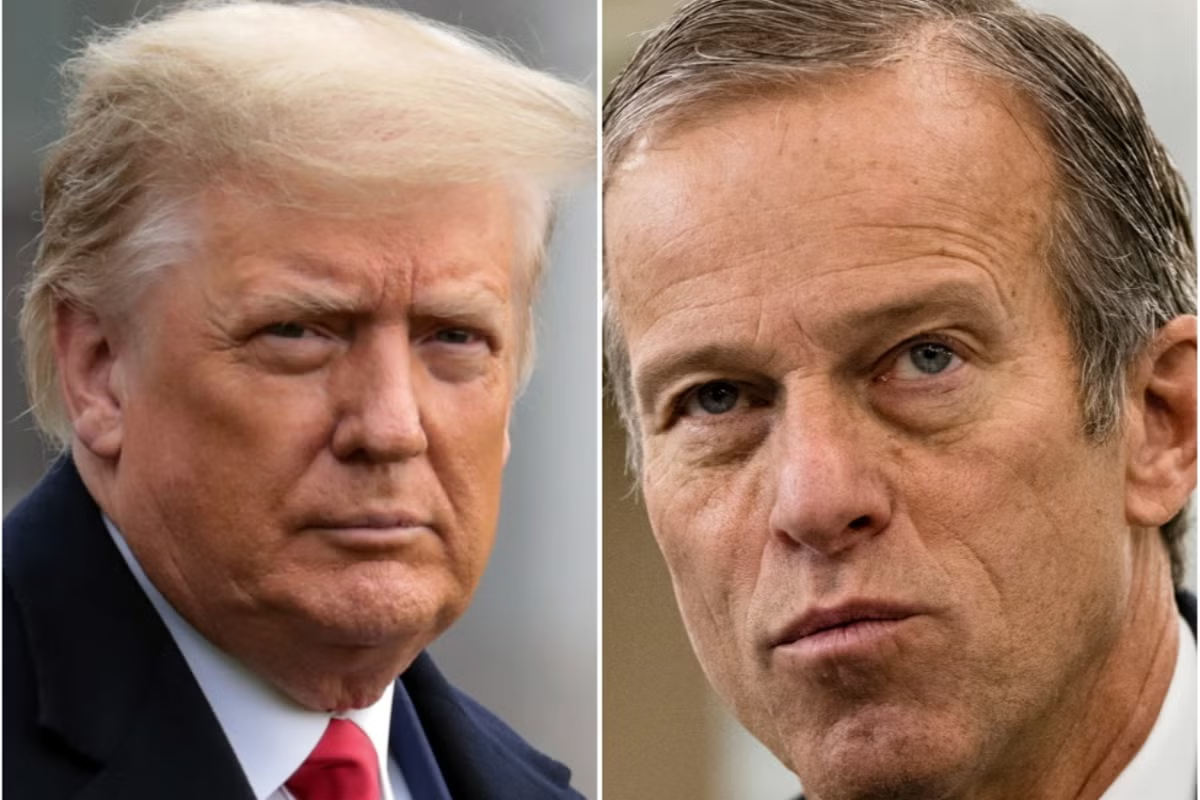
The relationship between Donald Trump and Senate Republicans reached a critical juncture this week, as the president undermined their efforts to swiftly confirm one of his own nominees and declared he would not sign the renewal of a crucial surveillance law without new conditions.
The strain intensified following Trump’s overnight social media post on Wednesday, announcing a delay in Jay Clayton’s nomination to become national intelligence director, just hours before the U.S. attorney’s confirmation hearing.
This move further frayed relations between the Senate and the White House, which have been deteriorating for weeks.
Later that day, some Republican senators, typically hesitant to directly challenge the president, openly criticized his deal to end the Iran war.
“This is the worst foreign policy blunder in decades,” Sen. Bill Cassidy, a Republican from Louisiana, stated on X.
These public tensions mark a near-complete reversal from a year ago, when Senate Republicans collaborated closely with Trump to pass a substantial package of spending and tax cuts.
At that time, criticism of the president was almost non-existent among Republicans on Capitol Hill, who had planned to highlight the bill’s passage in the midterms.
However, as the November election approaches and Republicans strive to defend their majorities, Trump is now challenging Congress with demands and reversals, prompting several Republican senators to publicly disparage his actions for the first time.
“I think somebody’s not dialing the president into the complexities of what he’s done here,” Sen. Thom Tillis, a Republican from North Carolina, remarked on Wednesday after Clayton’s confirmation was postponed.
“I mean, my God.”
The gradual unraveling of what once appeared to be an unshakeable alliance between the executive and legislative branches in a Republican-led Washington now extends to their policy priorities.
Trump appears to have lost interest in much of the GOP agenda, becoming almost singularly focused on his voting legislation requiring proof of citizenship, a measure with virtually no chance of passing.
Concurrently, he has asked members of Congress to fund parts of his White House ballroom project, approve a temporary intelligence director whom none of them favor, and cede their powers on the Iran war.
This widening rift has brought much of the Senate’s business to a standstill and placed Republicans up for reelection this year on the defensive.
It has also intensified pressure on Senate Majority Leader John Thune, who has been candid with Trump about the limits of what he can achieve in the Senate.
Trump has relentlessly pressured Thune to eliminate the filibuster and pass the strict proof-of-citizenship legislation, known as the SAVE America Act.
Thune, a Republican from South Dakota, has informed Trump, both publicly and privately, that votes for either step are unavailable. Despite this, Trump has maintained his push.
In a social media post on Thursday, Trump asserted he would be “the last Republican president” if the voting bill fails to pass.
“Senate Majority Leader John Thune, and the Republican Senate, must not let this ‘carnage’ happen,” Trump wrote. “They will go down on the wrong side of History, as will all Republicans who just stood by and watched.”
Nonetheless, Trump has yet to personally attack the well-regarded Republican leader, a stark contrast to his frequent criticisms of Thune’s predecessor, Sen. Mitch McConnell, a Republican from Kentucky, whom Trump once labeled a “dour, sullen, and unsmiling political hack.”
Trump and Thune communicate frequently, even when Thune delivers news the president may not wish to hear.
As Trump pushed for the voting bill, Thune scheduled weeks of floor time to consider it, an effort to demonstrate Senate support, even if the necessary votes were lacking.
Missouri Sen. Eric Schmitt, one of the president’s closest allies in the Senate, stated he has never heard Trump speak negatively about Thune. “It’s a difficult position,” Schmitt said of Thune’s role.
“I think they have a good working relationship.”
One of Thune’s closest allies, Republican Sen. Mike Rounds of South Dakota, described the even-keeled leader as the “right person at the right time.”