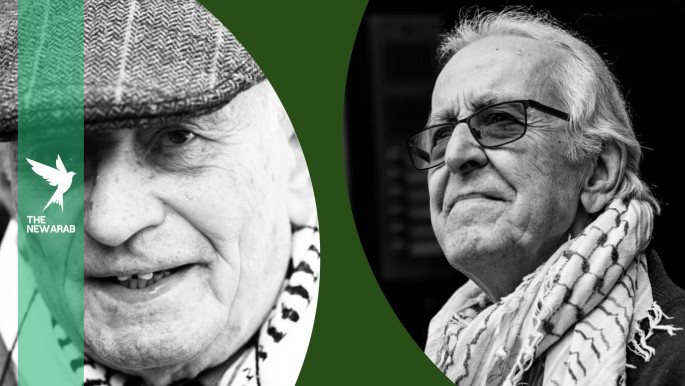
In a crowded London auditorium, Nakba survivor Antoine Raffoul and Holocaust survivor Stephen Kapos sit side by side and talk not about reconciliation or abstract “coexistence”, but about genocide, return, and what it would mean to build one democratic state in all of historic Palestine.
Their stories begin in 1940s Europe and 1948 Palestine – but every sentence keeps circling back to Gaza.
Antoine Raffoul was born in Nazareth in 1941, in a Palestine that still existed as a political reality on the map.
As an architect, he has dedicated much of his life to preserving and restoring Palestinian culture and heritage.
By his side, smiling often despite the gravity of the subject, sits Stephen Kapos – an activist born in Budapest in 1937 who survived the Holocaust in Nazi‑occupied Hungary before moving to the UK. Like Antoine, he, too, ended up in the world of architecture.
The two spoke at an event at London’s Palestine House to mark the 78th anniversary of the Palestinian Nakba – “catastrophe” in Arabic – the mass displacement and ethnic cleansing of Palestinians that accompanied the creation of the state of Israel.
The New Arab asked them why they chose to spend the latter part of their lives speaking about their own experiences in the context of Palestine, to which they said they felt “a duty” to speak up.
Nakba ‘not over yet’
Antoine spoke about the continuity between the Nakba in 1948, when over 700,000 Palestinians were forcibly displaced from their homes by Zionist forces, and the displacement of 1.8 million Palestinians during Israel’s genocide in Gaza, which began in October 2023.
“The Nakba is ongoing – it’s not over yet,” he said, arguing that policies from before 1948, through the Israeli occupation of the West Bank in 1967 and the Oslo Accords of the 1990s, have all led to the genocidal policies inflicted on Palestine today.
He drew a line from what his family experienced in historic Palestine in the 1940s to the hundreds of thousands of families who have been forced to abandon their homes, again and again, in Gaza.
Where his parents once made impossible choices about whether to flee or stay put, he said, Palestinian families now face the same terror on a loop: packing up what they can carry, leaving elders and graves behind, never knowing if the next evacuation order will be the last.
Stephen, too, says there are many similarities between his experience during the Holocaust and Palestine today.
He spoke about chilling echoes around relocation orders in both the Holocaust and Israel’s wars in the region – whether in Gaza or Lebanon – and the impossible problem of choosing whether to leave when there is a family member who cannot physically move.
He described what his own family faced. “What to do? It’s a choice sometimes between staying with a disabled person and exposing themselves to great danger, or the most impossible decision to think of leaving someone behind.”
Stephen’s family turned down an offer to flee from Hungary to the Romanian border because of a seriously ill uncle, who was judged too unwell to endure the difficult ride by horse and cart.
“So they stayed with this uncle, and shortly afterwards they were all deported to Auschwitz,” he said quietly.
“The whole family – 15 members of my family – perished this way. Only one cousin came back.”
From surviving genocide to naming genocide
As two survivors of genocidal periods of history, they both emphasised the importance and the precision of using the term “genocide” for what is happening in Palestine today.
The New Arab asked Antoine why he thought so many commentators remained hesitant to describe Israel’s war as genocidal, despite mounting evidence from international bodies and rights organisations that identified genocidal intent early on.
“I will say those people are not the millions of people who joined the Palestinians in their struggle, in their demonstrations, around the globe,” Antoine replied.
“We are seeing the most visual examples of genocide in real time throughout the course of the war,” he said, pointing to hours of harrowing footage, videos, images and testimonies from Palestinians on the ground.
Stephen went further in stressing the accuracy of the term when speaking about Palestine today. “Genocide is the destruction of a people, whole or in part. It’s not a question of numbers. It’s a question of treatment and intent. And there is no doubt that there has been a genocide going on,” he said.
He referred to the “weaponisation” of the Second World War by the Israeli state and the Zionist movement, which insist that the events in Gaza cannot be compared to the Holocaust, in which six million Jews were killed.
The Holocaust survivor recalled his time as a former officer in the Holborn & St Pancras Labour Party in London. He chose to leave the party after he was threatened with discipline for speaking about the Holocaust at a left‑wing event, where he argued against using the International Holocaust Remembrance Alliance (IHRA) definition of antisemitism, widely criticised for conflating criticism of Israel with hostility to Jews as a people.
“The Holocaust and the Second World War have been used by Israel, and are still being used by Israel and Zionist forces as justification for impunity,” he said.
“Because of the great suffering there, some feel justified to inflict similar suffering on others – the Palestinians, the Lebanese, the Iranians lately.”
One state, accountability and healing
If the first half of the conversation was about naming the catastrophe, the second was about what comes after. For both men, the answer is not a return to the language of “peace process”, but a reckoning.
After the Holocaust, the international community created new legal architecture – the Genocide Convention, the Geneva Conventions, and the Nuremberg trials – to prosecute war crimes and crimes against humanity.
Antoine notes this not to idealise post‑war justice, but to underline that even Europe recognised that some crimes cannot simply be “moved on” from.
“There is accountability. It’s coming. We’ve run out of options,” he said. “And the only option now is one state.”
For Antoine, that position has been consistent. “I’ve waited 78 years to see that one state solution because I never agreed with the 181 resolution, which divided Palestine,” he said, referring to the 1947 UN partition plan. “They gave my country to somebody else who wasn’t living there.”
He is blunt about the diplomatic record since, from Camp David to Oslo, he sees the international community producing frameworks that manage Palestinian dispossession rather than ending it.
Instead, he insists on a single democratic state in all of historic Palestine, grounded in equality and return rather than ethnic supremacy. “There are deep wounds in Palestine now – and we need to work to heal them,” he said.
“The Gaza solution – which is only possible under a one‑state solution – is that we have a similar commission to be composed by Palestinians, Israelis, and international legal experts, humanitarian experts,” he explained, “to show them how to heal.”
Here, his architectural eye comes back in. Antoine has been working on a plan for Gaza’s future that does not mirror glossy “Riviera” fantasies promoted in AI‑generated videos backed by US President Donald Trump, with casinos and beachfront towers.
Instead, he speaks about Gaza returning to what it once was – “a pearl on the road of pearls called the Via Maris (Way of the Sea), from Egypt and North Africa through Palestine, through Jerusalem, through Haifa – a trading route for the Mediterranean” – a land that centres Palestinian life and memory rather than investment portfolios.
On stage at the London event, he turns to Stephen and invites him to be a key architect in envisioning Gaza’s future, prompting a wry exchange about the “trauma” they share as architects and survivors.
Return, and what remains
As we prepare to close his interview, Antoine reaches back to a line he has carried with him since childhood.
“I have a beautiful old Arabic saying, which I memorised when I was little,” he shares. Decades later, he found it carved into a rock in the middle of the Sahara.
He recites it: “Oh dear neighbour who is hosting us: If you come to our house, we will be your guests. And you will be the owner of our house,” then adds, “You couldn’t be more generous than this. And that’s the heart of the Palestinian people.”
Their vision of return is not about inversion – the oppressed becoming the oppressor – but about shared ownership after a long exile.
“They may have occupied the land, but they have not occupied the people,” Antoine adds. “And to me, that is so crucial. I’m just sorry it took 80,000 martyrs to confirm that.”
Before the evening ends, Antoine shares a promise he has made to his granddaughter.
“I promised my granddaughter two things in life before I leave this universe,” he says.
“One is going to university, and the second is that I will go to Haifa and visit our house, or the land where the house was. And I hope I can fulfil those two options. I am confident I will. I shall.”
Stephen listened and nodded.
For both men, survival is no longer just about having lived through the worst their century had to offer.
It is about insisting that their memories not be used to justify another people’s destruction – and about insisting, against the odds, that there is still a future in which a Palestinian grandfather can take his granddaughter to see a house that no longer exists, in a country that is not allowed to exist, and still call that visit home.
Agnese Boffano is a journalist at The New Arab, with previous experience in breaking news and OSINT investigations across the Middle East. She graduated with a master’s degree in International Journalism from City University in 2021
Follow her on X: @AgneseBoffano