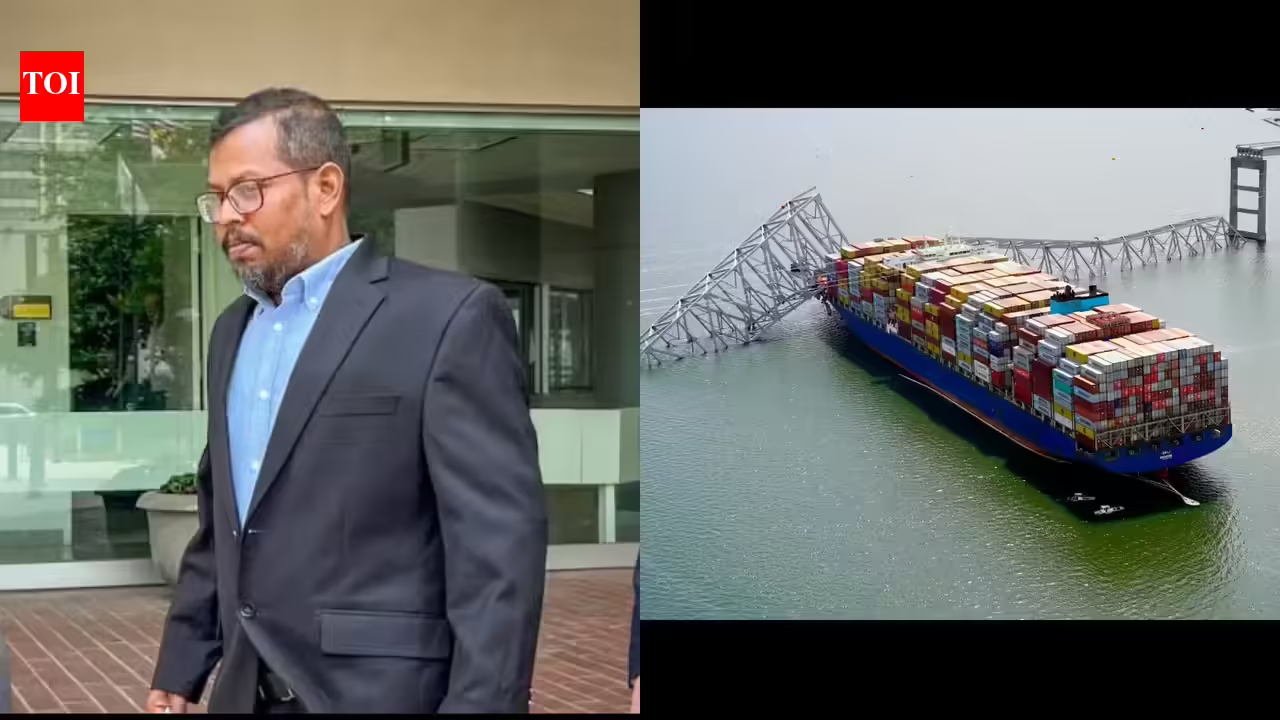
On March 26, 2024, container ship MV Dali left the Port of Baltimore as it was heading for Sri Lanka. Shortly after leaving the port, the ship lost power and struck one of the pillars of the Francis Scott Key Bridge. A large section of the bridge collapsed into the river, killing six workers who were on the bridge at that time. The accident became one of the most significant US maritime disasters.Now two years after the mishap, the then-chief engineer of Dali, admitted that he failed to report a hazardous condition to the US Coast Guard. Karthikeyan Deenadayalan, an Indian national, who was the chief engineer of Dali, said he was aware that Dali used an unsafe fuel supply pump. According to the Justice Department’s record, Deendayalan acknowledged that the unsafe pump, known as a flushing pump, lacked redundancy, which compromised the vessels’ safe navigation and ability to recover from the loss of power. He admitted that he knew that the inability to recover from a loss of power could adversely affect the safety of the vessel itself, as well as any bridge, structure, or shore area.
What is MV Dali?
MV Dali is a 900-foot foreign flag container vessel, registered in Singapore. Synergy Marine Pte Ltd, based in Singapore, and Synergy Maritime Pte Ltd, based in Chennai, India.
How did the accident happen?
Dali lost power twice in a four-minute span as it navigated out to sea from the Port of Baltimore, causing it to crash into the Key Bridge. A loose wire in a high-voltage switchboard likely caused the first power loss. Critical systems on the Dali were originally designed with reliable redundancies and automatic restart capabilities so the Dali could quickly regain power after a blackout. But shortly after the vessel regained power, it lost power again. The companies that were managing Dali allagedly altered the ship and relied on a flushing pump to supply fuel to two of the Dali’s four generators. However, the flushing pump was not designed to automatically restart following a blackout, and the Dali’s generators could not operate without a fuel supply, so the ship ultimately experienced a second blackout. If the Dali used the proper fuel supply pumps, the vessel would have regained power in time to safely navigate under the Key Bridge.Earlier this year, these two companies, along with an Indian man, Radhakrishnan Karthik Nair, who worked for both these companies as the technical superintendent, were charged with conspiracy, willfully failing to immediately inform the U.S. Coast Guard of a known hazardous condition, obstruction of an agency proceeding, and false statements.Deenadayalan’s acknowledgement statement comes after these three entities were charged by a federal court.
‘Write a convincing email’
Deendayalan detailed his conversations and correspondence with personnel from these two firms, including Nair, about the use of the unsafe flushing pump on the vessels. Deendayalan said Nair directed him to send a “convincing” email to the charterer of the Dali so that they would not ask additional questions about the fuel consumption of the Dali to prevent revealing the use of the flushing pump.