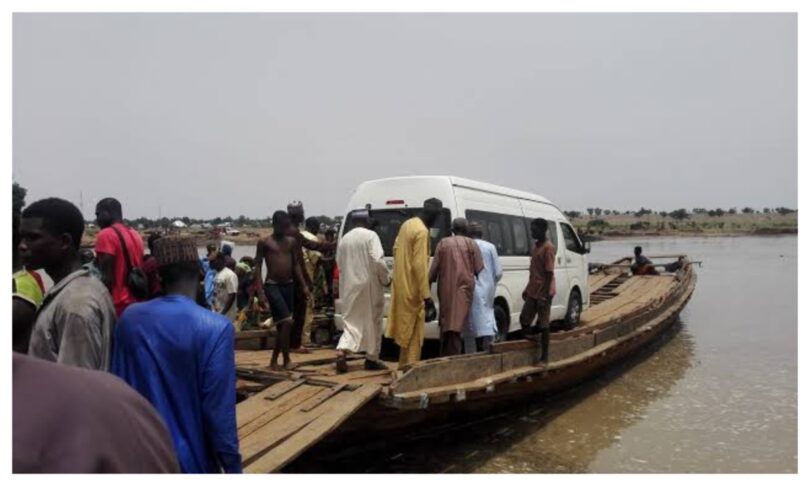
Motorists and residents along the Namnai route in Taraba State are continuing to grapple with severe transportation difficulties more than two years after the collapse of the Namnai Bridge.
The prolonged infrastructure crisis has forced commuters to rely on costly alternative means of crossing, with motorists paying between N3,000 and N5,000 for small cars, while operators of heavy-duty vehicles are reportedly charged as much as N20,000 per crossing.
Canoe operators are now smiling to the bank, as they make brisk business ferrying vehicles and passengers across the river to enable them to continue their journeys.
The situation, which has persisted since the bridge collapsed in August 2024, has become a major source of concern for residents, transport operators, traders, businessmen and women whose livelihoods depend on the route.
For motorists who use the route regularly, the crossing fee has become an unavoidable financial burden, coming on top of the already rising cost of fuel, vehicle maintenance and other operational expenses.
A truck driver who identified himself as Abdul Sarti said operators of heavy-duty vehicles were finding it increasingly difficult to absorb the cost.
“The situation is particularly challenging to those of us operating heavy-duty vehicles. We are charged up to N20,000 per crossing. We are finding it difficult to absorb, especially now that fuel, vehicle maintenance and other transportation costs remain high.”
Sarti said the collapse of the bridge had severely affected the movement of goods into and out of Taraba State.
“Since this bridge collapsed in August 2024, we have been finding it difficult to transport goods in and out of this state. All the promises made by both the state and federal governments to fix it have failed to materialise.
“We are still calling on them to do the needful because the contractors they claimed they awarded the contract to are nowhere to be seen at the site.”
Owners and operators of small vehicles, who reportedly pay between N3,000 and N5,000 to cross, are equally calling for urgent intervention.
A motorist, Chike Orum, said the fees were putting additional pressure on ordinary road users.
“The amount we are paying to get our cars across this river is telling on us negatively. We are once again appealing to the authorities concerned to keep to their promises by fixing this bridge.”
Orum also questioned why several collapsed bridges in neighbouring Adamawa, Gombe, Bauchi and Borno states had reportedly received quicker attention, while the Namnai Bridge remained neglected.
The prolonged collapse has also raised concerns about its wider economic consequences.
Transport operators are expected to factor the additional crossing charges into their operating costs, a development that could translate into higher transportation fares and increased prices for agricultural produce and other commodities transported through the route.
For farming communities and traders, the problem goes beyond inconvenience. The route serves as an important link for moving farm produce and other goods to markets, meaning prolonged disruption could affect both income and access to essential commodities.
What was initially expected to be a temporary transportation challenge has gradually become a daily reality for communities on both sides of the affected route.
Residents say they have endured the situation for more than two years, while repeated calls for intervention have continued.
The high crossing charges have become particularly burdensome at a time when households and businesses are already struggling with increased transportation and living costs.
Community members are therefore urging the relevant authorities to accelerate the rehabilitation or reconstruction of the bridge, stressing that residents and motorists should not be left to indefinitely bear the consequences of infrastructure failure.
They are also calling for greater transparency regarding the reported award of the bridge reconstruction contract and the commencement of actual construction work.