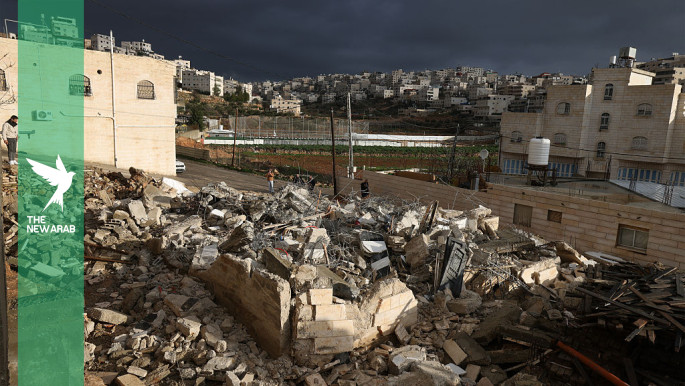
The house of Emran al-Atras, a Palestinian man who was killed in November at the Gush Etzion junction, after it was demolished by Israeli authorities in Hebron on January 15, 2026. [GETTY]
“What is the international community willing to do after all these empty promises?” These are the words of Abu Khamees pleading for action as his village once again faces demolition. Abu Khamees is a community leader in the Palestinian village of Khan Al-Ahmar. The village sits in the central West Bank, and residents have bravely battled Israeli attempts to forcibly remove them for decades.
Khan Al-Ahmar is situated in the centre of land designated by the Israeli government as the site of a huge settlement known as the E1 project. The aim of the project, in the words of Israeli Finance Minister Bezalel Smotrich, is to “bury” the idea of a Palestinian state.
The project has been condemned by governments, including the UK. UK Foreign Secretary Yvette Cooper described it as “clearly illegal and damaging to peace.” But let’s return to Khamees’s question – what will the UK government actually do to prevent the forced displacement of him and the rest of his village? If a recent property fair in London can teach us anything, the answer may well be to permit the sale of his land to settlers.
Infrastructure of apartheid
On Sunday 14 June, the Great Israeli Real Estate Event took place at Edgware United Synagogue. Amnesty International UK and others warned that the event’s website explicitly marketed the settlement of Gush Etzion and called for the government to intervene and cancel the event. The event organisers denied that properties in settlements would be advertised, adding for good measure that anyone saying otherwise was “anti-Israeli and terrorist supporters.” The event went ahead as planned.
As it turns out, we didn’t know the half of it. Photos from the event show properties in the settlements of Givat Ze’ev, Kfar Eldad, Ramat Eshkol, Givat Hamatos, French Hill and Ma’ale Adumim all being advertised. Abu Khamees would know Ma’ale Adumim well – part of the sprawling Adumim settlement bloc that surrounds Khan Al-Ahmar. It is from the Adumim bloc that the E1 project will expand all the way to Jerusalem, permanently displacing Abu Khamees and thousands of other Palestinians and effectively cutting the West Bank in two. Brochures handed out at the event boasted of Ma’ale Adumim properties with swimming pools.
The word “settlements” can sound a bit innocuous – but they are the infrastructure of apartheid. Ma’ale Adumim alone has a population of 40,000 Israeli settlers, essentially expanding Israel’s annexation of East Jerusalem eastward deep into the West Bank. Givat Ze’ev sits just north of Jerusalem off a strategically positioned road linking Tel Aviv with Jerusalem.
Built on land confiscated from Palestinian communities, expanded through state-backed settler violence, and now being marketed to buyers in a north London synagogue, these settlements are core to Israel’s campaign of ethnic cleansing in the West Bank.
A new Amnesty report – Erasing anything Palestinian: Israel’s ethnic cleansing of West Bank Bedouin and Herding communities – published this month, documents how at least 5,910 Palestinian Bedouin and herding community members have been forcibly displaced since 2023, their villages demolished to make way for settlements like these. This is not a property market. It is apartheid and annexation with a sales pitch.
Action, not words
The event in Edgware took place within days of the UK government’s “tougher UK action in response to record settlement expansion and rising settler violence in the West Bank.” This so-called tough action consisted of sanctions on individual violent settlers and settler groups and advice to British businesses not to operate in Israeli settlements. The sheer brazenness of this event taking place in the same week as that announcement exposes the utter hollowness of the UK government’s position.
Just as settlers can run rampant in the West Bank without consequence, the international networks enabling the criminal and often violent settlement enterprise know they can do as they please and suffer no more than the occasional tap on the wrist.
The problem with the UK government’s position is that it completely fails to recognise that the whole settlement enterprise is driven by the Israeli state and enabled and legitimised by banal-sounding real estate events like the one that took place in Edgware.
The government’s statement is therefore not only hollow but hypocritical. Does the government merely advise British businesses not to operate in Russian-occupied Crimea? Of course not. If a Russian property fair came to London advertising properties in Sevastopol, it’s not far-fetched to imagine the event would be prevented from going ahead, and the organisers would be investigated by UK law enforcement. Rightly so.
The UK government’s response to the Great Israeli Real Estate Event? To ask the Advertising Standards Agency to investigate it. Is there any other context where the sale of property on stolen land would elicit such a response? The ASA regulates misleading adverts. It cannot stop war crimes like settlements and crimes against humanity like apartheid.
Referring this event to an advertising watchdog is not a serious response – it is a fig leaf designed to create the appearance of action while ensuring nothing actually changes.
If the UK wants to take genuinely tough action, it must start with a total ban on all trade with settlements. Any products originating from settlements must be stopped at the border. There must be a complete end to any charities helping people move to settlements, any venues hosting events that market settlements and any property fairs like this one openly advertising homes in settlements.
For Abu Khamees and his friends and family in Khan Al Ahmar, the situation only gets more urgent. In May, Smotrich ordered their eviction “without delay.” Empty words of condemnation are not going to stop it. Smotrich no doubt anticipates with excitement the day settlements in E1 are marketed at lucrative property fairs in London.
A new UK Prime Minister is about to take office. Palestinians like Abu Khamees cannot afford another government that condemns settlements on the one hand while allowing them to be marketed in London with the other. This is a chance to do better. The time for condemnation is over.
Tom Guha is Amnesty International UK’s Crisis Response Campaigner.
Have questions or comments? Email us at: editorial-english@newarab.com
Opinions expressed in this article remain those of the author and do not necessarily represent those of The New Arab, its editorial board or staff.