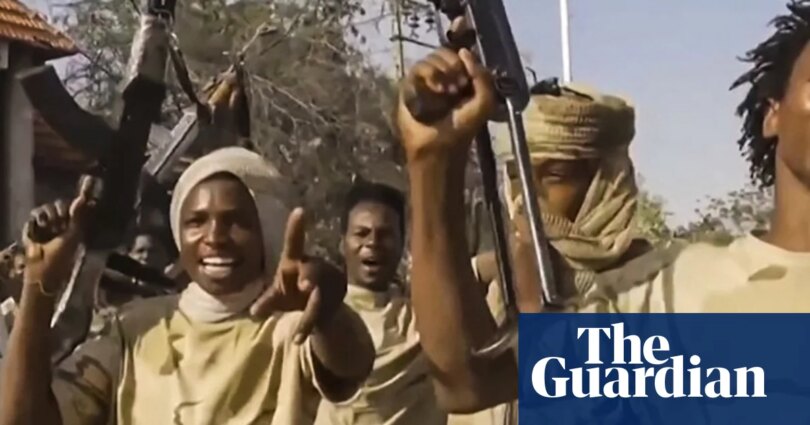
The British government had received intelligence that Ethiopia appeared to be supporting a genocidal militia in Sudan’s civil war as far back as 2024 but did not go public with the news for fear of upsetting the United Arab Emirates (UAE), a parliamentary committee will hear.
In May 2024, officials from the Foreign, Commonwealth and Development Office (FCDO) told Nathaniel Raymond, an American human rights investigator at Yale University, that “significant private pressure” from the UAE meant the UK would not publicly divulge information linking Ethiopia and the emirates to their support for the paramilitary Rapid Support Forces.
Ethiopia’s role in Sudan’s civil war did not become public until early this year. It continues to deny involvement.
In testimony to a parliamentary select committee on Tuesday, Raymond will allege that the UK government was more interested in preserving relations with the Emiratis than averting mass atrocities in Sudan.
The Commons international development committee is investigating the UK’s response to atrocity prevention after reports in the Guardian about the FCDO’s response to the RSF seizing the city of El Fasher, last year.
Raymond will also focus on what he describes as the UK’s “failed efforts to prevent the mass killing” of tens of thousands of people during the RSF’s genocidal massacre in El Fasher.
His testimony will include details of how a senior FCDO official attempted to downplay the huge death toll in El Fasher for “political” reasons.
After El Fasher fell to the RSF, following an 18-month siege, Raymond, director of Yale’s Humanitarian Research Lab (HRL), privately briefed the international development committee that at least 60,000 civilians had been killed.
An FCDO atrocity-prevention official contacted Raymond to ask if the figure was too high.
Raymond responded that his number did not include deaths from famine or the RSF’s bombardment of the city during its siege.
“I explained the math. I stated that, in reality, the number of people that the RSF systematically killed after capturing the city could have been higher,” said Raymond.
“The FCDO official and I discussed numbers further. I came to believe that this estimate of at least 60,000 people killed by the RSF was a political problem for the FCDO.”
Based on three years of encrypted messages, internal meeting notes, memos and phone records between the HRL and FCDO, Raymond’s testimony will also reveal how on 26 September 2025, a British UN official “expressed despair about the lack of any possible action by the Starmer government as the city was about to fall” – amid intelligence indicating that mass atrocities were inevitable.
Raymond’s revelations of longstanding Ethiopian involvement in Sudan’s war relate to 15 May 2024, when he met FCDO officials in London and shared collated data from mobile phones inside RSF headquarters during discussions on El Fasher’s worsening predicament.
HRL had tracked handsets moving between Ethiopia’s capital, Addis Ababa, to RSF-held territory in Sudan.
Some phones, Raymond will tell the committee, moved from RSF locations to addresses in the emirates, which HRL believes were shell companies linked to the RSF’s deputy commander, Abdul Rahim Dagalo.
One phone moved to Abu Dhabi from Addis Ababa in four hours, despite no official air traffic data or scheduled commercial flights matching the route, indicating deliberate attempts to evade detection.
FCDO officials requested Raymond to publicly release the phone data analysis linking UAE-based facilities to the RSF because the UK government could not.
Raymond will tell the committee: “They told me that the UK was facing significant private pressure behind the scenes from the UAE, limiting its ability to affect the situation.
“FCDO personnel suggested that HRL releasing this information could help neutralise these efforts by UAE to prevent the UK from linking them to the armament of the RSF.”
At the time, HRL could not share the telecommunications data publicly because it would compromise sources and operational methods.
However, HRL secretly shared the data with the US to support sanctions against Dagalo-linked shell companies.
Details of Ethiopia’s involvement in the Sudanese conflict became public in February after Reuters reported that Addis Ababa was hosting a camp to train RSF fighters.
Reuters said the move was backed by Ethiopia’s close ally, the UAE.
Ethiopia rebutted the reports, as did the UAE, which has also denied repeated accusations that it funds and arms the RSF.
Raymond will tell the MPs that he believes the FCDO prioritised the UK government’s “economic, security and diplomatic relationships with the UAE above preventing the intentional starvation and genocidal slaughter of tens of thousands of civilians living in El Fasher”.
He will add the UK’s position as “penholder”, or lead country, on Sudan at the UN security council meant its role was vital.
“The UK was our best hope at that time for stopping what we believed would become one of the single largest mass-casualty events of the 21st century.”
The FCDO was contacted for comment.