
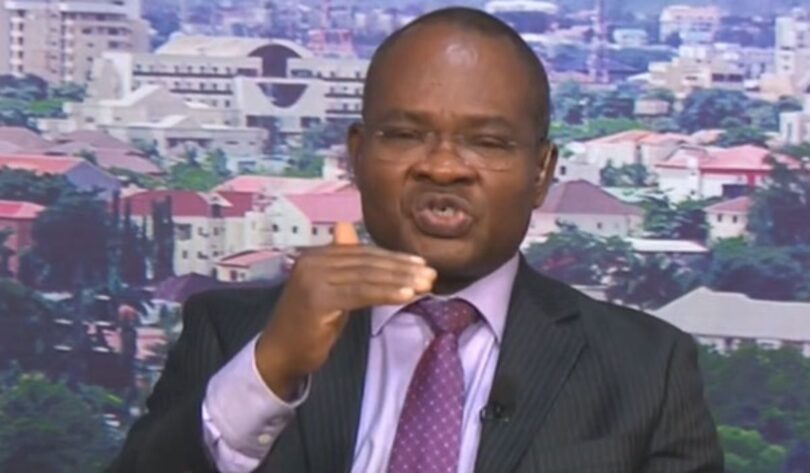
The ongoing court cases in the internal affairs of political parties, particularly those in the opposition bloc, may lead to weak participation ahead of the 2027 general elections, says Clement Nwankwo, Executive Director of the Policy and Legal Advocacy Centre.
Nwankwo, who was on the Arise Television morning programme on Tuesday, categorically stated that provisions in the Electoral Act were designed to prevent judicial interference in political parties, news.ng reports.
You may recall that some of the opposition parties, including the Labour Party (LP), Peoples Democratic Party (PDP), and African Democratic Congress (ADC), have pending cases in court, and the Independent National Electoral Commission (INEC) will act on the rulings or judgments of the courts.
According to him, “If we look at the Electoral Act, the intention with Electoral Act was really to try to stop the courts being the theatre for management of internal party affairs. And if you look at Section eighty-three of the Electoral Act, it’s very clear about what is needed to be done, parties are supposed to deal with their issues.”
He recalled that in the past, political parties had efficient internal structures that instilled discipline, preventing aggrieved members from going to court.
“And if we look back to the practice of democracy in this country, whether it is from the Second Republic and so on, you never would see a situation where parties have gone to court to decide on who is a chairman of a party, a national secretary of a party or whatever.
“And I think it’s so sad that, um, we have degenerated to this point where, uh, virtually everybody runs to court. Leadership takes a decision. One or two individuals go to court to try to get the courts to be on their side in order to continue with the perpetuation of instability within the political system,” Nwankwo observed.
To achieve limited court interference in political matters, the policy expert called on the highest court of the land to assert its limits and involvement in party affairs.
“And I do hope that the courts, whether it is the Supreme Court or any other court, would look back into the Electoral Act and say section 83 (2) of the Electoral Act says that we cannot be involved in the internal affairs or internal management of political parties. That’s I think what Nigerians expect the Supreme Court to again reemphasize and put its foot down,” he said.
He, therefore, warned that if this trend continues, it poses a great threat to the country’s nascent democracy.
“But we cannot, as a democracy, we cannot, as Nigeria, have an uncontested election in 2027. It will be very, very disastrous for this democracy. And if anybody thinks that we will successfully have an uncontested election in twenty twenty-seven, then that person has no understanding of history and nobody and has no understanding of the consequences of what is going on,” he cautioned.