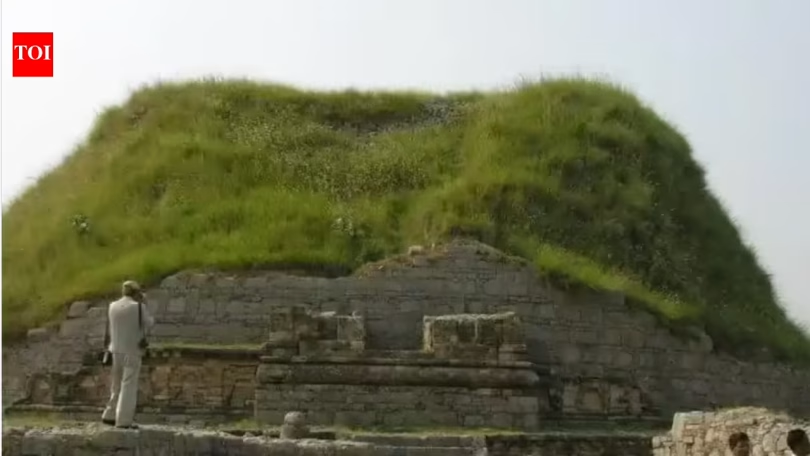
The UN has asked Pakistan to reverse the “reconstructions” that undermined the integrity of two historical sites in Taxila, warning that failure to act would result in their placement on Unesco’s ‘danger list’.Taxila, known in ancient times as Takshashila, is one of South Asia’s most significant archaeological sites. Its origins trace back to the Vedic period, with the city featuring prominently in Hindu epics like the Ramayana and Mahabharata.Unesco, the cultural arm of the UN, told senior government officials at a recent meeting that it would not hesitate to “delist” the historical sites at Mohra Moradu and Sirkap, citing recent “unnecessary interventions” . It reportedly reminded officials that it had previously removed a World Heritage Site in Germany over similar issues.The controversy emerged in March after a visitor and whistleblower shared information and pictures with Pakistan’s permanent delegate to Unesco in Paris, highlighting reconstruction works by the Punjab archaeology department . The visitor observed that original walls were being replaced with new construction or their height was being raised, interventions that could affect the authenticity and integrity of the property.Photographs showed fresh masonry works replacing ancient walls, with modern building material appearing polished and uniform in size, clearly distinguishable from irregular ancient stones.
Punjab archaeology department defends interventions
Last month, a joint technical visit was conducted by Unesco, the Department of Archaeology and Museums (DOAM), and the Ministry of National Heritage and Cultural Division to the Taxila Museum. Unesco has requested specific documentation regarding Mohra Moradu and Sirkap, including heritage impact assessment reports and photographic documentation of structures before and after restoration.However, DOAM officials have warned that using cement to erect walls at World Heritage sites is a serious violation of Unesco rules . The fear is not only technical but diplomatic: Pakistan, which has been trying to have 24 more sites included in Unesco’s World Heritage list since 1997, risks undermining its own credibility.Punjab Archaeology Department Director General Malik Zaheer Abbas has rejected the characterisation of the work as reconstruction . “The interventions being undertaken are conservation measures based on internationally accepted conservation principles, with the primary objective of stabilising vulnerable archaeological remains, preventing further deterioration, and preserving the authenticity and integrity of these World Heritage properties,” he said.“The works are conservation interventions, not reconstruction,” Abbas added, insisting there was no question of reversing the work.
Previous threats and deeper concerns
This is not the first time Taxila has faced the threat of being placed on the ‘danger list’. In 1998, Bhir Mound, adjacent to the Taxila Museum, was placed on the list after then-MNA Chaudhry Nisar Ali Khan approved the construction of a stadium at the site. The project was later shelved after public outcry.The current controversy has raised broader questions about heritage management in Pakistan. Critics argue the Taxila Archaeological Heritage Master Plan (2055), conceived largely within frameworks of urban planning and engineering, privileges visitor experience over archaeological integrity . Experts have noted that earthen courtyards at Mohra Muradu have been paved with modern mortar, and irregular ancient masonry has been replaced with uniform stonework.As one analysis put it: “Taxila has survived empires, invasions, and centuries of neglect, but it may not survive our well-intentioned impatience”.