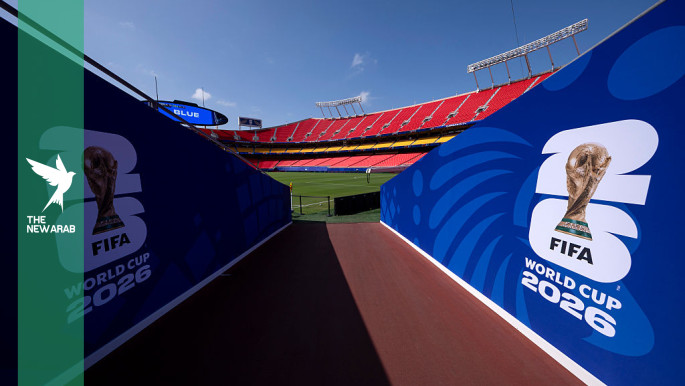
Players and officials have faced questioning and been denied entry to the US for the 2026 World Cup [Getty]
The BBC will broadcast the opening ceremony of the FIFA 2026 World Cup in the United States on Saturday, 13 June, despite growing controversy over the US government’s treatment of fans, players and FIFA officials, as well as ongoing concerns about migrant rights abuses.
The decision signals a marked shift from how the British public broadcaster handled the opening ceremony of the 2022 World Cup in Qatar, raising questions about potential double standards.
When the World Cup opened in Qatar on 20 November, 2022, the BBC refused to broadcast the opening ceremony.
Instead, viewers were shown an extended discussion between presenter Gary Lineker and pundits Alex Scott and Alan Shearer, who castigated the host nation over alleged migrant worker abuses, discrimination against LGBTQ+ people, and women, while claiming that Doha had been unfairly awarded the right to host the tournament.
At the 2018 World Cup in Russia, the BBC broadcast the opening ceremony as normal despite concerns of human rights abuses and Moscow’s involvement in the Syrian conflict, which saw Russian forces kill thousands of civilians in support of the dictatorial regime of former President Bashar al-Assad.
The 2026 World Cup comes amid the US-Israeli war on Iran, which has thrown the entire Middle East region into turmoil, and an ongoing crackdown on migrants in the US that has led to several deadly incidents, including the killings of Renee Good and Alex Pretti.
“An entire new journalistic trade of ‘Qatar bashing’ was invented in the run-up to the 2022 WorldCup as an Arab/Muslim state hosted the tournament for the first time. Issues over accessibility, human rights, affordability, and security over this World Cup in the US/Mexico/Canada are much worse. Where are all the op-eds?” Andreas Krieg, an associate professor at King’s College London, commented on the social media platform X.
These concerns were reflected in how players, fans, and officials have been treated when trying to enter the US.
Omar Artan, a Somali referee appointed by FIFA, was refused entry to the United States while at least 15 Iranian officials and staff were also denied visas.
Iraqi striker Aymen Hussein was also questioned for seven hours at Chicago’s O’Hare Airport before being allowed in the country, while team photographer Talal Salah was detained for over 10 hours before being expelled following a search of his phone.
Thousands of fans from around the world have also faced restrictions, denials, and prohibitive costs preventing their entry to the US. This contrasts with previous World Cups where governments eased their usual immigration rules to facilitate the entry of fans.
England footballing legend Ian Wright commented on how fans and sporting officials were being treated by the US in a video shared on TikTok and other social media platforms.
“Every few hours it’s another story, another story about fans denied, players denied, officials denied, journalists denied… The most expensive tickets ever, expensive accommodation, transport through the roof. Is this how the hosts behave, really? For the greatest game, the greatest tournament in the world? Why are we not hearing more? Are we seeing how Qatar got dragged? Is this the spirit of football, really?” he said.
Wright added that the tournament had become a “World Cup of Chaos” due to the behaviour of US authorities.
Despite the US treatment of World Cup fans, players and officials, its role in wars that have destabilised the Middle East, and its abuses against migrants, the BBC does not appear willing to subject it to the same level of scrutiny it directed at Qatar.
A BBC spokesperson told The New Arab that the BBC will discuss issues around the World Cup in its coverage but will broadcast the opening ceremonies in the US, Canada, and Mexico as normal.