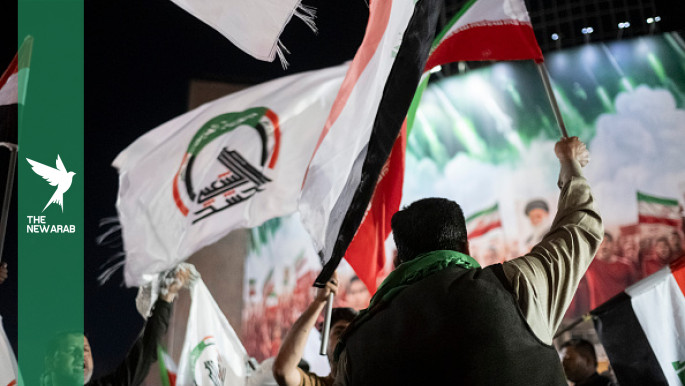
Dozens of airstrikes hit PMF bases in Iraq during the Middle East war, killing a number of faction leaders and fighters [Getty]
Conditions placed by Washington on Iraqi prime minister-designate Ali al-Zaidi are expected to complicate his job in forming a new cabinet amid deep internal divisions, particularly in regard to Iran-backed militias.
Zaidi’s appointment came after a months-long political deadlock where rival parties failed to agree on a new premier and amid US pressure to exclude Nouri al-Maliki, who is considered to be aligned with Iran.
Iraq has long been a battleground for external powers.
It has played a balancing act between Iran, which has strong influence in the country through its Shia allies, and the US, which led the 2003 invasion and occupation of the country.
Under Iraq’s power-sharing structure, the prime minister is reserved for a Shia, the speaker of parliament a Sunni, and the presidency – a largely ceremonial role – a Kurd.
Iraqi political sources informed on the matter told The New Arab that reaching a consensus on ministerial appointments or formulating the government’s programme is no longer a priority for the future cabinet, due to a set of US conditions delivered to Baghdad.
The US has reportedly indicated that it will not engage with any administration that includes representatives from factions designated by Washington as terrorist organisations, in a reference to Iran-backed Shia factions.
President Donald Trump spoke over the phone with Zaidi after his appointment, but the move was understood in Iraq to be a “conditional endorsement”, pending the cabinet formation.
Dozens of militia leaders and members were killed in suspected US-Israeli strikes on Iraq, amid the wider Middle East war that began on 28 February.
Airstrikes targeted bases belonging to the Popular Mobilisation Forces, an umbrella group that includes a number of factions, including the powerful Kataib Hezbollah militia.
Iran-backed groups repeatedly struck American interests in Iraq including the US embassy and troops stationed in the northern Kurdish city of Erbil.
Not a simple task
An unnamed senior member of the Shia-led Coordination Framework told TNA that one of the main US conditions for cooperating with the new government is to reshape Iraq’s armed landscape by dismantling Iran-backed militant groups.
This would include disarming them and integrating their weapons into the state’s arsenal, as well as preventing any direct role for them in the next cabinet formation.
He added that Zaidi has informed Coordination Framework leaders of the importance of cooperating on this issue to ensure the success of the government, warning that failure to do so could lead to “uncertain scenarios” with Washington that would harm Iraq economically.
Another political source told TNA that most leaders within the Coordination Framework support avoiding confrontation with Washington. However, the current dispute centres on attempts to exclude armed factions from government representation, which some groups view as part of their electoral entitlement.
The source added that discussions about disarming, integrating, or dismantling these factions would require a defined timeframe and major legal and security mechanisms, noting that “the Americans cannot speak about it as if it were a simple button the next Iraqi government can press”.
He said it is therefore unlikely that any government commitments or acceptance of these conditions would materialise in the short term, especially given Washington’s use of the threat of economic sanctions against Iraq, describing the process as a medium- to long-term path that will not be easy.
Coordination Framework member Adi al-Khadran told TNA that “any talk of external conditions or dictates related to the formation of the Iraqi government or the shaping of its political and security structure is categorically rejected”, stressing that “national decision-making must remain exclusively in the hands of Iraqi political forces, without any external interference”.
Al-Khadran added that the Coordination Framework rejects linking international support or bilateral relations with Iraq to conditions that infringe on national sovereignty or attempt to impose internal arrangements on the structure of the government.
Iran’s allies in Iraq have long called on the US to leave the country. Around 2,000 American troops remain in Iraq after a recent drawdown.