
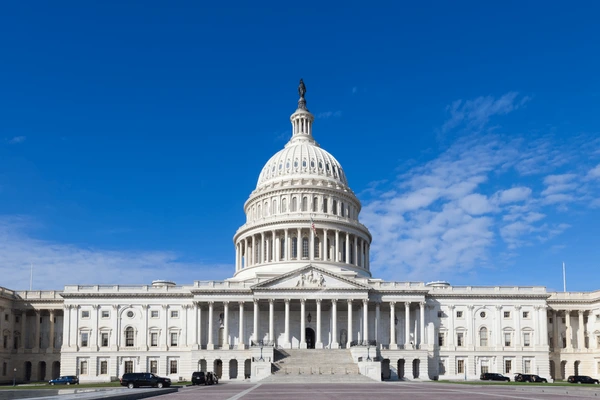
In a vote split down partisan lines, Republicans on a key committee on Tuesday began the process of replacing the Corporate Transparency Act’s requirements to disclose the true owners of shell companies.
A Republican-led House committee voted on Tuesday to effectively dismantle a landmark anti-corruption law, advancing legislation that would exempt American business owners from a federal requirement to disclose their true identities to the government.
Under the proposed replacement, foreign nationals would still be required to report their beneficial ownership to the Treasury Department’s Financial Crimes Enforcement Network (FinCEN). However, U.S. citizens operating domestic businesses would be entirely freed from the requirement.
The vote marks a sharp reversal for a transparency initiative that was originally fueled by years of global investigative journalism, including the Panama Papers and the Russian Laundromat, which exposed how anonymous shell companies are routinely exploited to facilitate tax evasion, terrorism, and international money laundering.
The committee’s actions drew fierce criticism from advocates pushing for a fairer, more transparent global financial system.
“There could be no greater gift to the fentanyl traffickers, fraudsters, and U.S. adversaries that rely on the anonymity that shell companies provide than gutting the Corporate Transparency Act,” said Erica Hanichak, deputy director of the Financial Accountability and Corporate Transparency (FACT) Coalition.
Representing a non-partisan alliance of more than 100 organizations dedicated to combating money laundering and corporate secrecy, Hanichak added, “Congress should be moving to strengthen this critical anti-money laundering law, not tear it down.”
For veteran law enforcement officials, the proposed repeal represents a major setback. Debra LaPrevotte, a former F.B.I. official and senior investigator at Restitution Impact Ltd., said her three decades of tracking international corruption showed exactly who benefits from corporate secrecy.
“I’ve seen firsthand how anonymous U.S. shell companies are used by kleptocrats, foreign officials, and cartels to launder illicit funds and purchase luxury assets in this country,” LaPrevotte said. “Gutting the Corporate Transparency Act would eliminate a key tool needed by law enforcement to follow the money and stop the United States from being a safe haven for criminal proceeds.”
The legislative push aligns with a broader policy shift by President Donald J. Trump. Although he signed the Corporate Transparency Act into law during his first term in 2020, he abruptly changed course last year. Shortly after taking office for his second term in 2025, he ordered the Treasury Department to halt the collection of beneficial ownership information from Americans, limiting the mandate exclusively to foreign-owned entities.
During a contentious hearing on Tuesday, Democrats fiercely criticized the repeal effort, warning that creating a carve-out for Americans would severely hobble law enforcement. They pointed to public support for the existing law from various civil society groups and the National Association of District Attorneys.
“Weapons trafficking, human trafficking, terrorism — without this data, prosecutors are left blind when investigating shell companies,” said Representative Stephen Lynch, Democrat of Massachusetts.
Lynch argued that the Republican proposal would “greatly curtail our ability to combat shell companies fueling illegal operations” and jeopardize national security. Representative Nydia Velázquez, Democrat of New York, echoed those concerns, warning that the bill’s passage would “tie the hands of law enforcement, increase criminal activity, and endanger our economy.”
To underscore the domestic threat, committee Democrats invoked the disgraced financier Jeffrey Epstein, who died in jail in 2019 while awaiting trial on sex-trafficking charges. Under the new Republican framework, Democrats noted, an American like Epstein would not be legally obligated to declare his ownership of the vast network of shell companies recently detailed in the Justice Department’s release of his files.
Republicans countered that the 2020 law is a regulatory boondoggle that unfairly burdens up to 33 million American small businesses, many of which already report ownership information to their lenders.
Representative French Hill, Republican of Arkansas and the committee chairman, defended the repeal by noting that bad actors abroad would still face scrutiny. “People from outside the U.S., corporations or individuals who try to form a pass-through entity in the U.S., would be subject to this rule,” Hill said.
He also cast doubt on the efficacy of ownership registries entirely. “I would remind my friends that Cyprus, U.A.E., Turkey, all have beneficial ownership databases. And they’re the most renowned money laundering places on the planet, according to the Financial Action Task Force.”
The Republican effort received unexpected external validation over the weekend from the Washington Post editorial board, which endorsed an overhaul of the Corporate Transparency Act. The editorial highlighted mounting constitutional challenges in federal courts and the law’s exorbitant costs.
“This has created significant compliance costs, more than $1 billion a year by one estimate, with little to no public benefit,” the editorial stated, criticizing the law’s murky definition of “substantial control,” which could theoretically force every employee of a 10-person small business to register.
The repeal effort will now head to the floor of the full House of Representatives, where Republicans hold a slim majority. Even if it passes as a stand-alone measure, its ultimate path to becoming law may depend on whether it can be attached as an amendment to a larger, must-pass piece of legislation—a maneuver identical to the one that originally enacted the Corporate Transparency Act as part of a defense spending bill in 2020.