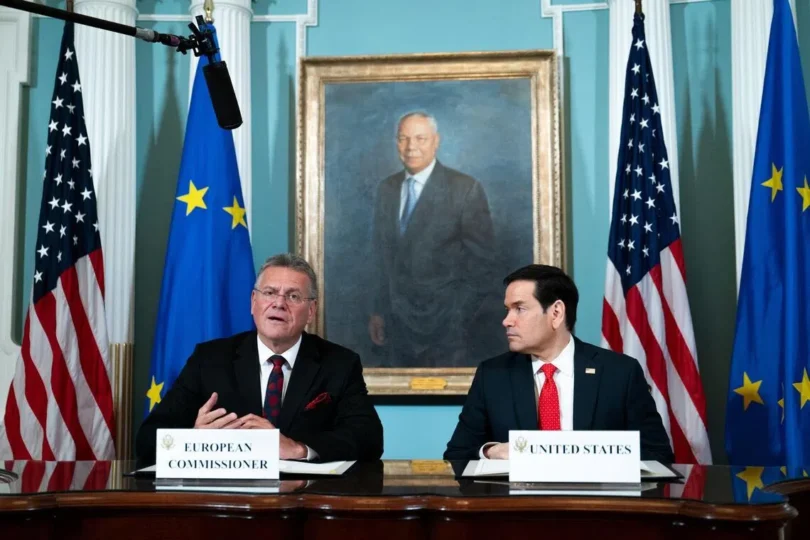
WASHINGTON – The European Union and United States signed an agreement on April 24 to coordinate on the supply of critical minerals needed for key industries, including defence, as China’s dominance becomes a growing concern.
The pact marks a rare embrace by President Donald Trump’s administration of the role of the EU, which it often berates as it instead champions right-wing populists within Europe.
Flexing its muscle at times of tension, Beijing has restricted exports of critical minerals needed for products including semiconductors, electric vehicle batteries and weapons systems.
“The overconcentration of these resources, the fact that they’re dominated by one or two places, is an unacceptable risk,” US Secretary of State Marco Rubio said, as he signed a memorandum of understanding with EU trade chief Maros Sefcovic.
“The combination of the United States and the European Union – it’s extraordinary. We are combined the largest customers and users” of the critical minerals, he said.
“We have to make sure that these supplies and these minerals are available for our futures and in ways that are not monopolised in one place or concentrated heavily in one place,” Mr Rubio said.
An action plan said that the EU and US would explore setting minimum prices on critical minerals – effectively preventing China or other outside powers from flooding the market with inexpensive exports.
They will also look at coordinating any subsidies and stockpiles of critical minerals, coordinate joint standards to ease trade across the Western world, and together invest in research.
The Trump administration has previously called for a preferential trade zone among allies on critical minerals.
Washington has also unveiled critical minerals action plans with Mexico and Japan, alongside a supply framework with Australia and others. AFP
China has restricted exports of critical minerals needed for products including semiconductors, electric vehicle batteries and weapons systems.
PHOTO: REUTERS