
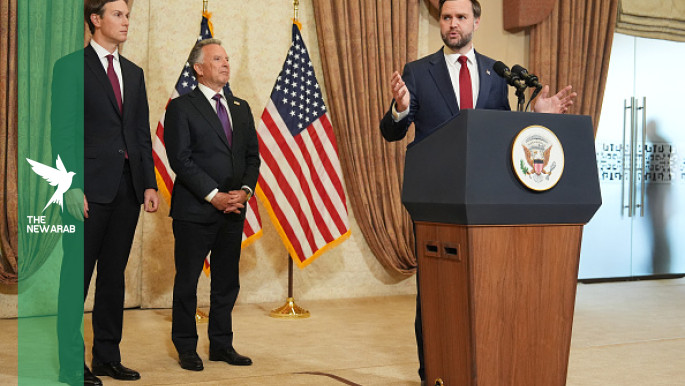
Vance announced the negotiations with Iran had failed less than 24 hours after they began [Getty]
Talks between the US and Iran in Pakistan ended without agreement on Sunday amid disputes over Lebanon, the Strait of Hormuz, and Tehran’s nuclear programme, according to US officials and regional sources.
US Vice President JD Vance said negotiations in Islamabad had failed after Washington presented what he described as its “final and best offer”.
“We’ll see whether the Iranians accept it,” Vance told reporters after 21 hours of talks, adding: “We did that, but unfortunately, we were unable to make any progress”.
Pakistani sources told The New Arab that major disagreements prevented any breakthrough, particularly over the Israeli war on Lebanon and control of the Strait of Hormuz, a key global oil transit route through which roughly a fifth of the world’s supply passes.
One source said the US delegation “rejected including Lebanon in any potential deal with Iran”, adding that American officials, including Steve Witkoff and Jared Kushner, sought to “hand over the Lebanon issue entirely to Israel” and separate it from wider negotiations with Tehran.
The proposal would effectively leave Israel to “deal with Lebanon alone, whether in peace or war”, the source said, amid Israel’s ongoing military assault on the country which has killed over 2,000 people – 357 of them on April 8 alone – and displaced hundreds of thousands from their homes.
Iran’s interest in Lebanon is closely tied to its support for Hezbollah, making the country a central pillar of Tehran’s regional influence and difficult to separate from wider negotiations.
The Strait of Hormuz also emerged as a major sticking point. According to sources, Washington pushed to postpone detailed negotiations over the waterway while pushing for its immediate reopening, without a significant Iranian role in its management.
US officials additionally sought to raise Iran’s missile programme during the talks, but Iran refused to discuss this.
Vance however framed the core dispute as centred on nuclear weapons, stating: “The simple truth is that we need a firm commitment that they will not pursue a nuclear weapon, and will not seek the tools that would enable them to build a nuclear weapon quickly”.
He added: “Do we see a fundamental commitment of will from the Iranians not to develop a nuclear weapon (…) not just now, and not just two years from now, but over the long term? We have not seen that yet, and we hope to see it”.
Iran has repeatedly said that it does not seek a nuclear weapon but the US focused on longstanding demands that Iran fully halt uranium enrichment and relinquish its stockpile of nuclear material.
Vance said: “We need a firm commitment that Iran will not seek to acquire a nuclear weapon or the tools to rapidly produce one,” adding: “They chose not to accept our terms”.
Donald Trump before and during the current conflict demanded “zero uranium enrichment” and the handing over of Iran’s nuclear fuel reserves, estimated at around 970 pounds.
International monitoring bodies have long maintained oversight of Iran’s nuclear activities, and have reported no conclusive evidence that Tehran is currently seeking to build a nuclear weapon, though Western officials have expressed concern over its technical capabilities.
After Vance decided to leave Islamabad, Pakistani Prime Minister Shehbaz Sharif, Foreign Minister Mohammad Ishaq Dar, and Army Chief Asim Munir accompanied him to his aircraft, where last-minute discussions took place.
Pakistani officials attempted to persuade both sides to continue negotiations, according to sources.
Separately, Iranian aircraft arrived at Nur Khan Airport to transport Tehran’s delegation, with two planes providing security cover. The Iranian team has since left the negotiation venue and is preparing to depart Pakistan.
Vance said the US delegation had approached the talks sincerely, adding that the president had instructed negotiators to “come here in good faith and do your best to reach an agreement”.
“I think we were very flexible. We were very cooperative,” he said.