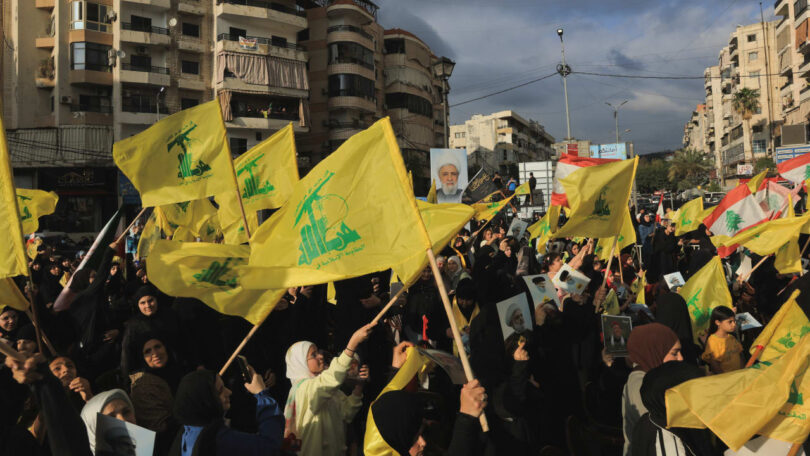
The US issued new sanctions against two Hezbollah-aligned Lebanese officials and other members of a Hezbollah business network overseen by a previously designated individual, the US State Department announced on Thursday.
The two officials, named Sleiman Antoine Frangie and Mahmoud Qamati, were added to the US Treasury Department’s Office of Foreign Assets Control’s (OFAC) Specially Designated Nationals (SDN) list.
Both were sanctioned under the authority of Executive Order 13224, which allows the White House to target groups and individuals associated with designated terrorist groups.
Frangie is the leader of Lebanon’s Marada Movement, and has previously served in several Lebanese governments. Moreover, he initially stood as a Hezbollah-favored candidate in the Lebanese presidential election until his withdrawal in 2024.
The other individual sanctioned, Qamati, has been a longtime senior member of Hezbollah. In early 2026, he called for the Lebanese government’s overthrow and compared the government to Vichy France in an interview with Al Jazeera.
Sanctioned officials worked to ‘undermine’ Lebanese gov.
American individuals and businesses are forbidden from working with SDN-listed individuals or groups, and those listed have their US-based assets frozen.
“These officials have used their influence to deliberately and systematically undermine the authority of the Lebanese state,” wrote US State Department spokesperson Tommy Pigott.
“By aligning themselves with Hezballah, a terrorist organization, they have prevented the Lebanese government from exercising full control over its territories and over its future. These activities obstruct efforts to restore a sovereign, independent Lebanon, instead entrenching a system of parallel power that keeps Lebanon weak and divided, at the expense of the entire Middle East.”
Another Lebanese national, Wael Constateen, was also listed as a SDN for carrying a close connection to previously sanctioned Alaa Hassan Hamieh, the leader of an international Hezbollah-supporting network encompassing Lebanon, Syria, Iraq and Oman.
Hamieh’s organization “raise[s] funds, execute[s] contracts, and operate[s] front companies to generate revenue for [Hezbollah] terrorists,” according to Pigott’s statement.
Hezbollah needs to disarm for regional peace, statement says
Additionally, five companies said to be a part of Hamieh’s network were included in the sanctions package.
“[Hezbollah] is a terrorist organization that puts Iran, not Lebanon, first,” the statement continued. It “is the single biggest obstacle to Lebanon’s recovery and future, and holds the state hostage to a permanent state of conflict.”
“Those who continue to provide political cover and material support to [Hezbollah] will suffer the consequences of their choices.
“For the sake of lasting peace in the region and Lebanese stability and prosperity,” the statement adds, “[Hezbollah] must disarm, its infrastructure must be dismantled, and the Lebanese state must regain its control of Lebanon’s future.”
“The United States will continue to target [Hezbollah’s] finances and those who help the group undermine the state of Lebanon.”
These sanctions come as the US and Iran agreed on a deal to, among other things, end the fighting between Israel and Hezbollah in southern Lebanon, as well as a push from the Lebanese government to disarm Hezbollah.