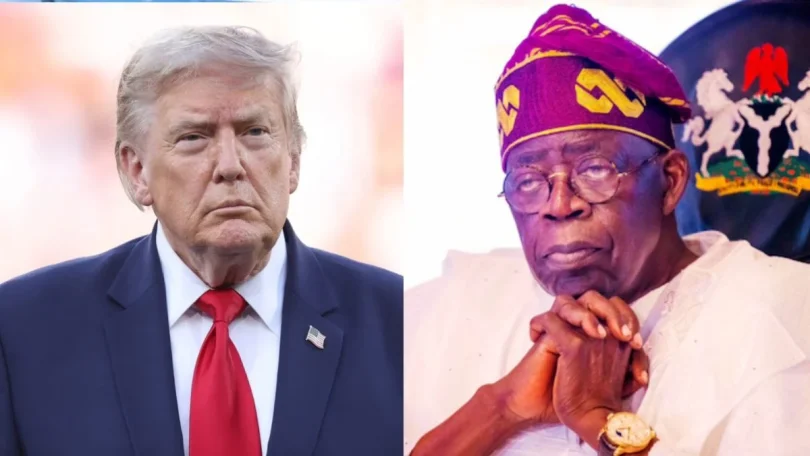
The United States government has disclosed that President Bola Tinubu’s administration has taken religious violence in Nigeria more seriously following President Donald Trump’s decision to redesignate the country as a Country of Particular Concern (CPC).
US State Department officials made the disclosure during a congressional hearing on Thursday, November 12, where they assessed Nigeria’s efforts to protect vulnerable communities and address attacks on Christians and other religious groups.
The officials, however, maintained that despite some reported improvements, the Nigerian government still has significant work to do to end attacks, protect affected communities and ensure that those responsible for violence are brought to justice.
The hearing was organised by the Africa Subcommittee of the US House Foreign Affairs Committee.
It was chaired by Congressman Chris Smith, who has repeatedly raised concerns over religious violence and the security situation in Nigeria.
Speaking during the session, Frank Garcia, Assistant Secretary of State for African Affairs, said the US government had maintained intensive diplomatic engagements with Nigerian authorities to address the persecution of Christian communities and strengthen accountability for those involved in attacks.
Garcia acknowledged that violence remained a major concern in several parts of Nigeria.
However, he said Washington was continuing to work with the Tinubu administration to improve security responses and prevent further attacks.
He explained that the United States expected the Nigerian government to demonstrate measurable improvements, particularly in communities affected by recurring violence.
“We are expecting results — protection for Christian communities in the Middle Belt through increased Nigerian security and law enforcement deployments, more timely and effective responses to early warnings of impending attacks, accountability for perpetrators through stronger courts and security services, and deeper military-to-military cooperation,” he said.
Garcia further explained that the US was pursuing a coordinated strategy to strengthen Nigeria’s security institutions.
According to him, the strategy involves building the capacity of Nigerian security agencies, expanding the use of biometric information to identify individuals involved in attacks and developing financial measures to disrupt terrorist funding networks.
He said these measures were intended to improve intelligence gathering, strengthen investigations and make it more difficult for armed groups to finance their operations.
The US official also indicated that Washington was not entirely satisfied with the pace of progress recorded by the Nigerian government.
He noted that American officials had communicated their concerns during the second session of the US-Nigeria Joint Working Group.
“Though Nigeria has reported progress, under Secretary Hooker made it clear in the joint working group second session that this pace is insufficient,” he said.
Another senior US official, Riley Barnes, Assistant Secretary of State for Democracy, Human Rights and Labour, also addressed the hearing.
Barnes disclosed that the United States had continued pressing Nigeria to address laws criminalising blasphemy.
He said Washington wanted the Tinubu administration to repeal such laws or, at the very least, stop enforcing them.
He linked the increased attention being given to religious freedom issues in Nigeria to Trump’s decision to redesignate the country as a CPC.
According to Barnes, the designation had pushed the Nigerian government to take Washington’s concerns more seriously.
He identified several steps reportedly taken by the Nigerian authorities since the designation, including changes in leadership, the deployment of military personnel to strategic locations and increased arrests and prosecutions.
Barnes also disclosed that Nigeria had agreed to provide more transparent information about funds allocated to internally displaced persons.
He said the Nigerian government had further agreed to develop a plan and timeline for ensuring that displaced people could safely return to their ancestral communities.
The US official, however, stressed that the ultimate objective of Washington’s engagement with Abuja was to achieve a significant reduction in attacks and violence.
“The government has reported leadership changes, strategically deployed military forces, and increased arrests and prosecutions,” Barnes said.
“They’ve agreed to report more transparently on spending for displaced people and to develop a plan and timeline for returning internally displaced persons safely and securely to their ancestral lands.
“But our chief goal remains an end to attacks and violence. The US has been clear that the measure of success will be simply fewer attacks and less violence, and importantly, demonstrable progress in holding the individuals who carry out attacks accountable. Abuja carries the burden of proof, and there is still more work to be done.”
Barnes’ comments indicate that the US government is placing considerable importance on the outcome of its engagements with the Nigerian authorities rather than relying solely on assurances from Abuja.
The hearing also featured contributions from Oge Onubogu, Director and Senior Fellow of the Africa Programme at the Centre for Strategic and International Studies (CSIS).
Onubogu called for a balanced assessment of religious violence in Nigeria.
She maintained that attacks against Christian communities should be addressed without overlooking the suffering of Muslims and other groups affected by insecurity.
She warned against presenting Nigeria’s security challenges as exclusively religious, noting that several factors contribute to violence across different parts of the country.
“The evidence does not support treating Christians as the sole victims of Nigeria’s violence or reducing the complex insecurity of the middle belt to a single explanation based on religion,” Onubogu said.
“Muslim communities have also suffered devastating attacks. Religious identity can intersect with ethnicity, land, and resource disputes, political competition, livelihoods, criminality, governance failures, and longstanding local grievances.”
She further argued that the CPC designation should be used as an instrument for achieving meaningful policy changes rather than becoming an end in itself.
Her submission highlighted the need to understand the different causes of insecurity and ensure that responses address all affected communities.
Meanwhile, Congressman Chris Smith maintained that the United States should not remove Nigeria from the list of Countries of Particular Concern without evidence of substantial improvements.
Smith opposed lifting the designation, insisting that it should remain in place until the Nigerian government demonstrates concrete progress in protecting vulnerable communities and addressing religious violence.
Nigeria’s CPC designation followed Trump’s announcement in October 2025 that the country would be redesignated over allegations of severe violations of religious freedom and attacks against Christians.
Recall that POLITICS NIGERIA had reported on Trump’s decision to redesignate Nigeria as a Country of Particular Concern over allegations of Christian persecution.
Trump subsequently authorised a US military strike targeting terrorist positions in Sokoto State on Christmas Day 2025.
The development was followed by increased security cooperation between Washington and Abuja.