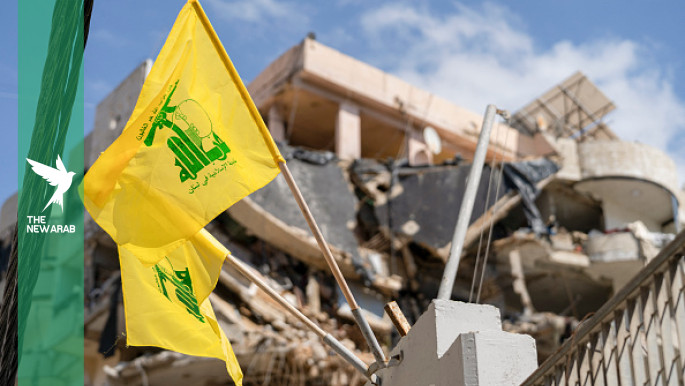
Hezbollah said the US sanctions were imposed to ‘intimidate the Lebanese people’ and to ‘bolster’ Israel’s aggression in the county. [Getty]
The US Treasury Department on Thursday imposed sanctions on nine Hezbollah-linked individuals in Lebanon for allegedly “obstructing the peace process” and “hindering” the group’s disarmament, as Israeli attacks continue in the country despite a ceasefire.
Those sanctioned include MPs from Hezbollah, its ally Amal, members of the Lebanese military, and the General Security Directorate.
In a statement, the Treasury said: “Hezbollah’s continued militant activity and coercive influence over the Lebanese state undermine the Lebanese government’s ability to assert its authority over state institutions and disarm the terrorist group.”
On Thursday, Scott Bessent, the Secretary of the Treasury, called Hezbollah a “terrorist organisation that must be completely disarmed”. He vowed that the Treasury Department “will continue to take necessary action against those officials who have infiltrated the Lebanese government and enable Hezbollah to wage its senseless campaign of violence against the Lebanese people and obstruct the achievement of lasting peace.”
Who are those impacted?
The sanctioned Hezbollah MPs include Hassan Fadlallah, Hussein al-Hajj Hassan, and Ibrahim al-Moussawi, as well as executive council leader Mohamed Abdel-Motalleb Fanich.
On this decision, the Treasury said: “Hezbollah relies on a network of political representatives, including members of parliament, to serve its interests and ignore the legitimate government’s calls for it to disarm and respect state sovereignty.” It added that “these actors, who are either senior Hezbollah officials or closely coordinated with them, serve the party’s agenda at the expense of the legitimate government and the Lebanese people of all regions and religions.”
Ahmed Asaad Ahmad Baalbaki and Ali Ahmad Safawi from Amal, Hezbollah’s ally, have also been sanctioned.
“Baalbeki is Amal’s security director and has coordinated public displays of force with Hezbollah leadership to intimidate the party’s political opponents in Lebanon,” the Treasury said, adding that Safawi is “the commander” of Amal’s militia in southern Lebanon.
“As Baalbeki’s subordinate, Safawi coordinated with and received directives from Hezbollah regarding attacks on Israel and led Amal militia forces in joint military operations against Israel,” it further added.
Washington has also imposed sanctions on the Iranian ambassador-designate to Beirut, Mohammad Reza Sheibani, who was declared a persona non grata back in March and ordered to leave the country. Sheibani had refused the request and still remains in Lebanon.
The US Treasury stated that “Iran’s violation of diplomatic norms, as well as practices typically followed by an ambassador in communication between the two countries, was cited as the reason for Sheibani’s expulsion”.
Others sanctioned are serving Lebanese military officers, Brigadier-General Khattar Nasser Eldin and Colonel Samir Hamadi.
The Treasury added that Hezbollah has also received “illicit support” from within “legitimate” Lebanese security institutions, namely the Lebanese Armed Forces and the General Directorate of General Security.
It accused Nasser Eddine and Hamadi of exchanging “significant intelligence with Hezbollah” during the conflict that raged over the past year.
The sanctions list also designates Sheibani, Baalbeki, Safawi, Nasser Eldin, and Hamadi for “providing material assistance, sponsorship, financial, material, or technological support, or goods or services to or in support of Hezbollah”.
Hezbollah and Amal condemn
The two Shia political parties have strongly condemned the move to impose sanctions on their MPs.
In a scathing statement, Hezbollah said the decision “attempts to intimidate the free Lebanese people in order to bolster the Zionist aggression against our country and give it a false political boost after its crimes failed to deter the Lebanese from exercising their legitimate right to resist in defence of their homeland”.
“These sanctions are a badge of honour for those targeted by them, and further confirmation of the correctness of our choice. Their effects are worthless, not even worth the ink they are written with, and they will have no practical impact on our choices or on the continued work of our brothers and officials in serving their people and defending their interests and sovereignty,” the group added.
Amal, on the other hand, called the decision “unacceptable and unjustified” despite the political party being “keen on national issues and protecting the state and institutions”.
The US State Department designated Hezbollah as a “Specially Designated Global Terrorist” in October 2001, and as a “Foreign Terrorist Organisation” under Section 219 of the Immigration and Nationality Act in October 1997.
While the US Treasury had previously imposed sanctions on Hezbollah officials and members of parliament, as well as its political allies, this marks the first time it has added security and military officials and leaders to its list.
This move raises several questions about how the United States will deal with Lebanese officials, particularly amid ongoing negotiations in Washington between Lebanese and Israeli delegations.
The US-mediated, direct negotiations are the first of their kind in decades and are aimed at reaching a peace agreement and disarming Hezbollah following years of devastating war. The Iran-backed group has sharply criticised the talks, calling them “a grave sin that will destabilise” Lebanon, and urged for indirect dialogue instead.