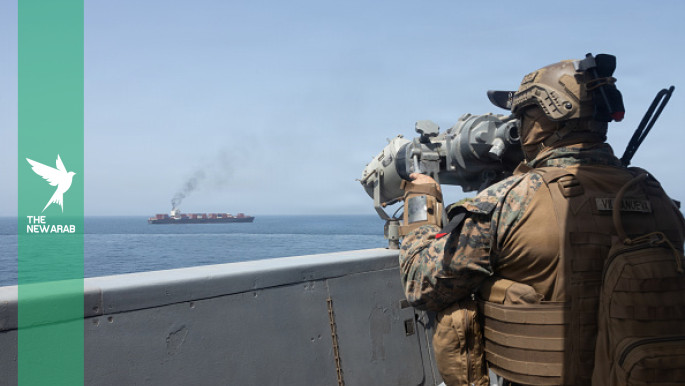
Iran has insisted that it will not agree to talks with the US until its blockade on Iranian shipping is lifted [Getty]
The US Defense Department said Thursday its forces boarded a vessel in the Indian Ocean that was providing material support to Iran, the second time it had done so in three days.
“Overnight, U.S. forces carried out a maritime interdiction and right-of-visit boarding of the sanctioned stateless vessel M/T Majestic X transporting oil from Iran, in the Indian Ocean,” it said on X.
Meanwhile, Iran tightened its grip on the Strait of Hormuz, seizing two vessels, as the status of the ceasefire between the United States and Israel remained unclear.
Tehran, which has not explicitly agreed to US President Donald Trump’s indefinite extension of the truce, has insisted that Washington’s continued blockade of Iranian ports is an act of war.
Iran’s parliament speaker Mohammad Bagher Ghalibaf said on X that the reopening the Strait of Hormuz, the slender chokepoint that carried a fifth of the world’s oil trade before the war, was impossible with such a “flagrant breach of the ceasefire”.
“You did not achieve your goals through military aggression and you will not achieve them by bullying either,” he wrote in his first response to Trump’s ceasefire announcement. “The only way is recognising the Iranian people’s rights.”
However, despite the stern rhetoric from both sides, at least 34 of Iran-linked vessels – including several carrying Iranian oil – have circumvented the US blockade, according to a report by The Financial Times this week.
The report said that 19 Iran-linked tankers departed the Gulf, while 15 others entered it via the Arabian Sea. At least six of the tankers departing from Iran were reportedly carrying an estimated 10.7 million barrels of Iranian crude.
For its part, the US Central Command (CENTCOM) said on Wednesday that it had directed 30 vessels to turn around since the beginning of the blockade. US forces have seized two Iran-linked tankers, while Iran on Tuesday seized two vessels and fired on a third.
White House Press Secretary Karoline Leavitt told Fox News that Washington does not consider the acts as violations of the ceasefire, as they did not belong to the US or Israel.
In his Tuesday announcement, Trump said that the US had agreed to a request by Pakistani mediators “to hold our Attack on the Country of Iran until such time as their leaders and representatives can come up with a unified proposal … and discussions are concluded, one way or the other”.
‘Six months’ for mine clearing
A Pentagon assessment said it could take six months to completely clear the Strait of Hormuz of Iranian-laid mines, which could keep oil prices high, The Washington Post reported on Wednesday.
According to officials close to the discussion, the assessment added that it was unlikely such an operation would begin before the end of the war.
The six-month estimate was shared with members of the House Armed Services Committee during a classified briefing, the Post reported.
Lawmakers were told that Iran may have placed 20 or more mines in and around the strait, some of which floated remotely using GPS technology, making them harder to detect, according to the report.
Pentagon spokesman Sean Parnell told The Washington Post that its information was “inaccurate”.
Asked about the report, Chief Pentagon Spokesman Sean Parnell said “the media cherry picking leaked information, much of which is false, from a classified, closed briefing is dishonest journalism”.
“One assessment does not mean the assessment is plausible, and a six-month closure of the Strait of Hormuz is an impossibility and completely unacceptable to the Secretary,” Parnell told AFP on Thursday.
Iran’s Revolutionary Guards have warned of a “danger zone” covering 1,400 square kilometres — 14 times the size of Paris — where mines may be present.
Iran’s parliament speaker said the Islamic Republic would not reopen the Strait as long as the US naval blockade remained in place.
A spokesman for German transportation giant Hapag-Lloyd cautioned last week that shippers needed details on viable routes as they remain fearful of mines.
When the Strait of Hormuz briefly reopened at the start of the ceasefire this month, only a few ships trickled through amid fears of attacks or mines.
Earlier in April, the US Navy said its ships transited the waterway to begin removing the mines, but this was denied by Iran’s Revolutionary Guard, which threatened any military vessels attempting to cross the channel.
London hosted talks with military planners from over 30 countries starting on Wednesday regarding a UK and France-led multinational mission to protect navigation in the Strait of Hormuz once hostilities end.
The “defensive” coalition is set to discuss plans to reopen the strait and conduct mine clearance operations.