
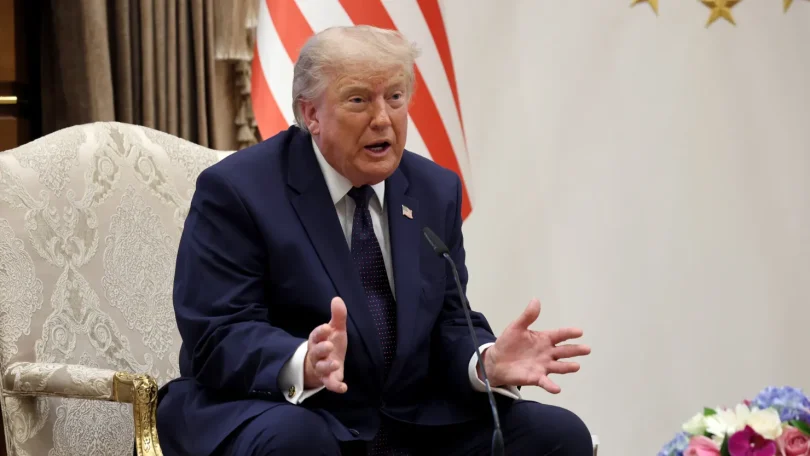
United States President Donald Trump has warned that Iran would face devastating military retaliation if it attempted or succeeded in assassinating him, further escalating tensions between Washington and Tehran despite renewed diplomatic engagements….
United States President Donald Trump has warned that Iran would face devastating military retaliation if it attempted or succeeded in assassinating him, further escalating tensions between Washington and Tehran despite renewed diplomatic engagements.
In a post on his Truth Social platform on Friday, Trump said the U.S. military had already been placed on alert and would respond with overwhelming force to any threat against the American president.
“1,000 missiles are locked and loaded and aimed at the Islamic Republic of Iran, with thousands of more to immediately follow, should the Iranian Government act on its threat… to assassinate, or attempt to assassinate, the sitting President of the United States of America, in this case, ME!” Trump wrote.
He added, “Orders have already been given, and the U.S. military is ready, willing, and able… to completely decimate and destroy all areas of Iran.”
Trump’s remarks came a day after he disclosed that the United States had agreed to hold further talks with Iran, even as he maintained that the ceasefire between the two countries had effectively collapsed.
READ ALSO: Trump Reassures NATO Allies After Iran Rift
“The Islamic Republic of Iran has asked us to continue ‘talks.’ We have agreed to do so, but the United States has stated to them, in no uncertain terms, that the Cease Fire is OVER!” he said.
The latest exchange underscores worsening relations between the longtime adversaries following recent military confrontations that threatened to derail efforts to transform a fragile truce into a lasting peace.
Responding on Saturday, Iran rejected Trump’s claims, insisting it had honoured the ceasefire agreement while accusing Washington of violating the terms of their memorandum of understanding.
Iranian Foreign Minister Abbas Araghchi said Tehran had remained committed to the agreement despite what he described as repeated breaches by the United States.
“The Islamic Republic of Iran has so far kept its word, unlike the so-called US Treasury Secretary who is violating Para 9 of the MoU,” Araghchi said.
“That violation follows other violations and missteps by the United States. Reality check: There can only be mutual compliance,” he added.
Under the memorandum of understanding, Iran agreed to maintain the status quo of its nuclear programme, while the United States pledged not to impose new sanctions or deploy additional military forces to the region pending a final agreement.
Despite the renewed diplomatic contacts, there has been little sign of progress. U.S. and Iranian officials have held one round of direct negotiations in Switzerland alongside indirect talks mediated by Qatar.
The diplomatic uncertainty comes amid renewed concerns over the Strait of Hormuz, a critical global oil shipping route.
According to reports by Axios and Politico, Washington has given Tehran until Saturday to halt attacks on commercial vessels in the waterway and publicly acknowledge that the strait remains open to international shipping.
Iran has asserted greater control over the strategic passage following months of conflict, insisting it has the right to regulate traffic through the strait, although international law generally prohibits either Iran or Oman from blocking passage or imposing transit fees.
The United States carried out major strikes on Iranian targets earlier this week after attacks on vessels in the strait, prompting retaliatory strikes against American military installations in the Gulf.
Meanwhile, the U.S. Treasury Department has revoked a temporary sanctions waiver that previously allowed Iran to continue exporting crude oil through August.
Araghchi is expected to travel to Oman for talks on the Strait of Hormuz, while Qatar has continued mediation efforts aimed at easing tensions between the two countries.
Pakistan has also intensified diplomatic engagement, with Prime Minister Shehbaz Sharif holding separate discussions with Qatar’s Emir and Iranian President Masoud Pezeshkian, urging all parties to preserve the fragile peace.
However, Iran’s chief negotiator, Mohammad Bagher Ghalibaf, signalled Tehran’s resolve to resist external pressure.
“Ending the war is a priority for the countries of the world, but everyone must know that this confrontation will never end with Iran’s surrender,” he said, adding that Iranians were “fully prepared to defend ourselves.”
AFP