
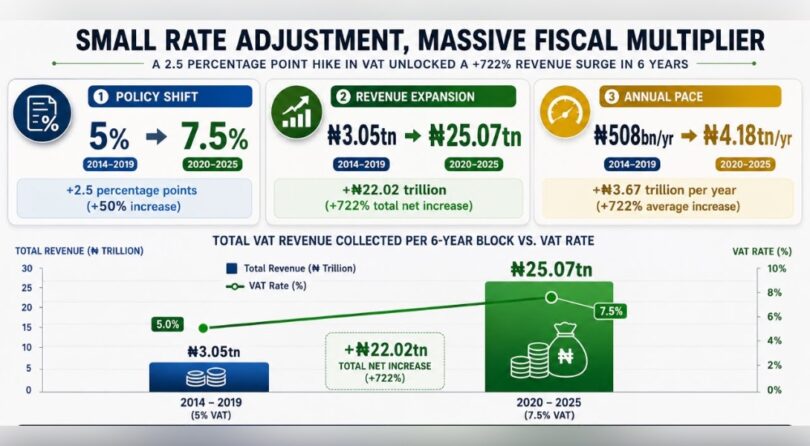
…Revenue Jumps 722% After Rate Rose From 5% To 7.5%
…Inflation, Digital Economy, Tax Reforms Boost Collections
The increase in Nigeria’s Value Added Tax from five per cent to 7.5 per cent in 2020 has led to a quantum leap in earnings from the consumption tax from N3.05tn to N25.07tn in equal six comparable years.
Other factors that buoyed the nation into higher VAT performance include inflation which raised the value of taxable transactions; stronger tax administration and compliance; expansion of the digital economy; and broader tax coverage.
In the six years after the increase in the consumption tax from five per cent to 7.5 per cent, the country earned an average of N4.18tn per annum or a total of N25.07tn in the six-year period.
This contrasts sharply from an average of N508.33bn or a total of N3.05tn earned in the six years before the increment in the consumption tax rate.
VAT is a consumption tax payable on the value added on each stage of the supply chain of goods and services. Thus, the final incidence of the tax is on the consumer, and it could rightly be said to increase the cost of goods and services.
The revenues generated through VAT six years after the rate was raised surpassed the revenues generated in the six years before the rate was increased by N22.02tn. This shows a quantum jump of 721.97 per cent.
Before the VAT rate was increased, the revenues made from VAT stood at N493.95bn in 2014; N469.84bn in 2015; N474.02bn in 2016; N510.65bn in 2017; N517.61bn in 2018; and N584.61bn in 2019, according to data obtained from the Nigeria Revenue Services and Satisense.
These give a total of N3.05tn for six years or an average of N508.33bn per annum.
However, after the rate was raised to 7.5 per cent, the revenues rose to N1.53tn in 2020; N2.07tn in 2021; N2.51tn in 2022; N3.64tn in 2023; N6.72tn in 2024; and N8.6tn in 2025.
These give a total of N25.07tn in six years or an average of N4.18tn per annum.
On January 13, 2020, the late President Muhammadu Buhari signed the Nigeria Finance Bill into An Act Parliament. The law changed the VAT collection rate from five per cent to 7.5 per cent.
This reflects 50 per cent rise in the consumption tax payable by consumers of goods and services and the effective date for implementation was set as February 1, 2020.
One of the characteristics of the period after the VAT rate was raised is significant year-on-year increase in the total amounts collected from the consumption tax.
In 2020, the VAT collection rose by 29.3 per cent from the amount collected in 2019. In 2021, it rose by 35.3 per cent, and in 2022, the collection rose by 21.51 per cent.
The increase continued in 2023 by 45 per cent. The highest increase was in 2024 when the collection rose by 84.6 per cent. This steep rise is attributed to surging consumer prices, stronger digital tracking, and enhanced enforcement and tax administration.
Although 2025 witnessed the highest annual VAT collection in the history of the consumption tax in the country, the percentage increase over the previous year was 28 per cent.
Again, these sharp increases contrast sharply from the slow rise or even decline witnessed in the six years before increase in the VAT rate.
In 2014, the growth rate was 2.57 per cent. The following year, the collection declined by 4.88 per cent before rising to 0.89 per cent in 2016.
The growth rate was 7.73 per cent in 2017. In 2018, a growth rate of 1.36 per cent was recorded before the highest growth rate of 12.94 per cent within the period was recorded in 2019.
Nigeria raised the VAT rate to expand the non-oil revenue and reduce its historic dependence on volatile oil revenues. Both national and subnational budget deficits were also widening and raising the VAT provided an avenue to bridge the gap.
There was also a need to seek extra funding because of the minimum wage of N30,000 which was enacted in 2019. The government also argued that it was imperative to close the gap between the country’s VAT rate and regional rates of about 15 per cent.
Before the recent changes introduced by the tax reforms of 2026, the 36 states of the federation and the Federal Capital Territory shared 50 per cent of pool of VAT revenues.
The local government councils shared 35 per cent of the revenues generated through VAT while the Federal Government retained 15 per cent of the revenues.
However, following the National Tax Act which came into effect on January 1, 2026, the proportion of the VAT revenues retained by the Federal Government changed to 10 per cent while the proportion shared by the state governments and the FCT increased to 55 per cent. The proportion going to the local government councils remained 35 per cent.
The reforms also introduced three factors in sharing of the proportion of VAT going to the subnational governments. These are equality factor, derivation/consumption factor and the population factor.
Although the new tax law exempted small businesses with an annual turnover of N100m and below from VAT registration, charging and filing, it expanded the services requiring 7.5 per cent compliance.
The new areas requiring 7.5 per cent VAT remittances include service charges imposed on customers in such as POS transaction fees, USSD transaction charges, mobile banking transfer fees, card issuance fees, and loan processing and documentation fees.
By the Act, foreign digital services providers were brought into the tax net. Thus, foreign companies providing digital services, apps, streaming, and e-commerce goods to Nigeria are now required to register, charge and remit 7.5 per cent VAT.
Given this development, the VAT collected by the Nigeria Revenue Services in 2026 is expected to surpass the N8.6tn made from VAT in 2025.
Statistics provided by the NRS for the first quarter of 2026 show that the country is on its way to recording the highest VAT revenue in the current year.
According to the statistics, the NRS collected a VAT revenue of N2.42tn, January to March, 2026. This is 9.98 per cent higher than the N2.2tn collected in the last quarter of 2025. On year-on-year basis, it is 17.06 per cent higher than what was collected in the first quarter of 2025.
A breakdown of the sources of the first quarter VAT collection showed that N1.11tn (45.9 per cent) came from local VAT payments; N830.47bn (34.3 per cent) came from foreign VAT payments, while N477.55bn (19.8 per cent) came from import VAT payments.
The largest contributions to the VAT revenue in the first quarter of the year came from manufacturing, 29.75 per cent; Information and Communications Technology, 20.61 per cent, and mining and quarrying, 12.32 per cent.