
LA GUAIRA, Venezuela – The death toll in Venezuela’s twin earthquake disaster reached 1,430 June 27, and millions more were feared to lack sanitation and other basic needs as the first US aid flights trickled into Caracas.
Facing public outrage at the response by local officials, US-backed interim Venezuelan leader Delcy Rodriguez said the country was “not alone”.
The United States said one runway at Simon Bolivar International Airport was now functioning and that C-17 US military planes were landing there, while a naval ship had arrived off the coast.
The UN humanitarian agency OCHA said search-and-rescue teams from at least 17 countries were being mobilised to help find survivors.
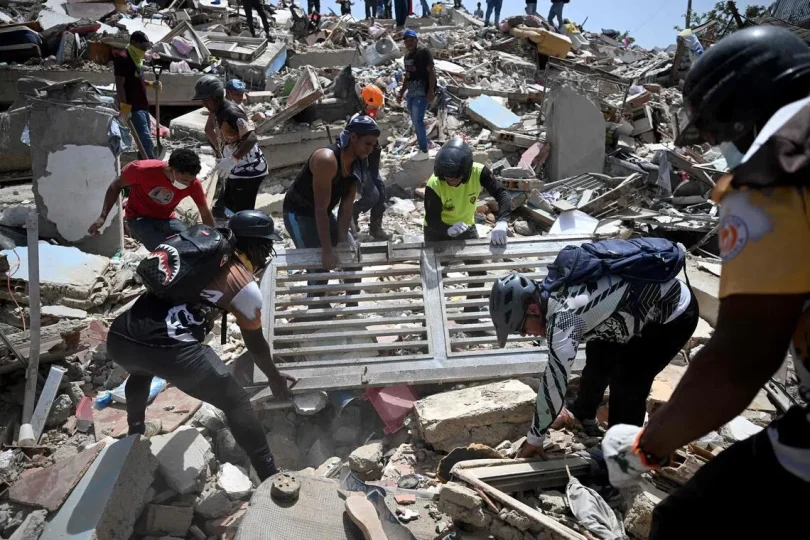
But the search for survivors saw desperate attempts by local residents to claw away rubble from apartment buildings that collapsed in the June 24 double-quakes.
Volunteers and relatives searching for possible victims amid the rubble of a collapsed building in Caraballeda, La Guaira state, Venezuela, on June 26.
PHOTO: AFP
Experts say the first 72 hours after natural disasters are the key, narrow window for finding the living.
There was joy in the hardest-hit coastal area of La Guaira, north of Caracas, when locals pulled an infant alive from the wreckage on June 26, some 32 hours after the magnitude 7.2 and 7.5 tremors. In one social media video, a man welled up in tears as he held the baby in his arms.
The United Nations’ migration agency said it had examined available population and damage data and had determined that “up to 6.76 million people could be affected,” and would “require emergency shelter, safe water, sanitation and hygiene services, healthcare, protection support and essential relief items.”
National Assembly President Jorge Rodriguez reported on June 27 that 1,430 people were dead and 3,238 injured, while the UN estimated US$6.7 billion in physical damage – equivalent to 6 per cent of Venezuela’s GDP.

Venezuelan rescuers recovering a body from the site of collapsed buildings in Caraballeda, La Guaira state, Venezuela, on June 26.
PHOTO: AFP
UN aid chief Tom Fletcher on June 26 told AFP the death toll could continue to soar, adding that more than 50,000 people were missing.
Venezuelans – already battered by years of a failing economy and the turbulence of the US intervention to topple leader Nicolas Maduro in January – were furious at the government.
Yessica Mendoza was forced to transport her own daughter to a morgue in Caracas after 25-year-old Yesimar Rodriguez and her husband Jhomel Anaya, 26, did not survive the tumbling debris of their home in La Guaira on June 24.
“We were the ones who pulled them out ourselves. No help ever came,” the bereaved mother, 43, told AFP, adding that the couple would be cremated without a wake due to the rapidly advancing decomposition of their bodies.
Some Caracas residents jeered Delcy Rodriguez as she visited a destroyed neighbourhood on June 26.
“The government isn’t doing anything for the people,” residents yelled from behind cordons next to a pulverised building.
The government restricted access to La Guaira state on June 26, also announcing a military deployment to the disaster zone.
Rodriguez said she had spoken with US President Donald Trump and Secretary of State Marco Rubio, who “reaffirmed their commitment to supporting the response efforts.”
The US said earlier it was sending a disaster response team of more than 250 personnel, including three special search-and-rescue units with dogs trained to locate people trapped beneath the rubble.

A Virginia Task Force 1 urban search and rescue team travelling to Venezuela aboard a US Air Force C-17 Globemaster III, on June 26.
PHOTO: VIA REUTERS
Venezuela’s worst earthquake in more than a century has come after the oil-rich country endured more than a decade of economic collapse.
The crisis has hollowed out hospitals and public services, driving millions to leave the country.
And the country is still in a fragile political transition six months after the US ouster of Maduro.
“Even before the earthquakes, millions of people across Venezuela were facing food insecurity, collapsing health services, protection risks, and limited access to basic services,” the UN and other aid agencies said in a statement on June 26.
Earthquakes of similar magnitude claimed more than 200,000 lives in Haiti in January 2010 and 73,000 lives in Kashmir in October 2005.
Those killed in Venezuela included 28 Portuguese nationals, five Spaniards, two Brazilians, seven Chinese nationals, one Chilean and one Italian-Venezuelan.
Venezuela’s northern coast sits on a boundary between the Caribbean and South American tectonic plates, but had not experienced a major quake since 1997. AFP