
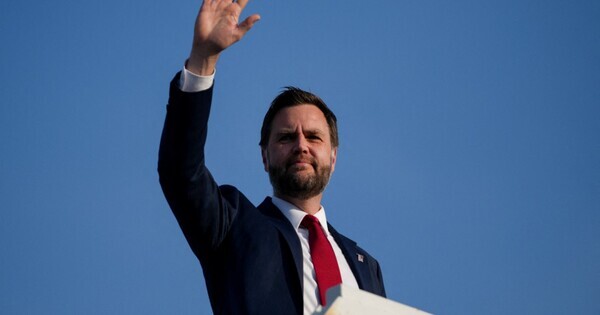
Burgenstock [Switzerland], June 23 (ANI): US Vice President JD Vance on Monday (local time) described the latest round of technical talks between the United States and Iran as part of the 14-point memorandum of understanding (MoU) to end the hostilities in West Asia, in Switzerland, as ‘a very productive 36 hours’, expressing optimism over progress made on maritime security, regional stability and nuclear oversight of the Islamic Republic.
Speaking to reporters ahead of his departure from Switzerland following technical discussions with Iranian representatives, Vance said significant steps had been taken to establish mechanisms aimed at ensuring stability in the region.
‘I feel great about the progress that we made over the last couple of days,’ Vance said.
According to the US Vice President, one of the key outcomes of the talks was an agreement on measures to keep the Strait of Hormuz open and secure.
‘The fundamental things that we got are number one, we set up the mechanism to ensure not only the Straits of Hormuz are open but will stay open. We think about 15 million barrels of oil come out; that’s one of the reasons why oil is so low right now, which also means lower gas prices and gas prices will keep coming down,’ Vance said.
He added that the parties had also established a framework to support a regional ceasefire and manage potential future tensions, particularly on the issue of Israeli strikes on Lebanon.
Vance further stated that Iran had agreed to allow nuclear inspectors into the country, describing the development as a significant breakthrough.
‘Number two, we actually set up the right mechanism to ensure the regional ceasefire to manage the inevitable conflict that might come up,’ he said.
‘We have the Iranians allowing weapons inspectors, nuclear inspectors, into the country for the first time in a long time. We will bolster the inspection so that the regime can never have any nuclear weapons,’ Vance added.
The Vice President noted that technical negotiations would continue, with both sides leaving members of their teams behind to advance discussions.
‘We continue to make progress on these technical negotiations. We have left a lot of our team; the Iranians left a lot of their team. All in all, this has been a very productive 36 hours,’ he said.
Emphasising the need for verification, Vance said the success of any agreement would depend on Iran’s actions rather than its commitments.
‘You can’t trust anybody’s words–you have to trust what they actually do. Letting in the inspectors is a big deal–but again, we’re going to see what they actually let the inspectors do once they’re in the country. That’s going to continually be part of our negotiation,’ he said.
Responding to questions regarding the possible release of frozen Iranian assets, Vance said any decision would depend on continued progress in negotiations.
‘Fundamentally, that money is not going to be unfrozen unless we continue to see progress, and that will obviously be a big part of the negotiation in the days to come,’ he said.
Meanwhile, Switzerland welcomed the developments emerging from the diplomatic exchanges hosted at Burgenstock involving the United States, Iran, Pakistan and Qatar.
In a post on X, the Swiss Ministry of Foreign Affairs said the establishment of a High-Level Committee under a Memorandum of Understanding and an agreed roadmap towards a final agreement within 60 days represented important progress.
‘Switzerland welcomes the constructive progress achieved through the intensive diplomatic exchanges held at the Burgenstock between the United States, Iran, Pakistan and Qatar,’ the ministry said.
The Swiss MFA added that the agreement provides a framework for the next phase of negotiations and enables immediate technical discussions, while reaffirming Switzerland’s readiness to support dialogue, de-escalation, regional stability and peace through its good offices. (ANI)