
Ghanaians and pundits have continued to fume after Tuesday’s goalless World Cup draw against England, with the Black Stars and the country protesting what they believed was a clear late penalty.
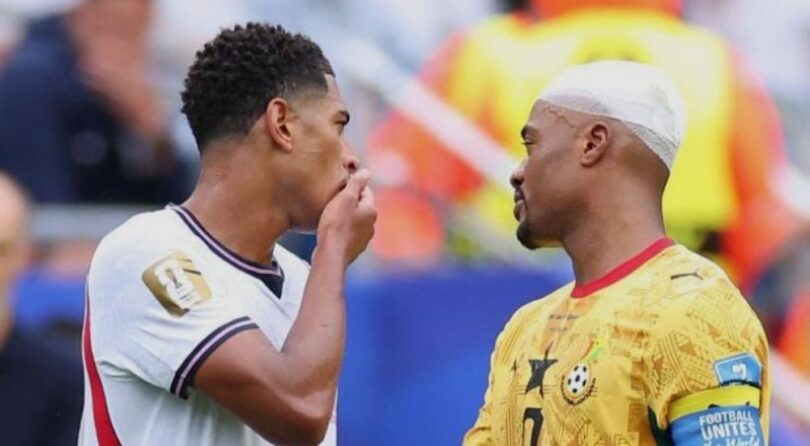
The West African Nation also condemned Jude Bellingham’s escape from a red card when he obviously covered his mouth while speaking with Jordan Ayew.
Although Ghana celebrated a hard-earned point against one of the tournament favourites, coach Carlo Queiroz said after the match that the result should have been more, insisting his side were denied a spot-kick after Prince Kwabena Adu was brought down in the box by England defender Ezri Konsa.
The incident occurred late in the game when Adu surged into the penalty area before Konsa came across and appeared to clip the midfielder.
No penalty was awarded, much to Ghana’s frustration, despite replays suggesting the defender made contact with Adu’s knee and failed to touch the ball.
Queiroz did not hold back in his post-match reaction, openly questioning the effectiveness of the video assistant referee system at the World Cup.
“I’m not sure VAR is still working in the World Cup. We still have VAR? It’s working?” the Ghana manager said after the match.
“I have some doubts about that because another penalty that they need give to Ghana, a clear penalty against England [was missed]. They’re lucky. They’re very lucky.
“It was a clear penalty, red card. You have any doubts about that? You guys who saw the game have any doubts about that or is it only me that was in the game?
“I’m sorry for my sarcasm, but if I say these kind of things seriously they punish me, so I hope you understand that I’m joking.”
The penalty decision quickly became one of the major talking points of the match, with several pundits agreeing that Ghana had a legitimate grievance.
Former England captain Wayne Rooney said on BBC One: “I think that’s a penalty.
“Konsa takes a huge risk. His feet are off the floor when he comes flying in and he gets the man, not the ball.
“That could easily have been given in my view.”
Former England defender Micah Richards also believed the challenge could have resulted in a penalty.
“England were chasing the game, they were trying to score the goal but you still need that protection behind you,” Richards said.
“On another day, that could have been a penalty.”
Former World Cup final assistant referee Darren Cann went even further, saying the challenge should have been referred for review.
“As an England fan I am delighted that it wasn’t given,” Cann said on BBC One.
“But I have to be honest, for me this should have been referred…
“Konsa makes absolutely no contact at all with the ball, he brings down his opponent. He is airborne, he is out of control, he makes contact with the attacker. For me this was a penalty kick.”
The failure to award the spot-kick or send the incident for an on-field review raised fresh questions about VAR standards at the World Cup.
According to reports, FIFA’s head of referees, Pierluigi Collina, has instructed officials to operate with a higher threshold for fouls and VAR intervention during the tournament. The aim is to promote consistency and allow more challenges to stand on the field, which may explain why the Konsa-Adu collision was not reviewed further.
Yet Ghana’s anger was not limited to the penalty claim.
Another controversy erupted after England midfielder Jude Bellingham was seen covering his mouth while speaking to Ghana’s Jordan Ayew, an act that has drawn attention under a new rule introduced for the 2026 World Cup.
Under the law, a player can be sent off for covering his mouth while speaking to an opponent in a confrontational situation. The measure was introduced at the request of FIFA president Gianni Infantino after Benfica winger Gianluca Prestianni was banned by UEFA in February for homophobic conduct toward Real Madrid forward Vinicius Jr during a Champions League match.
Paraguay’s Miguel Almiron became the first player to be sent off under the rule during a weekend game against Turkey after VAR advised the referee to issue a red card.
That precedent prompted questions over why Bellingham was not similarly punished against Ghana.
However, tournament officials have made it clear that the rule does not ban players from covering their mouths in all circumstances. The decisive factor is whether the exchange is confrontational.
Before the tournament, Collina explained that players remain free to cover their mouths in ordinary or friendly conversations.
“Players can continue to cover their mouth with an arm and the shirt because they may chat with friends,” Collina said.
“It’s normal to a chat before, during or after the match.
“So if the conversation is a friendly conversation, they can continue to do it without any problem.
“When the conversation is confrontational, covering the mouth means that you are doing something very wrong, potentially, and the sanction is the red card.”
In Bellingham’s case, there was no sign of animosity between the England midfielder and Ayew, with the pair appearing to be engaged in a routine exchange rather than a heated confrontation. That context is understood to be why VAR did not intervene and no disciplinary action was taken.