The Academic Staff Union of Secondary Schools (ASUSS) has criticised the Federal Government’s now-suspended proposal to increase registration fees for the West African Senior School Certificate Examination (WASSCE) and the National Examinations Council Senior School Certificate Examination (NECO SSCE), insisting that access to education should not be sacrificed in the pursuit of revenue.
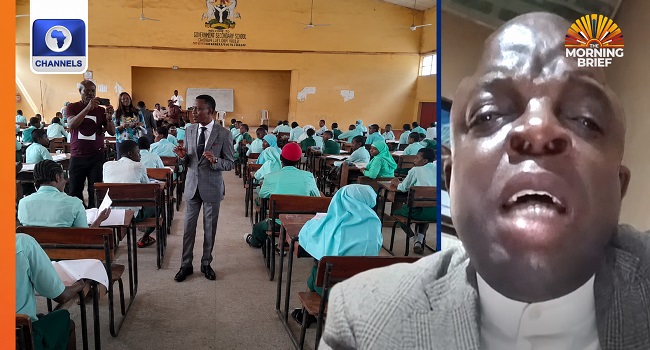
Speaking on Channels Television’s The Morning Brief on Tuesday, Ogun State ASUSS Chairman, Felix Agbesanwa, said policymakers must consider the economic realities facing Nigerian families before introducing measures that could further increase the cost of education.
According to him, while examination bodies such as WAEC and NECO face genuine operational challenges, any decision to raise fees should be implemented with caution and sensitivity to the plight of parents.
“Education should not be a revenue-generating means from the less privileged, though NECO and WAEC serve as internally generated revenue sources for the Ministry of Education. You can’t blame them; they have their own ways of conducting the examinations,” he said.
READ ALSO: FG Suspends Planned WAEC, NECO Fee Hike
Agbesanwa acknowledged the financial demands involved in administering nationwide examinations, including printing question papers, transporting materials across the country, conducting examinations, marking scripts and releasing results within stipulated timelines.
“If we look at the bottlenecks they have to overcome, they print examination questions, conduct examinations, move materials across states, mark papers and release results on time. Nevertheless, there should be a proper process for introducing policies of this nature,” he added.
]]>
His remarks followed the Federal Government’s proposal to increase registration fees for the 2027 WAEC and NECO examinations from N27,000 to N50,000, citing rising costs associated with logistics, security, printing of examination materials, technology deployment and quality assurance.
However, the proposal was suspended on Monday after attracting widespread criticism from parents, students and other stakeholders in the education sector.
Despite recognising the financial pressures on examination bodies, Agbesanwa maintained that increasing examination fees is not a priority Nigerians can afford at this time.
“Even if there is a need to increase WAEC and NECO fees, this is not the right time considering what Nigerian parents are going through,” he said.
He urged authorities to take into account the struggles of families trying to keep their children in school amid rising living costs.
“Think about parents with three children in school who struggle to support them from JSS1 to SS3, or parents who can barely provide food for their children before they leave for school. These are the realities that should be considered when formulating policies,” Agbesanwa said.
He stressed that educational policies must strike a balance between the financial needs of examination bodies and the ability of ordinary Nigerians to access education without additional hardship.