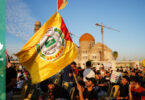
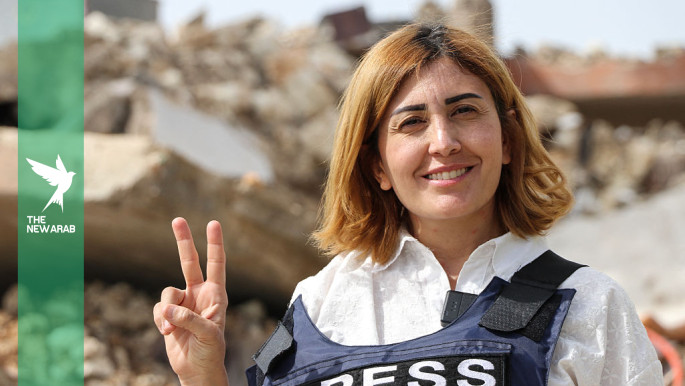
Amal Khalil, a Lebanese journalist known for her reporting and her unmistakable smile, was murdered by Israeli forces on 22 April 2026, after an Israeli strike in southern Lebanon, writes Sara Qudah. [GETTY]
We knew she was alive beneath the rubble — a real, breathing presence. Not in the abstract, not as rumour or hope. The 40-year-old female journalist, Amal Khalil, whose voice had just reached her family and colleagues, her survival depended on whether the machinery of rescue would be allowed to operate as it is supposed to under international law, and the law of humanity.
That is what made what followed so difficult to process—not only emotionally, but structurally. Because this was not a case of disappearance in the fog of war. It was a case of proximity to survival that collapsed into confirmed death while rescue was still theoretically possible.
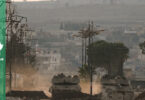
Amal Khalil, a Lebanese journalist known for her reporting and her unmistakable smile, was murdered by Israeli forces on 22 April 2026, after an Israeli strike in southern Lebanon. She had been on assignment with fellow journalist Zeinab Faraj in Al Tayri when the building they were sheltering in was struck, trapping them under rubble.
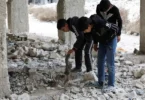
For seven hours, according to multiple reports, her location was known, contact had been made, and rescue efforts were attempted under conditions of active fire and restricted access. The Red Cross eventually reached the site, but only after delays and interruptions that proved fatal for Khalil.
This is where grief alone falls short, and survival remains apparent and unprotected.
International humanitarian law does not leave this question open. Journalists are civilians under Article 79 of Additional Protocol I to the Geneva Conventions. Their protection is not conditional on political alignment, geographic location, or the content of their reporting. It is absolute, unless individuals are actively engaged in hostilities. On paper, this is one of the clearest protections in the laws of war.
But yesterday Israel — once again — confirmed to the world that clarity in law does not guarantee enforcement in practice.
The circumstances surrounding Khalil’s death raise multiple overlapping concerns that can’t be resolved by narrative alone. First, the strike that caused the collapse of the building where journalists were sheltering. Second, the reported prior threats against her, including allegations of a death threat attributed to Israeli forces in 2024. Third, the obstruction and delay of rescue operations under conditions of continued fire prevented timely evacuation despite knowledge of her entrapment.
Each of these elements requires independent investigation. Together, they are closer to a systemic failure of legal protection mechanisms designed precisely to prevent such outcomes.
This distinction matters because if we collapse all civilian deaths in war into inevitability, we remove the legal and moral pressure points that constrain conduct. International humanitarian law is not built on the assumption that civilian harm can be eliminated in war; it focuses on the requirement that harm be limited, that combatants be distinguished from civilians, and that it not be intentionally caused.
The obstruction of rescue efforts is particularly significant here. Under international humanitarian law, parties to conflict have obligations not only to avoid targeting civilians, but to allow and facilitate rapid humanitarian assistance. When ambulances are delayed, when access is conditioned under fire, when rescue teams are forced to withdraw repeatedly, the issue is no longer only about the initial strike—it becomes about whether there is compliance with the continuing duty to preserve life after harm has occurred.
That is a greater duty to preserve life after an attack, and one that is often overlooked in public discourse, which tends to focus on the moment of impact rather than the critical hours after an attack when rescue can save lives.
An overarching pattern – we have seen this before in Gaza, and now in Lebanon.
Press freedom organisations, including the Committee to Protect Journalists (CPJ), have documented an unprecedented number of journalist deaths in multiple conflict zones since October 2023. Israel was responsible for two-thirds of all journalist and media worker killings in 2025, driving the total number killed worldwide last year to a record 130 — the highest ever amount documented by CPJ since the organisation started keeping records more than three decades ago.
When those witnesses are killed, and when investigations are delayed or absent, it is harder to establish accountability, and more difficult for international law to operate on the basis of a verified record. Law depends on documentation. Accountability depends on evidence. And evidence depends on survival.
Which brings us back to Amal Khalil.
Her death can’t be understood only as an individual tragedy, though it is that to everyone who knew her, every journalist in the region, and myself. It must also be understood as a stress test of the systems that are supposed to prevent this outcome — early warning, protection, humanitarian access and accountability. On each of these dimensions, the case raises unresolved questions.
It breaks every one of us to contemplate that her rescue was imminently possible but not realised, and survival was known but not secured; the moral weight of the event shifts. That gap is where accountability either functions or fails.
We had her at the grip of the hand. She was there, alive and trapped beneath the collapsed building, and we knew that. That knowledge is not just a source of grief, it is a record of responsibility. And whether that responsibility is ever properly examined will determine not only how Amal Khalil is remembered, but whether the next journalist trapped beneath rubble is treated as someone still reachable, or already written off by the systems meant to protect them.
Sara Qudah is the Middle East and North Africa Regional Director for the Committee to Protect Journalists (CPJ).
Follow Sara on LinkedIn
Have questions or comments? Email us at: editorial-english@newarab.com
Opinions expressed here are the author’s own, and do not necessarily reflect those of their employer, or of The New Arab and its editorial board or staff.