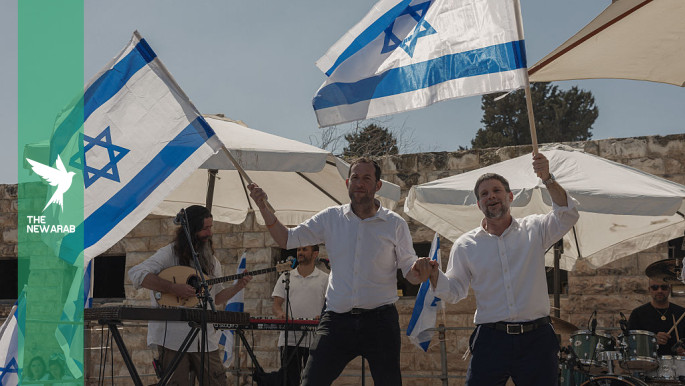
Israeli Finance Minister Bezalel Smotrich (R) and another man raise Israeli flags in the West Bank on April 22, 2026. [GETTY]
Genocide denial frameworks identify recurring strategies: minimising victim numbers, victim-blaming, questioning witnesses, and reframing violence as unavoidable. Contemporary discourse surrounding Gaza reproduces many of these strategies, but also extends beyond classical typologies of denial.
Unlike historical cases of genocide, which relied on reconstructing past events, Gaza has been a battlefield of competing narratives in real time. Instead of withholding information, Israeli and pro-Israeli systems of denial have reinterpreted and reconstructed information as it emerged. Even after major hostilities in Gaza eased in October 2025.
A prominent strategy has been stretching antisemitism into extreme “definitional elasticity”, further blurring the line between true prejudice and dissent. This acts as a discursive deterrent, discouraging scrutiny of Israeli crimes while repositioning Israelis as victims of those subjected to their violence.
However, the broad scale of Israel’s atrocities in Gaza has made this effort unsustainable. In response, Israeli Hasbara and its allies have leaned further into this conceptual elasticity, at times to the point of absurdity.
For example, the US-based Facebook page JewBelong habitually cites antisemitic incidents, for valid reasons, but extends them beyond a reasonable context. One post reads: “Artemis II proves how far we’ve come. Antisemitism proves how far we haven’t.” While the sentiment may resonate, the framing is detached from context.
Another post escalates to overt bravado, a shift from the dominant victim narrative: “If you thought the 10 plagues were bad, wait till you see what happens if you don’t stop f—ing with the Jews,” framed as if spoken on God’s behalf.
Victimhood
Invoking the Shoah intensifies this dynamic, since historical traumas carry immense moral authority. As such, when contemporary criticism of Israel is called antisemitic, it becomes associated with an existential threat, reminiscent of the Jewish genocide. This negates or displaces other contexts, including the killing of nearly 70,000 Palestinians in Gaza and the rapidly growing global disenchantment with Israel.
Elasticising anti-Semitism also allows for even deeper invocation of Israeli-Jewish victimhood, normalising Israel’s war crimes as justifiable, if at all criminal. This operates at four levels: ein breira (no choice) warfare, downplaying Palestinian suffering, victim-blaming, and historical decontextualization.
Ein breira was used by Israel frequently since 1948 to justify military action, framing it as necessary for survival. The mass murder in Gaza is consequently seen as self-defence – an argument that carries strong moral weight and an assumption of broad acceptance.
This worldview obscures the power asymmetry between occupier and occupied. And when convenient, it allows for the re-definition of the occupied as equally capable, such as claiming that “Hamas was trying to commit a genocide against Jews,” which then serves to justify extreme military responses.
For this logic to hold, Palestinians must be dehumanised and their suffering downplayed.
Consider how Israeli media coverage has focused heavily on Hamas targets, military achievements, and hostage narratives, while relegating the high civilian death toll in Gaza to marginal coverage or omitting it altogether.
This has produced what may be described as the individualisation of Israeli victims and the overgeneralisation of Palestinians. Israeli victims are presented with names, faces, and personal stories; Palestinians are reduced to statistics or seen in bulk.
Only humanising Israelis
Israeli media would run multiple stories on the tragic demise of the Bibas family captured in Gaza, with intense focus on their children, baby Kfir and 4-year-old Ariel, as symbols of innocence and “Palestinian cruelty.” Meanwhile, thousands of Palestinian children killed by Israel in Gaza, an average of 28 per day over two years, receive little sustained attention, or are deemed footnotes in “the much bigger – and often tragic – Israeli-Jewish story”.
While in the in-group versus out-group dynamics, empathy prioritises “those who are like us”, it facilitates large-scale moral disengagement and, after 7 October, mass murder of “those who are not like us.”
This dynamic is reinforced by recurring patterns of severely disproportionate Palestinian-versus-Israeli casualties in the Israeli onslaughts on Gaza since 2008, roughly a 1-to-80-100 ratio.
Many Israeli-Jews were conditioned to view the ratio as a measure of human value, which in turn allowed the Gaza genocide to appear as only a needed step-up in the military crackdown on Palestinians.
That said, when Palestinian suffering becomes too visible to hide or convincingly justify, blame deflection is used.
Civilian casualties are/were attributed to Palestinian armed groups, often framed as using “human shields,” implicitly separating them from the society they are part of. Another form of dehumanisation.
Another recurring claim is that “Hamas started the war.” This framing removes historical context, reducing decades of occupation and dispossession to a single starting point: 7 October. Israeli actions are thus presented as reactive rather than part of a longer structural, colonial process.
Invalidating Palestinian suffering
A further strategy in the genocide denial is what may be called a “parallel reality.” This involves not only contesting Palestinian casualty figures but also questioning or dismissing Palestinian lived experience itself as invalid or unreliable.
Reports from the Gaza Health Ministry are dismissed outright, “Hamas-run Ministry,” they say. While testimonial evidence by civilians is frequently depicted as fabrication — sometimes under derogatory labels such as “Pallywood” or “Gazawood.” Images of mutilated children, I was told by an Israeli journalist, are just orchestrated “emotional terror” against Israel.
A more recent example of the parallel reality insertion emerged around the Gaza Marathon in early May 2026. Images of Palestinian youngsters running amidst the ruins of Gaza were picked up by pro-Israel advocacy groups as evidence that the genocide did not occur.
Selective ‘moments of normalcy’ were isolated from the broad Gaza scenery and utilised as a form of narrative inversion. The pro-Israel media watchdog HonestReporting, for instance, implied on 9 May that the scenes of resilience and ‘well-fed people’ contradicted claims of systematic destruction. “The public is being played,” they wrote.
Denial here creates a self-reinforcing interpretive loop in which contradictory evidence is rejected. Within it, Israeli narratives, even when outlandish, are treated as definitive and authoritative, while others are dismissed. Think, for example, of the slogan “free Gaza from Hamas”, which coexists with the reality of prolonged Israeli occupation of that same Gaza.
The parallel reality dynamic extends internationally, too. Supporters of Israel may interpret global criticism as disinformation, irrational hostility, or bias, rather than political dissent. Disagreement itself becomes evidence of prejudice.
As scholar Gregory Stanton, the founder of Genocide Watch, argues, denial frequently operates through claims of bias and bad faith, whereas scrutiny is perceived as political, not evidentiary.
Downplaying the genocide
The final line of defence within this framework is the claim: “If Israel wanted to commit genocide, it could have.” Evidence on the ground is excluded from the accepted reality and brushed aside accordingly. Sure, there isn’t a genocide in Gaza, because – implies reductively HonestReporting – there would not be anyone left to run a marathon there.
Israel could have crippled all those left, goes the suggestion, but it did not. As if genocide is total and absolute, not reductive.
While this dismissal can be psychological and partly unconscious, it is reinforced through a conscious effort, which may be termed “credence imbalance” in media coverage.
First, asymmetrical reporting – particularly in Western media – grants Israelis more airtime, prominence, and humanisation. Language is also selective: Israelis are “killed,” but Palestinians “die”; Israeli sources “say,” but Palestinians “allege”.
The imbalance shows, second, in “context provision”. Israeli actions are explained in terms of security and necessity, while Palestinian experiences are introduced as counterpoints to the Israeli narrative, secondary or reactive.
When media debates Israel’s actions, credence is questioned as “signalling Israel out,” which is perceptually unfair, as Harriet Malinowxtz points out in her book Selling Israel.
These patterns are reinforced by information control. Foreign journalists are largely barred from Gaza unless under Israeli military supervision, allowing ambiguity to function as a resource rather than a limitation.
A final factor in denial is “moral projection through humanitarian rhetoric.” Israel aligns itself with broader struggles beyond Gaza to project moral legitimacy, as if trying to balance out its lost moral argument on Gaza.
As an example, Israel has partly promoted its military actions against Iran as support for the Iranian people against their brutal state. Similar to the claims of “freeing Gaza from Hamas” while bombing its population and restricting aid to them.
This extends to broader claims that Israel is “defending Western civilisation”, according to Netanyahu, aligning its actions with global struggles for dignity and freedom.
Together, these strategies – whether conscious or not – are yet to yield fruit, being overshadowed by the evidentiary weight of the Gaza genocide.
The strategies, therefore, mainly benefit Jewish Israelis’ righteous self-image while fighting a terrifying cognitive dissonance that may shatter their belief system.
It is denial that has evolved from reaction to adaptation.
Dr Emad Moussa is a Palestinian-British researcher and writer specialising in the political psychology of intergroup and conflict dynamics, focusing on MENA with a special interest in Israel/Palestine. He has a background in human rights and journalism, and is currently a frequent contributor to multiple academic and media outlets, in addition to being a consultant for a US-based think tank.
Follow him on Twitter: @emadmoussa
Have questions or comments? Email us at: editorial-english@newarab.com
Opinions expressed in this article remain those of the author and do not necessarily represent those of The New Arab, its editorial board or staff.