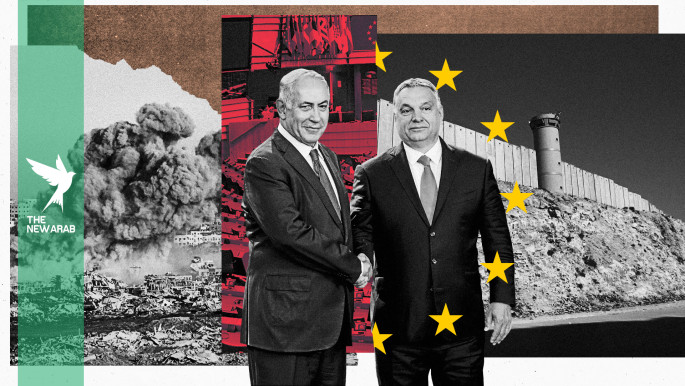
On 12 April, Viktor Orban’s sixteen-year grip on power ended in a landslide electoral defeat that carries consequences far beyond Budapest.
While Orban’s defeat was framed primarily as a domestic mandate against corruption and authoritarianism, it also reflects the loss of the Israeli government’s most reliable populist anchor in Europe.
Israeli Prime Minister Benjamin Netanyahu was one of the few Israeli politicians to cultivate ties with Orban during his years in opposition. As a result, Netanyahu secured a critical EU ally, as Orban used Budapest’s power to veto EU decisions in support of Israel, effectively acting as what commentators described as an “EU Firewall”.
In return, the Orban-Netanyahu alignment helped Budapest gain further favours within Washington during Donald Trump’s first presidential term, creating a form of “illiberal obstructionism”.
Orban’s record in shielding Israel is extensive. In February 2024, his government blocked two EU consensus statements calling for a humanitarian pause ahead of Israel’s planned assault on Rafah, while all other twenty-six member states backed these statements.
In July 2025, Hungary led opposition, alongside Germany and the Czech Republic, to a suspension of the EU-Israel Association Agreement. And in April 2025, Orban made Budapest the first European capital to welcome Netanyahu after the International Criminal Court (ICC) issued its arrest warrant for the Israeli PM.
Under Orban’s leadership, Hungary also worked hard to dilute critical language of Israeli settlement expansion and de facto annexation of the West Bank.
Observers have noted that Hungary’s objections to EU measures had a chilling effect on EU ministers’ appetite to condemn Israel, since the negative image of a visibly divided EU discouraged them from attempting statements Budapest would block.
That dynamic, however, may now be shifting with Orban’s departure.
“Orban’s defeat is a setback for illiberal obstructionism, not its end,” Alberto Alemanno, Jean Monnet Professor in European Union Law at HEC Paris, told The New Arab.
“Netanyahu is already reaching out to other populist hard right actors to keep a voice within EUCO, especially now that Spain is calling for a suspension of the EU-Israeli agreement.”
What changes and what doesn’t
So far, Orban’s successor, Peter Magyar, has signalled continued ambiguity. On 20 April, he pledged to rejoin the ICC and signalled that his government would arrest Netanyahu if he entered Hungary, signalling a pivot from Budapest’s past policy.
Arguably, this could spell trouble for Netanyahu’s increasingly unpopular government rather than broader EU-Israel ties, since Magyar insisted Israel is a “key economic partner” and suggested Budapest would oppose EU proposals to sanction Israel.
While Orban’s defeat removes a key “EU firewall”, it would be premature to expect his departure alone to automatically open the floodgates for EU action on Israel.
“I don’t think the fall of Orban will lead to an immediate change in EU policy towards Israel, because it still has other countries more or less on its side (though perhaps not to the extent of inviting Netanyahu to visit and defying the ICC),” Ian Bond, Deputy Director of the European Centre for Reform and former senior British diplomat, told The New Arab.
Indeed, Germany has been consistently reluctant to support sanctions on Israel and was widely perceived as using Hungary’s veto as diplomatic cover, letting Budapest take the political heat for positions Berlin supported.
The Czech Republic, particularly under its new prime minister, Andrej Babiš, who is a close Orbán ally, has joined Hungary in blocking sanctions on settlers and in opposing critical UN resolutions.
Austria has taken similar positions. The absence of Hungary’s veto may simply expose these other fault lines more clearly.
Israel’s far-right strategy in Europe
From Israel’s perspective, as support from mainstream centrist European parties dwindled, the populist right had emerged as the key counterbalance consistently willing to back Tel Aviv. Specifically, Netanyahu’s government has spent years deliberately and strategically cultivating these ties across Europe.
It is often considered an unholy alliance built on mutual Islamophobia, anti-migrant politics, and a ‘clash of civilisations’ narrative presenting Israel as a Western outpost defending ‘Western civilisation’ against what much of the European far right calls the threat of Islam.
What was once an under-the-table relationship has recently become formal.
In February 2025, Netanyahu’s Likud party was granted observer status in Patriots for Europe, the third-largest bloc in the European Parliament, which includes Orban’s Fidesz, Marine Le Pen’s National Rally, Geert Wilders’s Party for Freedom, Spain’s Vox, and Italy’s Lega. Likud was the first non-European party to join in any capacity.
At the same time, Israeli Foreign Minister Gideon Sa’ar instructed diplomats to establish formal contacts with the National Rally, Vox, and the Sweden Democrats.
“Some of these parties have bad roots,” he acknowledged, “but we look at their deeds in practice today”.
Netanyahu remains committed to this populist strategy. On 16 April, Israel’s ambassador to France, Joshua Zarka, held the first-ever official meeting with Marine Le Pen at the Israeli Embassy in Paris. The discreet meeting reflects Israel’s continued pivot to certain European nationalist parties even after Orban’s departure.
There is a deeper irony that Orban’s defeat brings into sharper focus.
Israel has embraced parties whose antisemitic roots sit awkwardly alongside its own invocations of antisemitism. Orban’s political campaigns repeatedly trafficked in imagery targeting George Soros, who is often crudely linked to tropes of Jewish control of financial and political institutions.
The AfD, which Israel has praised, is officially classified by Germany’s domestic intelligence agency as a “confirmed right-wing extremist endeavour,” with members accused of downplaying Nazi crimes.
The Austrian Freedom Party’s founders included former SS members, even as it has taken a staunchly pro-Israel stance.
Netanyahu’s government has not just decided that the diplomatic utility outweighs the contradictions; his coalition shares the same nationalist impulses that drive them.
The current Israeli coalition, which includes the far-right Religious Zionist Party and Jewish Power (Otzma Yehudit) alongside Likud, has found more ideological kinship with Europe’s nationalist right than with its traditional centre-right partners.
Yet those ties which Netanyahu has built leave long-term vulnerability for Israel’s far-right coalition government. If the success of these European movements wanes, Israel’s coalition partners may burn bridges and find themselves diplomatically isolated.
That vulnerability is already visible. On 14 April, German Chancellor Friedrich Merz, a staunch supporter of Israel, clashed with Finance Minister and Religious Zionist Party leader Bezalel Smotrich after Merz warned against the de facto annexation of the West Bank and condemned settler violence.
In return, Smotrich, a staunch supporter of annexing the West Bank, said Merz should “bow his head and apologise a thousand times on behalf of Germany” instead of “preaching morality”.
The Iran war throws a curveball
Critically, the Iran war has appeared to change the dynamics. While much of the far right was willing to turn a blind eye to Israel’s destruction of Gaza and even supported its atrocities in many instances, the economic shocks of the Iran war have proven uncomfortable for many of these factions.
“Netanyahu has made it even unpalatable for right-wing populists to side openly with Israel without experiencing a backlash. Netanyahu has willingly sacrificed Israel’s standing in the West for his own political survival,” Andreas Krieg, associate professor at King’s College London, told The New Arab.
Dr Krieg added that due to global economic stability from the war Netanyahu has supported, it’ll be less appealing for the RN or AfD to continue justifying support for Israel.
“The notion that Israel is able to drag the world into wars that are extremely unpopular in Europe makes Israel currently a difficult pill to swallow even for the far right, who have turned a blind eye to Israeli atrocities in Gaza and elsewhere,” he said.
“The narrative of the ‘common enemy of Islam’ is not strong enough to bond unlikely bedfellows together, when European prosperity is affected.”
In Italy, Meloni suffered a significant defeat in a constitutional referendum in late March, with 54% of voters rejecting her judicial reforms in a vote widely interpreted as a referendum on her leadership.
Analysts linked the loss in part to growing Italian discomfort with Meloni’s close alignment with Trump and the economic fallout from the US-Israeli war with Iran, particularly the closure of the Strait of Hormuz, which has hit Italy’s energy-dependent economy harder than almost any other European state.
“I think Israel is meeting more criticism in Europe, including from traditional friends like Germany,” said Ian Bond.
“Netanyahu’s close alignment with Trump is also damaging Israel’s standing: even populist parties in Europe are trying to put some distance between themselves and Trump, and that may have an impact on how vocal they feel they can be in their support for Trump’s closest international ally.”
While a string of electoral setbacks for leaders like Orban and Meloni suggests the far right’s momentum is stalling, particularly where geopolitical alignments have incurred visible economic costs, the movement remains a formidable force.
Despite local losses in France and Slovenia, the AfD’s resilience and National Rally’s record polling ahead of 2027 indicate that the European status quo is merely entering a more volatile phase.
The defeat of Orban will certainly test broader support for Israel. Spain, with support from Ireland, Slovenia and Belgium, is pushing for a suspension of the Association Agreement, the cornerstone of Israel-EU trade, political dialogue and cooperation across various sectors.
However, Germany’s stated opposition to the Agreement’s suspension shows that the fundamental EU support for Israel remains strong for now.
Still, the removal of Orban’s automatic veto recalibrates the calculus for member states like Germany, which may now face direct pressure to defend their own positions rather than sheltering behind Budapest’s obstructionism
Ultimately, Netanyahu’s strategy of substituting mainstream European support with far-right alignments, which is proving less durable than anticipated, is reaching a point of fragility.
As his own coalition ministers alienate centrist politicians, and his populist allies face electoral headwinds fuelled by the economic fallout of the Iran war, the viability of this pivot is being tested to its limit.
Jonathan Fenton-Harvey is a journalist and researcher who focuses on conflict, geopolitics, and humanitarian issues in the Middle East and North Africa
Follow him on Twitter: @jfentonharvey
Edited by Charlie Hoyle