Former Israeli prime minister Ariel Sharon, when asked to explain the apparent about-face that led him to advocate the unilateral withdrawal from the Gaza Strip, quoted a beloved Israeli pop ballad. “What you can see from there, you can’t see from here,” he said, referring to the shift in perspective he had supposedly undergone since coming to power.
Although the 2005 Gaza disengagement was perhaps less a change of heart than one of strategy, as his senior adviser later admitted, the lyric became a byword of Israeli politics, an oft-cited reminder that perspective is everything.
Israeli-born Holocaust historian Omer Bartov invoked the same line when he was asked how he had come to view Israel’s ferocious assault on Gaza as a genocide. Living in the US, where he has spent more than three decades, he said, had given him the necessary distance to see the annihilation of Gaza for what it was. “I think it’s very hard to be dispassionate when you’re there,” he said.
Bartov did more than simply apply the word genocide to Israel’s actions: he shouted it from the establishment-media rooftops, making the case in a lengthy July 2025 essay in the New York Times titled: I’m a Genocide Scholar. I Know It When I See It. (He had addressed some of the arguments in a Guardian essay the year prior.) Bartov’s declaration cost him several close relationships, he told me, even though subsequent events have not only validated his analysis but further demonstrated the lack of concern for Palestinian suffering that has become prevalent in Israeli society.
His new book, Israel: What Went Wrong?, is an attempt to explain that indifference. The book, which was published on Tuesday by Farrar, Straus and Giroux, is a detailed account of how Israel was transformed from a hopeful nation that in its founding document promised “complete equality of social and political rights to all its citizens irrespective of religion, race or sex” into one intent on what he bluntly terms “settler colonialism and ethno-nationalism”.
The Brown University professor, who teaches a popular course on the Holocaust and the Nakba, is hardly a disinterested observer. Both his parents were devoted Zionists who fought in the 1948 war, and Bartov himself spent four years in the IDF, serving in the West Bank, northern Sinai and Gaza, ultimately commanding an infantry company. He went on to earn a doctorate in history at Oxford, becoming a highly regarded genocide scholar.
Bartov has spent decades researching the second world war, antisemitism, Nazi indoctrination and historical amnesia, and has published 10 books about the Holocaust. So he speaks with considerable authority when he deplores the way the memory of the Shoah has been has been instrumentalized for political purposes, becoming “a vast fig leaf”, as he puts it in the book: “its lamentable effect to combine self-victimization and self-pity with self-righteousness, hubris, and the euphoria of power”.
Bartov’s goal is not, of course, to minimize the horrors of the Nazi extermination campaign but to demonstrate the ways in which this trauma has been exploited to shape the Israeli psyche and political ideology. Though Zionism predates the Holocaust by decades, it was the murder of 6 million Jews that turned it from a pipe dream into a viable political project – one that has always combined two key strands, Bartov said. “One is a settler-colonial, ethno-national movement, and the other is the liberation and emancipation and rescue of a persecuted minority.” If the Jews had had a state of their own, the case went, they would have escaped this unspeakable horror, he said, “and this was not an entirely vacuous argument”.
The problem arose, from his perspective, after Israel declared its independence in 1948. “When the state decides that it’s not going to be a normal state, it’s not going to have a constitution, it’s not going to define its borders, it’s not going to try and have a normal relationship with its own Palestinian citizens, it’s not going to at least try and make a gesture of compensation and reconciliation with the people that it evicted – when it does that, then its nature changes,” he said.
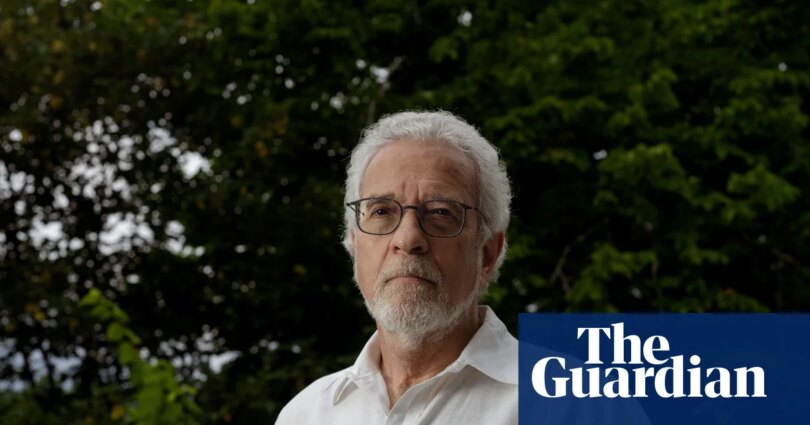
Speaking on a video call from his home in Providence, Bartov is reserved and unassuming, his white hair and scholarly demeanor offering a sober counterpoint to his fitted black T-shirt and stylish gray hoodie. Bartov’s insistence that Zionism, as originally conceived, was essentially a movement of liberation helps explain his refusal to identify as an anti-Zionist. “I don’t even know what that means,” he said, emphasizing that he believes that Jews have a right to self-determination as long as they don’t “trample over other people’s rights”. Accordingly, he does declare himself “completely, vehemently opposed to the kind of Zionism that exists today in Israel”.
Bartov is well aware that for Palestinians and their supporters, his critique won’t go nearly far enough. Writing in the Journal of Genocide Studies, human rights law professor Sonia Boulos accused Bartov and others of “deploying the term genocide in a manner that seeks to blunt its force”, in part by analyzing it apart from the broader colonization of Palestine since 1948. In the eyes of such observers, “what went wrong” is no great mystery: western imperial powers unleashed a settler-colonial project that aimed from its inception to “eliminate, uproot, murder the Palestinians”, as he put it in summarizing the narrative. He rejects this characterization as overly simplistic and insufficiently attuned to the aspirations of Europe’s Jewish refugees, but nonetheless allows: “It is what [Zionism] became.”
Precisely how it did so – and how things might have been otherwise – is the focus of the book. Much of What Went Wrong? focuses on what Bartov frames as the original sin of Israel’s founding, the resistance to granting meaningful legal weight to the lofty words contained in the nation’s declaration of independence, coupled with the founders’ subsequent failure to adopt a national constitution and bill of rights. Had Israel’s first prime minister, David Ben-Gurion, pushed for either approach, Bartov argues, the nascent state might well have grown into the kind of liberal democracy it has, however speciously, long proclaimed itself to be.
Despite his condemnation of present-day Israeli society, Bartov does see a narrow path toward the nation’s peaceful coexistence with its neighbors. A section of the book is devoted to the confederation plan championed by a group of Israeli and Palestinian intellectuals called A Land for All – a version of which was originally considered by the United Nations in 1947. Under this scheme, sovereign and independent Palestinian and Jewish states would exist side by side, divided roughly along pre-1967 borders. Citizens of both entities would be allowed to live and travel freely throughout the combined territory, but would vote only in their own national elections – not unlike the way an Italian, for example, can live and work anywhere in the European Union while voting in Italy.
Bartov acknowledged that the idea seems far-fetched as corpses are still being dug from the rubble of Gaza and Israel is prosecuting yet another bloody war. But what he sees as the nation’s preference for military confrontation over diplomacy depends entirely on American support, he pointed out, and that patronage is now being tested as never before. As a result of the Gaza genocide, a clear majority of Democratic voters now have a negative view of Israel. More recently, the ill-conceived US-Israeli aggression against Iran has significantly eroded GOP support. “Maga is becoming anti-Israel,” Bartov said, due to “Netanyahu completely leading Trump by the nose into a completely idiotic war”.
Despite some alarming strains of ethnic bias underlying the perception of wealthy and powerful Jewish interests manipulating the US government, pointing out antisemitism has lost effectiveness, in part because the influence of pro-Israel donors on US politics – and Israel’s campaign to convince the US to wage war on Iran – is undeniable. Additionally, the charge of antisemitism has grown hollow, Bartov said, due its flagrant “weaponization” as “a tool to shut people up” as the state wreaks destruction on its neighbors. “Having claimed to be the definitive answer to antisemitism,” he writes in What Went Wrong?, “Israel is now the best excuse for antisemites everywhere, a nation whose addiction to violence and oppression, reliance on great powers and financial clout, and constant harping on the horrors of the Holocaust as an excuse for untethered violence against Palestinians are making even some of its erstwhile supporters shrink from it in discomfort, or horror and disgust.”
As a result, America’s indulgence of its longstanding Middle East ally may at last be reaching its limits. Should the United States withhold military support – as is advocated by growing numbers of Democratic policymakers – “Israel will have to go through a process of coming to terms with itself,” Bartov predicted. Under such circumstances, the country would have no choice but to pursue diplomacy. Ironically, that might be the so-called Jewish state’s best hope for a peaceful and prosperous future.
Bartov last visited Israel, where his son and grandchildren still live, in December of 2024. It wasn’t a pleasant trip. “It was hard even just to sit in a cafe,” he recalled. “People were sitting around, having fun, living a normal life, while there was genocide happening down the road. And I just couldn’t take that, because when you’re there, you’re complicit. You can’t help it. It doesn’t matter what you think.”
His outspokenness has come with a price. Many of his best friends are in Israel – “at least they were my best friends until recently”, he said. “I don’t know now. So there’s also a personal sorrow here. Because I’m now into my 70s and it’s nice to have some old friends, but I may have pissed off many of them.”
Bartov’s new book is coming out in “nine or 10” languages, he said, but Hebrew is not among them. Though he offered to translate it himself, he says even left-leaning Israeli publishers took a pass. “I think they felt offended because I don’t have a particularly good opinion of the so-called Israeli left, and I write about it,” he said. “They feel that I’m this Israeli living in America in an air-conditioned room, as they say, sipping espresso, while they’re suffering.”
They may have a point. Then again, if the Israeli public isn’t able to read Bartov, how else can they hope to see from there what he has come to see so clearly from here?