
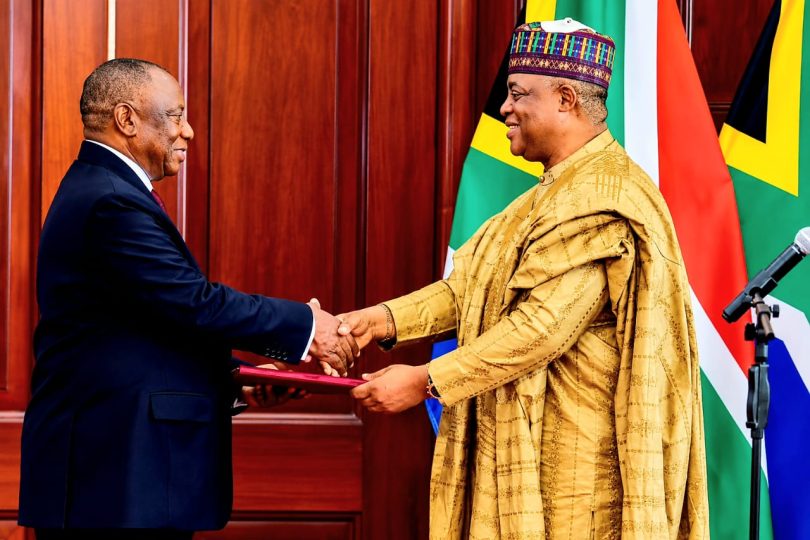
There are moments in the life of a nation when history must be summoned, not merely to remind the present generation of the sacrifices of those who came before them, but to interrogate the contradictions of contemporary conduct. The unfolding conversation around xenophobic hostility in South Africa presents precisely such a moment. It also provides an opportunity to revisit the historical relationship between Nigeria and South Africa, particularly the extraordinary role Nigeria played in the struggle against the horrific, atrocious, and horrendous apartheid that bedeviled that southern part of the African continent. It is against this historical backdrop that the recent intervention by Nigeria’s emissary to South Africa, Ambassador Chief Femi Fani-Kayode, deserves serious consideration.
Speaking in Pretoria on November 9, 2026, Ambassador Fani-Kayode expressed concern over the growing hostility directed at Nigerians and other African nationals in South Africa. His remarks brought renewed attention to an uncomfortable contradiction. Worrisome is how a country whose liberation struggle attracted enormous solidarity and empathy from across the African continent become a theatre of hostility against fellow Africans seeking legitimate opportunities within its borders. For the life of this litterateur, I would have argued the possibility of what fellow Africans now witness and experience in the hands of their fellow African brothers and sisters. To appreciate the enormity of this contradiction, one must first revisit history.
Nigeria was not a passive spectator during South Africa’s darkest political experience. She was an active participant in the struggle for liberation, committing diplomatic influence, financial resources, educational opportunities and human capital to the dismantling of apartheid. Pointedly, under the leadership of General Murtala Ramat Mohammed, Nigeria assumed an unmistakably assertive position in the campaign against racial oppression in Southern Africa. The establishment of the Southern African Relief Fund in 1976 represented a practical demonstration of Nigeria’s commitment to the liberation of oppressed African populations. These contributions went considerably beyond diplomatic statements and political declarations. South African students found educational opportunities in Nigerian institutions. Exiled freedom fighters received support and hospitality. Nigerian civil servants contributed through what became popularly known as the Mandela Tax, a voluntary salary deduction designed to support the anti-apartheid struggle.
These were not inconsequential gestures. They represented tangible sacrifices by a country whose government and ordinary citizens understood that the liberation of South Africa was inseparable from the broader aspiration for an emancipated African continent. Indeed, in his address to Nigeria’s National Assembly in March 2016, former South African President Jacob Zuma expressly acknowledged Nigeria’s historic contributions, describing the country’s support as a special chapter in the history of Africa’s liberation.
That acknowledgement is important because it establishes that Nigeria’s contribution is not merely a product of national nostalgia or retrospective political embellishment. It is part of South Africa’s own officially acknowledged history.
THE CONTRADICTION OF AFRICAN SOLIDARITY
This is where the present circumstances become particularly troubling. South Africa’s emergence from apartheid was celebrated as a triumph of human dignity over institutionalised discrimination. The images of Nelson Mandela’s inauguration, the dismantling of racial segregation and the emergence of a democratic South Africa inspired generations across the continent.
Yet, recurring incidents of xenophobic violence and hostility against foreign nationals have exposed a troubling contradiction in the country’s post-apartheid experience. The issue is not whether South Africa has the sovereign right to regulate immigration, enforce its laws or address criminality within its borders. Every responsible government possesses such obligations.
The issue is the distinction between legitimate law enforcement and the collective persecution of people because of their nationality. Criminality must be addressed through established legal institutions. Immigration concerns must be handled through lawful administrative procedures. Neither can justify mob violence, intimidation, destruction of businesses or the indiscriminate vilification of entire nationalities.
Equally important, criticism of xenophobic conduct must not degenerate into hostility towards South Africans collectively. The perpetrators of violence must be distinguished from the millions of South Africans who reject such behaviour. African solidarity cannot survive on historical sentiment alone. It requires contemporary commitment, mutual respect and a demonstrable willingness to protect the dignity of fellow Africans.
FANI-KAYODE AND THE RESPONSIBILITY OF DIPLOMATIC CANDOUR
It is within this context that Ambassador Fani-Kayode’s intervention assumes its significance. An ambassador or high commissioner is not appointed merely to occupy an office, attend diplomatic receptions and exchange pleasantries with officials of the host country. The office carries a fundamental responsibility to represent national interests, protect citizens and communicate legitimate concerns through the appropriate diplomatic channels.
The Ifè-born chief has publicly identified the protection of Nigerians in South Africa as a foremost priority of his assignment. He has also acknowledged the dissatisfaction within sections of Nigeria’s political and business communities over developments in the country, while cautioning against allowing disagreements to destroy the longstanding relationship between both nations. There is an important balance to be maintained here.
Diplomatic effectiveness requires firmness, restraint and an appreciation of established protocols. The Vienna Convention on Diplomatic Relations provides the framework within which diplomats are expected to conduct their responsibilities. Equally, diplomatic protocol should not become an excuse for avoiding difficult conversations or diminishing legitimate national concerns.
The recent disagreement surrounding the livestream of his November 13 presentation of credentials to President Cyril Ramaphosa has also attracted considerable attention. Ambassador Fani-Kayode alleged that his delegation and address were excluded from the broadcast, while South African officials disputed aspects of his account and subsequently raised concerns about his public handling of the disagreement.
That controversy deserves to be assessed separately from the substantive question of xenophobia. Both national dignity and diplomatic procedure matter. One does not necessarily cancel out the other. Nevertheless, the larger question remains how should a Nigerian representative respond when the safety, dignity and legitimate interests of Nigerians abroad become subjects of public concern? It is a question that requires neither theatrical nationalism nor diplomatic timidity, but principled engagement. On this, Ambassador Fani-Kayode, in the considered opinion of this penman did not disappoint. As a matter of fact, he deserves all the commendations however teeny-weeny or handsome (in number) they may come.
THE TINUBU LEADERSHIP CONTEXT
Ambassador Fani-Kayode’s diplomatic assignment also brings into focus the broader responsibility of the Tinubu administration in managing Nigeria’s relationship with South Africa. President Bola Ahmed Tinubu approved his posting to South Africa, and the High Commissioner has disclosed that he personally requested the assignment because of his interest in issues affecting Nigerians in the country. This makes the protection of Nigerians, the preservation of bilateral relations and the pursuit of African cooperation important considerations in assessing the work of the Nigerian mission.
The administration’s approach must ultimately be judged by measurable outcomes — the safety of Nigerian nationals, the protection of their businesses and property, effective diplomatic engagement, and the capacity to secure meaningful assurances from Pretoria. There is no contradiction between defending Nigerian citizens and maintaining cordial relations with South Africa. Indeed, a mature foreign policy must be capable of pursuing both objectives simultaneously. Nor should the historical friendship between the two countries be sacrificed on the altar of contemporary disagreements.
Nigeria and South Africa remain important players in continental affairs. Their cooperation has implications for regional stability, economic integration, trade, investment and the wider African development agenda. A disagreement between these two powerful African countries should therefore be approached with the seriousness it deserves, but also with the maturity required to preserve a relationship that predates the establishment of formal diplomatic relations in 1994. This is exactly what underscores Chief Fani-Kayode’s position in that part of the continent.
HISTORY IS A MORAL COMPASS
Ultimately, the unfolding debate is bigger than the Ambassador, bigger than Nigeria and bigger than South Africa. It essentially concerns the kind of continent Africans wish to build and the values upon which their collective future should rest. A continent that once united against apartheid must not become indifferent to discrimination when it assumes a different form. A people who benefited from the generosity and sacrifices of others should understand the importance of extending dignity and protection to fellow Africans.
History is not merely a repository of yesterday’s sacrifices; it is also a moral compass by which today’s conduct must be measured. Nigeria’s contribution to South Africa’s liberation was not an investment in future political indebtedness. It was an expression of African brotherhood and a conviction that no African nation should remain indifferent to the oppression of another. That conviction remains relevant today.
Chief Fani-Kayode’s intervention has consequently reopened an important conversation about the meaning of African solidarity, the responsibilities of diplomatic representation and the imperative of protecting Nigerians wherever they reside. The ultimate test of his assignment will not be the volume of public exchanges or the intensity of diplomatic controversies, but the tangible progress achieved in protecting Nigerians and strengthening relations between both countries.
For Nigeria, the message should remain unmistakable — friendship with South Africa must be preserved, but the dignity and safety of Nigerians and other Africans must never become negotiable. Africa must learn to honour its history not merely by celebrating the sacrifices of yesterday, but by upholding the principles for which those sacrifices were made. This is what Nigeria’s emissary has echoed to Africans in his recent speech, and by extension, to the world.
I stand with Ambassador Chief Femi Fani-Kayode.
Omogbolahan L.A. BABAWALE
Public Affairs Analyst
Life Camp, Abuja