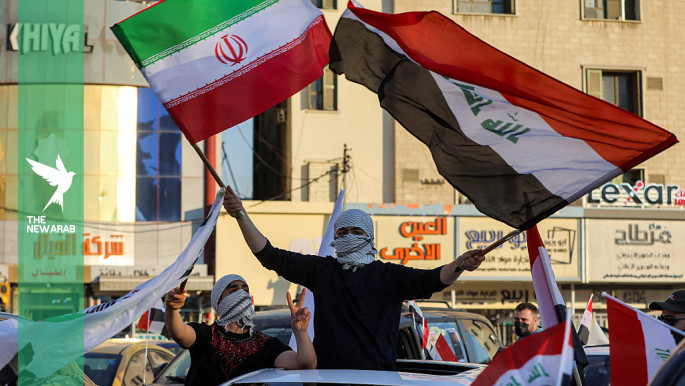
The US State Department issued a multimillion dollar reward for two Iran-aligned Iraqi leaders [Getty]
Two prominent leaders of Iran-aligned armed factions in Iraq, Abu Alaa al-Wala’i and Haider al-Gharawi, have recently come under renewed scrutiny after the United States placed multimillion-dollar bounties on them, accusing their groups of carrying out attacks against American interests in Iraq and Syria.
Washington has offered up to $10 million for information on each man, as part of a broader effort to target figures it says are central to a network of armed groups operating within the so-called “Axis of Resistance” aligned with Iran.
Abu Alaa al-Wala’i
Abu Alaa al-Wala’i, whose real name is Hashim Faniyan Rahim al-Sarraji, is the founder and leader of Kata’ib Sayyid al-Shuhada, an armed faction established in 2013.
Born in Baghdad in 1960, al-Wala’i rose to prominence after the 2003 US-led invasion of Iraq, with his trajectory shaped more by militant activity than formal politics.
His group first gained visibility in Syria, where it fought alongside government forces, before expanding its presence in Iraq during the war against the Islamic State group after 2014.
Kata’ib Sayyid al-Shuhada later became part of the Popular Mobilisation Forces (PMF), an umbrella network of mostly Shia paramilitary groups that was formally integrated into Iraq’s security apparatus.
Despite this official status, the group has maintained its own ideological and operational structure and is widely considered to be closely aligned with Iran’s Islamic Revolutionary Guard Corps (IRGC).
US assessments suggest that al-Wala’i became part of a broader coordination network with Iran-linked factions following the killing of IRGC Quds Force commander Qassem Soleimani in 2020.
Washington accuses the group of involvement in rocket and drone attacks targeting bases hosting US and coalition forces in the region, particularly amid heightened regional tensions since October 2023.
Haider al-Gharawi
Haider al-Gharawi, meanwhile, represents a different trajectory – from local politics to armed mobilisation. Known formally as Haider Muzhir Malik al-Saidi, he hails from the southern province of Maysan and was initially involved in political activity linked to the Sadrist movement.
In 2013, he founded a political entity called “Al-Sidq wal-Ataa”, which performed relatively well in local elections and secured positions within Maysan’s provincial administration. However, the rapid territorial expansion of the Islamic State group that same year marked a turning point.
Al-Gharawi subsequently established Ansar Allah al-Awfiya, an armed faction that also operated under the PMF umbrella. Like Kata’ib Sayyid al-Shuhada, the group evolved from a local militia into a player within a wider network of Iran-aligned factions.
Ansar Allah al-Awfiya has been particularly active in Iraq’s western region, including Anbar province and areas near the Ain al-Asad airbase, and has coordinated operations with other factions such as Kata’ib Hezbollah and Asa’ib Ahl al-Haq. It has also maintained a presence along the Iraqi-Syrian border.
US officials accuse the group of carrying out drone attacks against American targets, some of which have reportedly resulted in casualties among US personnel. In addition, the group has faced domestic accusations related to the suppression of Iraq’s 2019 elections, including alleged involvement in kidnappings and assassinations of activists – claims it denies.
Between state authority and regional alliances
Both al-Wala’i and al-Gharawi are viewed as part of a broader ecosystem of armed actors whose influence straddles the military and political spheres in Iraq. While their factions are formally integrated into the PMF, they retain independent command structures and ideological alignment with Tehran.
Security analysts say their designation by the US reflects not only their alleged operational roles, but also a wider geopolitical contest.
“Al-Wala’i represents a model of faction leaders who possess dual influence – both on the ground and politically”, security expert Kazem al-Issawi told The New Arab. “The PMF structure gives him space to influence security decisions, while political alliances grant him indirect presence in the political process”.
Similarly, analyst Imad al-Fatlawi said al-Gharawi’s inclusion on the wanted list is part of a broader US strategy to dismantle cross-border militant networks.
“Listing al-Gharawi reflects a US approach aimed at undermining leadership roles within these factions”, he told The New Arab. “His importance stems not only from leading a faction, but from being part of a wider operational network that spans borders and operates within complex regional coordination”.
Despite US pressure, both men remain embedded in Iraq’s fragmented power structure, illustrating the blurred lines between state and non-state actors nearly two decades after the fall of Saddam Hussein.