
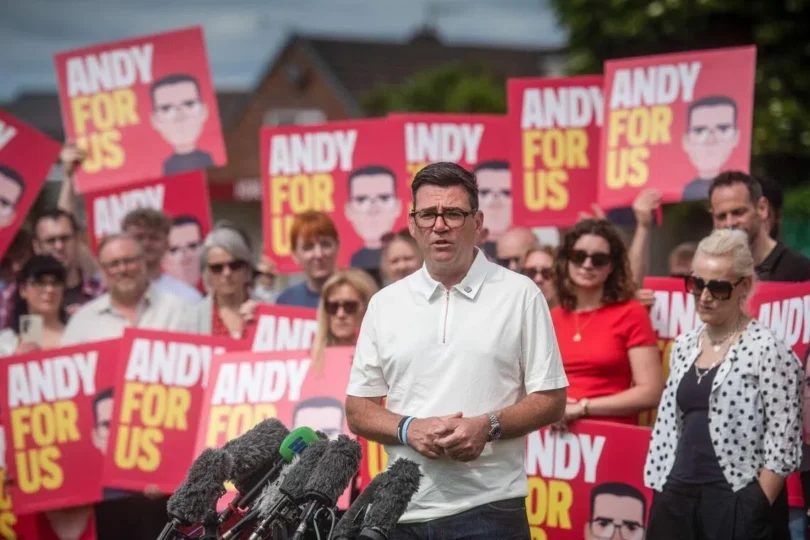
Andy Burnham’s likely ascent to the pinnacle of British politics reflects an aptitude as a politician, orator and organiser that many members of Parliament found lacking in the job’s current occupant, Keir Starmer.
Burnham, 56, a Labour politician and former mayor of Greater Manchester, appears set to succeed Starmer as prime minister after the incumbent announced his resignation on June 22.
Who is Burnham, and what could he actually do to change the trajectory of a country weighed down by economic malaise that will now have had five prime ministers in four years?
Burnham was born in the Liverpool area to a father who was a telephone engineer and a mother who worked as a receptionist. He joined the Labour Party at the age of 15. Burnham studied English at the University of Cambridge, and after graduating he followed a path well-worn by British politicians, working as a researcher in Parliament.
He was first elected to the House of Commons in 2001 and was an adviser and then a minister under then-Prime Minister Tony Blair, voting for the 2003 British military intervention in Iraq alongside the US. His most senior role came as health secretary under Blair’s successor, Gordon Brown, and he subsequently became one of the few top Blair-era officials to work with Jeremy Corbyn, the hard-left leader who has since been ousted from the Labour Party.
Burnham sought the party leadership twice but his previous support for the Iraq invasion hampered his bid on both occasions. Burnham came in a distant second to Corbyn in the second of those contests in 2015, and he stepped down from Parliament in 2017.
He went on to reinvent himself as a champion of England’s northern, working-class population in more than two terms as the mayor of Manchester, one of the Britain’s biggest cities.
During his tenure, the Greater Manchester region has boomed, its economy growing at twice the national rate. Burnham has raised the area’s profile and become a cheerleader for a place whose confidence now contrasts with the national mood. He acquired the nickname “King of the North”, in reference to the TV series Game of Thrones, after he gave a fiery speech criticising the government’s treatment of Manchester during the Covid-19 pandemic. The moniker stuck.
Burnham has spent the past year trying to turn his mayoral record into a blueprint for national renewal. The result is what he calls “Manchesterism” – a political strategy rooted in local control of essential services alongside an optimism he projects in his home region. His signature policy has been an overhaul of the bus transportation system.
Burnham is expected to pursue a more interventionist approach in managing Britain’s underperforming economy.
He has repeatedly said the wealthy should pay more in taxes. He has called for deep reform of struggling social services, proposed a public housing building programme, and backed a £2 (S$3.43) cap on local bus fares.
He advocates bringing Thames Water, the private utility serving much of southern England, under public ownership. Executing these ideas will depend partly on whom Burnham selects as his chancellor of the Exchequer, who oversees tax and spending policy.
Burnham also has urged a “drive of reindustrialisation” across Northern England, and said education should be retooled to direct people toward careers in industry, rather than the current system “dominated by the university route”.
Yet Burnham isn’t a typical leftist progressive. He has suggested cutting welfare spending to pay for an increase in defence outlays. He has backed Home Secretary Shabana Mahmood, arguing her immigration overhaul should go further. And he has been supportive of a Manchester police chief whose opposition to some progressive criminal justice policies has seen him dubbed “anti-woke”.
In 2025, when he was already being sized up as a potential successor to Starmer, Burnham said Britain had to move beyond being “in hock” to the bond markets. Concerned this meant bigger budget deficits and more debt, investors have returned the favour by driving up benchmark bond yields as he edged closer to a challenge against Starmer.
Burnham has said his comments were misunderstood, and he recently moved to reassure investors, committing to current Chancellor of the Exchequer Rachel Reeves’ self-imposed constraints on spending and borrowing. Those require the government to cover day-to-day spending with tax receipts and for debt to be falling as a share of the economy. He also has pledged not to make any exception for defence spending, just weeks after floating the idea in a Bloomberg interview.
The market reaction to any change in the fiscal rules could depend as much on timing and presentation as substance, as well as on Burnham’s chancellor pick. His allies say he has no plans to reappoint Reeves.
Burnham cultivates the image of a man of the people. As Manchester mayor, he was a prominent advocate for northern England and a defender of working-class voters, qualities that have been key to his rise from regional politician to prospective national leader.
In northern English towns, many voters have switched allegiance from Labour to the anti-immigrant Reform UK, the movement founded by Brexit cheerleader Nigel Farage. Reform is widely seen as the biggest threat to Labour at the next general election, which is due by 2029. Burnham’s Labour colleagues generally view him as their best shot at keeping Reform out of power.
Burnham’s supporters, including Britain’s high-profile energy secretary, Ed Miliband, see his past record working with the centrist Blair and with the leftist Corbyn as proof of his pragmatic adaptability. Others say it shows a weakness they also found in Starmer: A lack of the core convictions required to devise and push through a coherent governing project.
Burnham has not denied changing alliances, saying it is because he operates on a party-first basis rather than faction-first one.
Several recent shifts have revived the criticism that Burnham’s flexibility can look like slipperiness. Burnham angered some supporters when he ruled out an attempt to take Britain back into the European Union – something he previously advocated.
Another worry is that Burnham simply will not have the financial breathing room to pursue ambitious plans. Now that his campaign has committed to maintaining the existing self-imposed restraints on spending and borrowing, some Labour figures fear the state of Britain’s economy means Burnham will have little choice but to follow a programme not dissimilar to the man he’s looking to replace. BLOOMBERG