
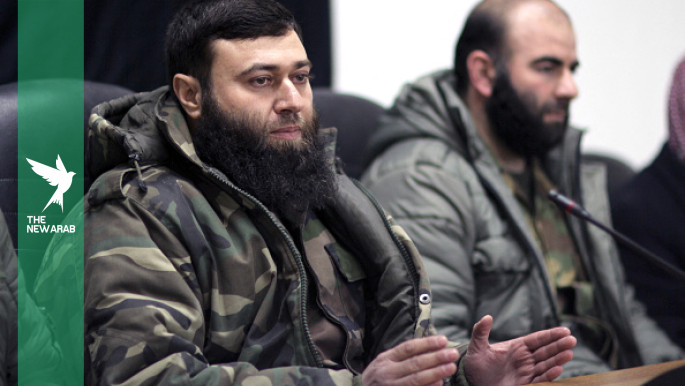
Former Syrian rebel leader Issam Buwaydani was released in April after being detained for nearly a year by the UAE, in a case that drew attention due to his past as head of one of the most powerful Islamist factions in Syria’s civil war.
The New Arab looks into who Buwaydani is and what happened during his detention and release by the UAE.
Who is Issam Buwaydani?
Buwaydani, also known as Abu Hammam al-Buwaydani, is from Douma in eastern Ghouta, the opposition stronghold on the outskirts of Damascus that became a focal point of the war.
He rose through the ranks of Jaish al-Islam, taking up arms against the regime of Bashar al-Assad, eventually taking over leadership in late 2015 following the killing of its influential founder, Zahran Alloush, in an Assad regime airstrike.
Under Buwaydani, the group remained a dominant force in eastern Ghouta, exercising military and administrative control over large parts of the enclave and continuing its fight against Assad and his Iranian and Russian allies.
Following the collapse of the Assad regime in 2024, Buwaydani was incorporated into Syria’s new military structure.
He is now regarded as a prominent figure within the country’s defence establishment and is considered close to the current leadership, reflecting the integration of former rebel commanders into state institutions.
What was Jaish al-Islam?
Jaish al-Islam was a major Islamist rebel faction formed in 2013 through the merger of several armed groups in eastern Ghouta. Led by Zahran Alloush, it quickly became one of the most powerful forces fighting Assad’s army around the capital.
The group was ideologically hardline Islamist and widely reported to have received backing from Saudi Arabia.
It played a central role in the armed opposition in the Damascus area and was involved in some of the fiercest battles of the war.
Jaish al-Islam also faced criticism from human rights organisations and rival factions over its conduct in areas under its control, including allegations of abuses.
Its presence in eastern Ghouta came to an end in 2018, when government forces retook the enclave, and fighters were evacuated under a negotiated deal.
What happened in the UAE?
In April 2025, Buwaydani was detained at Dubai International Airport while on a private visit to the UAE. Though it has not been confirmed, some have speculated he was visiting the state for family reasons.
He was reportedly travelling on a Turkish passport and was arrested while attempting to leave the country.
He remained in detention for nearly a year, with no official explanation provided by Emirati authorities and no public charges announced.
Why was he detained?
The reasons for Buwaydani’s detention were never formally disclosed. However, his background as a senior Islamist rebel leader is widely seen as a key factor.
The UAE has long taken a hardline stance against Islamist movements across the region. As the former leader of Jaish al-Islam, Buwaydani was associated with an Islamist current that Abu Dhabi has consistently opposed.
Why was he released? Where is he now?
Buwaydani has returned to Damascus, where he is understood to have re-joined Syria’s evolving military establishment.
His release may point to a broader recalibration in relations between Syria and the UAE following the fall of Bashar al-Assad. Regional powers are adjusting to the country’s new political order.
Buwaydani’s case involves a senior figure now embedded within Syria’s military apparatus.
It suggests his detention and eventual release were tied not only to his past as a rebel leader, but also to evolving diplomatic ties between Damascus and Abu Dhabi.