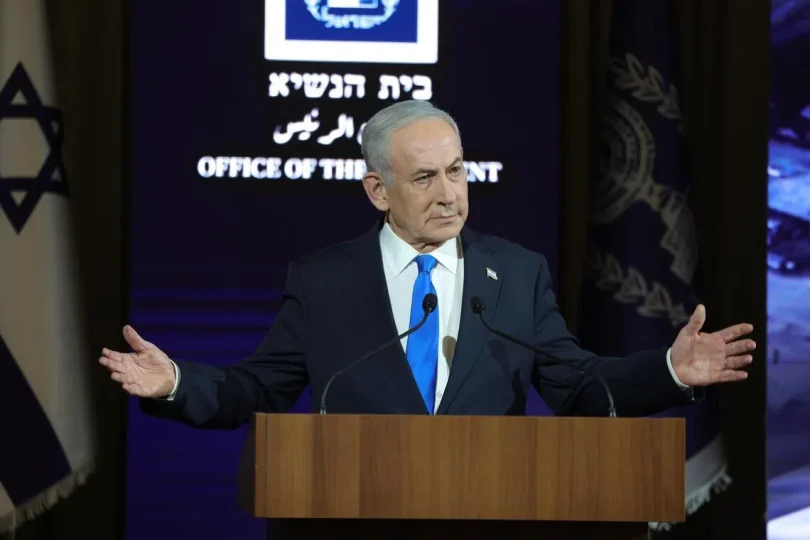
Israel is gearing up for a fall election that will effectively be a referendum on Benjamin Netanyahu, 76, the country’s longest-serving prime minister.
The Knesset adjourned on July 17, and a general election has been set for Oct 27, the latest date permitted by law. That means the upcoming vote will mark the first time in nearly four decades that Israeli elections are held on schedule following a full parliamentary term.
It will be the first national election since the Hamas assault of Oct 7, 2023, the deadliest day in Israel’s history. Netanyahu’s accountability for the security failure and the unresolved regional wars that followed are poised to dominate the campaign, followed closely by the clash between those fighting for a liberal democracy and those pushing for a majoritarian state with a higher level of government control.
How popular is Netanyahu’s government?
Israel has always had coalition governments as no political party has ever won a majority in the 120-seat Knesset. Netanyahu’s Likud joined forces with right-wing and Orthodox Jewish parties after the 2022 election, resulting in the country’s most nationalist, religious Cabinet ever.
The current government, made up of seven parties that together hold 68 seats, has lost popular support since the last election, according to polls. Criticism of it has focused on the failure to prevent the Oct 7 assault; the mounting toll of multifront wars against Hamas in Gaza, the Hezbollah militia in Lebanon, and Iran; and the leadership’s inability to translate military force into long-term stability on any of these fronts.
Public discontent has also been fuelled by the government’s drive to weaken the courts and centralise power. Just days before the Parliament’s election recess, the coalition pushed through a series of controversial laws: perpetuating draft exemptions for ultra-Orthodox men despite warnings of military manpower shortages, stripping the attorney-general’s authority, tightening government control over the media, and expanding options for gender segregation in academia.
Based on an averaging of mainstream media polls in mid-July, the parties in the ruling coalition were on track to secure 51 seats, well short of the 61 needed for a Knesset majority. Netanyahu’s Likud, which currently holds 32 seats, is locked in a tight race with ex-military chief Gadi Eisenkot’s Yashar party for the single largest faction; both are hovering at 20 to 23 seats, according to the polls. Crucially, for the first time, Netanyahu is also trailing in polling on who is most fit to serve as prime minister.
A persistent outlier is Israel’s channel 14, an explicitly right-wing, pro-Netanyahu network that in mid-July projected 63 seats for the coalition bloc compared with just 47 seats for the opposition. The same poll showed 57 per cent support for Netanyahu as prime minister, versus 32 per cent for Eisenkot.
What about the opposition?
The main opposition bloc is a mix of centrist, right- and left-leaning parties that share an antipathy toward Netanyahu. Polls released through mid-July suggested that they could win a combined 59 seats, on average, just short of a majority. Even if they managed to reach the 61-seat threshold, their ideological differences could stifle coherent policy making.
Some of those parties are ideologically closer to Likud but refused to align themselves with Netanyahu after he was indicted in 2019 for alleged bribery, fraud and breach of trust. The prime minister, whose trial is currently underway, denies the charges, calling them part of a witch hunt against him.
The opposition has also accused the government of waging a campaign against law enforcement institutions and the civil service by seeking to concentrate more power in the hands of the executive and of attempting to curb the freedom of the media.
Ten seats in the Knesset are currently held by Israeli Arab parties. Because of their support for an independent Palestinian state and the political climate in Israel following the Oct 7 attacks, opposition parties have expressed reluctance to include them in any coalition government.
If no political leader is able to form a government that enjoys the support of at least 61 Knesset members, a new election will be called.
Who are Netanyahu’s main rivals for prime minister?
Netanyahu has served as prime minister for more than 18 years across three non-consecutive terms, first taking office in 1996. Eisenkot, who has edged ahead in polling on who is better suited to lead the country, could stand between him and a fourth term.
Eisenkot is viewed as a plain-speaking centrist who would not make concessions on security but would respect democratic institutions and forgo the prioritising of religious and nationalist causes. He launched his party, whose name means “straight” or “honest” in Hebrew, in 2025.
Another contender is former Prime Minister Naftali Bennett, who has teamed up with opposition leader Yair Lapid, a centrist, to combine their parties and form Beyachad, meaning “together” in English. Under their pact, Bennett would become prime minister if they manage to form a government. He is a right-leaning, observant Jew, was previously the head of the Yesha Council – the umbrella organisation for Israeli settlements in the West Bank – and objects to a Palestinian state. Beyachad is polling at around 16 to 18 seats, having recently lost some momentum.
What are the main election issues?
Security is at the top of many voters’ list of concerns as Israel continues to grapple with the aftermath of the Oct 7 assault.
Security
Netanyahu’s pitch to the public is that he is still the best person to protect Israel from its enemies. He has dramatically overhauled Israel’s long-standing military doctrine, moving away from a reactive “quiet-for-quiet” stance in which Israel maintained ceasefires until attacked.
Instead, the country has embraced a highly aggressive preemptive strategy rooted in the Talmudic dictum: “If someone comes to kill you, rise up and kill them first.”
This shift is evident in Israel’s recent strikes on Iran, continuous operations to neutralise looming threats in Lebanon despite formal ceasefires, and the swift seizure of a buffer zone in Syria amid the collapse of the previous regime there.
Few, if any, of Netanyahu’s rivals object to that change in strategy, under which Israel has struck five countries in the region and stationed troops inside Lebanon, Syria and Gaza. But they have criticised his failure to deliver the “total victory” promised against Iran and its regional proxies.
Iran has not capitulated; Hamas, while weakened, still dominates the Palestinian-controlled area of Gaza; and Hezbollah militants are still capable of attacking northern Israel from Lebanon. Netanyahu’s rivals blame that mostly on what they describe as his unwillingness to translate military victories into sustainable diplomatic solutions.
The Trump factor
While Netanyahu has played up his relationship with President Donald Trump – calling the US leader “the best friend Israel has ever had in the White House” – his opponents have accused him of being a puppet. Netanyahu’s own national security minister, hardliner Itamar Ben Gvir of the far-right Otzma Yehudit party, has accused him of ceding to US pressure that constrains Israel’s military actions.
Netanyahu and Trump have clashed over the war in Lebanon, where Israel’s push to root out Hezbollah threatened to derail talks aimed at ending the war the US and Israel launched against Iran in February.
Under a US-brokered deal in June, Israel agreed to begin a limited withdrawal from southern Lebanon while maintaining a presence until Hezbollah is disarmed. If Netanyahu were to carry out a more substantial pullback at Trump’s urging, this would fuel accusations that he’s turned Israel into a vassal state.
Israel has been excluded from negotiations that aim to find a permanent resolution to the Iran war. There are concerns that if the US and Iran do eventually reach a peace settlement, this will not fully neutralise the threat that the Islamic Republic poses to Israel.
While Trump has insisted that Iran will never have a nuclear weapon, at one point he suggested that the country should be able to have some ballistic missiles “because some other people have some”. Iran’s support for anti-Israel militias in the region does not appear to be on the negotiating agenda.
Military service exemption
Israel’s Supreme Court ruled in 2024 that the decades-long exemption of ultra-Orthodox Jewish men from mandatory military service was inequitable.
The decision was widely disregarded by Netanyahu’s government as he sought to keep his coalition intact. This angered many Israelis, hundreds of thousands of whom have been called to serve in the reserves as the military has undertaken multiple offensives.
Netanyahu supported a Bill to reinstate the exemption, although it never passed due to public and political backlash. As part of a final legislative blitz before the election, the Knesset passed a law that temporarily suspends the arrest of ultra-Orthodox men who evade the military draft.
A day later, the new law was frozen by the Supreme Court after a petition was filed arguing that the legislation is unconstitutional. In parallel, a Basic Law declaring Torah study a constitutional value was approved, providing a legal justification for a future attempt to again exempt ultra-Orthodox men from military service.
Judicial reforms
Some Israelis believe that their country’s future as a liberal democracy is at stake in this election. Soon after coming into power, Netanyahu’s Cabinet launched an effort to overhaul and weaken the judiciary, prompting unprecedented protests led by business and tech leaders.
After a pause provoked by the war set off by the Oct 7 attacks, the coalition’s campaign resumed.
The government successfully passed laws increasing the role of politicians in both the police watchdog and the judicial selection process while simultaneously expanding the jurisdiction of religious rabbinical courts. Hours before its dissolution, the Knesset approved a Bill stripping the attorney-general of her binding authority, rendering her legal opinions non-binding, and allowing the government to bar her from court whenever her position contradicts that of the cabinet.
Tensions with the judiciary have threatened to spill over into a constitutional crisis. The government has said that it will not respect a Supreme Court ruling to preserve the board of a broadcasting regulator, which it wants to replace with its own appointees.
To that end, the pre-election legislative rush included a law establishing a new regulatory body to be controlled by political appointees wielding licensing and sanctioning powers over independent media. Underscoring the tensions between the judicial and executive branches, this law was also frozen by the Supreme Court in response to a petition arguing that it severely harms freedom of expression and the press.
The economy
In addition to resentments about the ultra-Orthodox who do not serve in the military, there are concerns about the community’s low participation in the labour market. Economists and policymakers have warned of growing fiscal pressure from this expanding demographic’s reliance on state allowances and subsidies.
There are also fears about a “brain drain”. In recent years, there has been a surge in the number of Israelis choosing to leave the country due to concerns about war and political turmoil. Many of them are doctors, workers in the technology industry and other high earners.
Almost 60 per cent of Israel’s exports in 2025 were high-tech products and services, according to the Israel Innovation Authority, and the sector’s employees pay a third of all income tax.
Those seeking a change argue that relying so heavily on military rather than diplomatic solutions is harming the economy. On top of the strain of military spending, workers are repeatedly forced into uniform for reserve duty, and Israel has been turned into a pariah whose products and personnel are increasingly shunned. BLOOMBERG