Data centres at the centre of climate activism
Earlier activists were protesting peacefully against the development of data centres like this rally in Minnesota
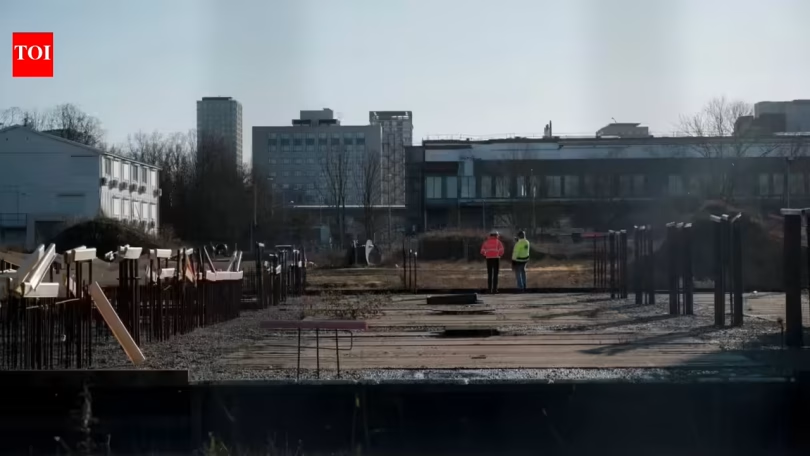
As targets for climate activism go, data centres have come to the front and centre. The facilities underlining the benefits of the AI boom are a major driver of carbon emissions due to their intense energy demand and also cause major problems with local water supplies.In the western port area, British data centre operator Pure DC is building three large data stacks that will be leased to the American tech giant Microsoft. The data centre will be split into three data halls reaching heights of 85m, and will offer 78MW of capacity. Microsoft is set to be a customer of Pure DC in Finland also.According to a report from NRC regarding XR’s attack on the site, Pure DC and emergency responders confirmed balloons were thrown at the site, but Pure DC said that it had no impact on construction and the company would seek legal action against those responsible. “Yesterday morning, balloons were thrown over the perimeter fence of Pure DC’s Amsterdam site which, protestors claim, contained corrosive chemicals. While we have not yet tested the substances to independently verify these claims, if true, these actions could have seriously injured protestors or workers and are irresponsible and dangerous. The Amsterdam Police have been informed and are investigating the matter. On this occasion, there has been no damage, and no delay to construction, but activities of this nature would amount to serious criminal damage, for which we would pursue prosecution to the fullest extent of the law,” said Pure DC in a statement.In the post-action statement, Extinction Rebellion argued that the data centre in question is weaponising a loophole “to circumvent the rules banning so-called ‘hyperscalers,’” and will “consume a gigantic amount of power in an area that already suffers from power shortages.”Along with local concerns around electricity usage and climate impacts, the group also connected their action towards Microsoft, which international rights groups argue played an instrumental role in Israel’s destruction of Gaza. “The climate and ecological crisis cannot be viewed in isolation from Israel’s genocide of the Palestinians or the fight against the destructive effects of AI,” said Martjin Dekker, a spokesperson of the group. “These abuses originate from the same few mega-rich, the same large corporations.”“We must join forces and resist the anti-democratic power of this small group of the very wealthiest,” he added. “Stopping the construction of this data centre is a necessary step in that regard.”
Lawsuits and attacks

Three residents of the village of Sturtevant filed a class-action lawsuit against Microsoft’s data centre in Wisconsin
While this data centre was attacked by activists, Microsoft has been having a hard time with its data centres across the United States. The tech giant’s much-touted $7.3 billion AI data centre in Fairwater, Mount Pleasant, Wisconsin was proudly announced by CEO Satya Nadella as “the world’s most powerful AI data centre.” But as per reports by The Milwaukee Journal Sentinel, three residents of the village of Sturtevant filed a class-action lawsuit against the data centre, alleging that the data centre was emitting “unreasonable and excessive noise onto Plaintiff’s properties, thereby causing property damages through private nuisance and negligence.”The noise being generated by “diesel generators and heating, ventilation and air conditioning (HVAC) systems including chillers, cooling towers, air-handling units and condenser fans” is “consistent and pervasive” as per the lawsuit. The residents claim that Microsoft failed to mitigate the noise through “adequate acoustic barriers, shields or walls.”Not just noise, people have complained of facing water shortages, electricity outages, and many other problems while residing in areas near these data centres that are expected to power the world of AI while destroying the world of humans.As per a report by CBS, the Brown family of Coweta County, Georgia decided to sell their home to Georgia Power, rather than risk seizure by eminent domain. They are one of the likely 300 landowners who will have their property seized so that the for-profit, investor-owned corporation can build a new transmission line to connect new AI data centres. “To us it’s theft,” Browns’ mother told CBS. “It’s literally a billion-dollar company stealing land from smaller people, people who can’t fight back. We don’t have the money to fight Georgia Power.”It seems that with growing AI data centres, tech firms must be ready for opposition, not only from activists but also from landowners and homeowners whose lives are being disrupted with no solution in sight.