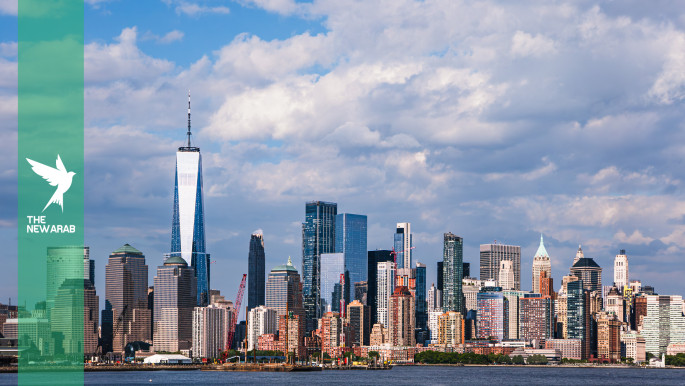
A panoramic view of the New York City skyline with One World Trade Centre rising above Lower Manhattan, seen across the Hudson River [Getty]
A new public artwork in New York City’s historic “Little Syria” district has sparked backlash among Lebanese communities at home and abroad after several renowned poets, including Gibran Khalil Gibran, were described as Syrian rather than Lebanese.
The installation, titled Al-Qalam: Poets in the Park, was unveiled as part of an initiative led by the Washington Street Historical Society in partnership with NYC Parks and other cultural institutions.
The yellow-coloured artwork spells out “Al-Qalam”, Arabic for “the pen”, and was intended to celebrate writers linked to the Arab diaspora and the former Ottoman-era region of Greater Syria.
Names including Gibran, Mikhail Naimy, Ameen Rihani and Elia Abu Madi appeared on the installation, triggering criticism from Lebanese officials, historians and social media users who accused organisers of erasing the writers’ Lebanese identity.
Lebanon’s foreign ministry said it had intervened over the issue.
“Efforts by the Ministry of Foreign Affairs and Emigrants have resulted in the removal of the current identification plaque for the ‘Al Qalam: Poets in the Park’ project, which had included an inaccurate description pertaining to prominent figures of Lebanese literature,” Lebanese Foreign Minister Youssef Rajji wrote on X on Wednesday.
“I have been informed that the old plaque has been removed and will be replaced with a new one featuring corrected wording that reaffirms the Lebanese identity of these poets and writers, who represent a cultural legacy deeply rooted in the national memory,” he added.
Gibran is widely regarded as one of the world’s best-selling poets and authors, largely due to the enduring global success of his 1923 book The Prophet.
A famous quote attributed to Gibran reads: “If Lebanon was not my country, I would have chosen it to be.”
The controversy quickly spread online, where many Lebanese accused organisers of cultural appropriation and historical revisionism.
“Al Qalam ‘monument’ is cultural robbery by woke racialist hypocrites who supposedly hate ‘cultural appropriation’. These great poets were, and will always remain, Lebanese. Appropriate this,” political commentator Eli Khoury wrote online.
The dispute has also revived broader debates about identity and history in the Levant.
While present-day Lebanon and Syria were governed together for centuries under the Ottoman Empire as part of Bilad al-Sham, or Greater Syria, they did not exist as a single modern sovereign state.
Gibran, Naimy, Rihani and Abu Madi all came from towns within the Mount Lebanon Mutasarrifate, an autonomous Christian-majority administrative region established under Ottoman rule after 1860, decades before the creation of modern Lebanon in 1920.
Lebanon and Syria later remained under French mandate rule before gaining independence as separate states in 1943 and 1946 respectively.
In a post on his Heritage and Roots page, Lebanese public historian Charles al-Hayek argued that the monument “failed to account for the distance between two distinct historical moments: the world the Pen League inhabited, and the world in which the monument was erected”.
The Pen League was the first Arab-American literary society, founded in New York City in 1915 by Syrian and Lebanese writers, most notably Gibran and Naimy.
New York’s “Little Syria” district flourished in lower Manhattan during the late 19th and early 20th centuries following waves of migration from Ottoman Syria, which included present-day Lebanon and Syria.
Much of the neighbourhood was later demolished during major infrastructure projects, including the construction of the Brooklyn-Battery Tunnel and redevelopment around the World Trade Centre, leaving “Little Syria” today largely as a historical and cultural memory project.