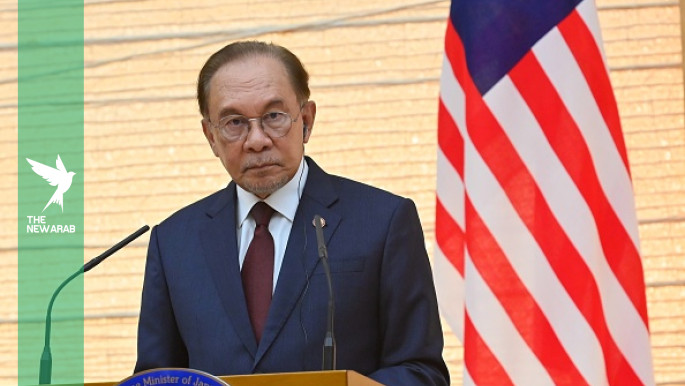
Malaysian PM Anwar Ibrahim has said his country could look beyond Europe to meet its defence procurement needs [Getty]
A months-long rift between Malaysia and Norway has continued over the European state’s revocation of an export license for a Naval Strike Missile (NSM) system in March, despite more than 90% of the deal having been paid for.
The NSM, manufactured by Norway’s Kongsberg Defence & Aerospace, is an advanced anti-ship missile intended to equip Malaysia’s Maharaja Lela-class littoral combat ships, a key component of the country’s long-delayed naval modernisation programme.
Speaking to Russian state news outlet RT earlier this week, Malaysian Prime Minister Anwar Ibrahim warned that his country, as well as other states, could turn away from Europe to fulfil their defence procurement needs.
The dispute has spotlighted the issues facing smaller states like Malaysia in balancing its international ties amid a volatile global climate.
Why did Norway cancel the missile deal?
Norway cancelled the export license for the NSM system, citing “security concerns”, according to the Malaysian prime minister. The cancellation came as tighter export controls on sensitive military technologies came into force.
Norway has said exports of some of its most sensitive defence technologies will now be restricted to allies and “closest partners” following changes in the European and global security environment. Oslo has maintained that the policy shift was not directed specifically at Malaysia.
Anwar said he had discussed the issue with Norway’s prime minister and was still seeking an explanation over why the agreement was not honoured.
The move “appears to have been a unilateral decision by Norway, driven by a fundamental reassessment of its security environment”, Shahriman Lockman, Director of Special Projects at the Institute of Strategic and International Studies (ISIS) in Malaysia, told The New Arab.
“Russia is undoubtedly the key variable here. Norwegian officials maintain that the decision was not specific to Malaysia, but rather the result of a reprioritisation towards their own defence requirements and those of their Western allies,” Lockman said.
Norway’s decision comes as several European states have tightened defence export controls and sought to prioritise military production for domestic use and allied countries amid heightened security concerns linked to Russia and the war in Ukraine.
“Nonetheless, this has not stopped speculation that Malaysia’s longstanding policy of non-alignment, and its continued openness to maintaining relations with both Russia and China, may also have been a contributing factor,” he added.
Was the US behind the cancellation?
Anwar said that despite early suspicions that the cancellation was influenced by the US or NATO, it was later discovered that Washington was not involved, and in fact attempted to help Malaysia secure the missiles.
“On the contrary, the US Government appears to have facilitated Malaysia’s acquisition of the NSM, including by helping to secure the requisite export-control licences for US technologies embedded in the system,” Lockman said.
“Furthermore, the United States has long supplied Malaysia with sensitive and sophisticated defence capabilities, including the AIM-9X air-to-air missile for the Royal Malaysian Air Force’s F/A-18 Hornets,” he added.
According to the Observatory for Economic Complexity, the US was the top supplier of arms to Malaysia between May 2025 and April 2026, with a total of 86.8 million ringgit ($21,000,000) in exports.
Too close to Tehran?
The timing of the cancellation fuelled speculation in Malaysia because it coincided with the launch of the US-Israel war on Iran, while Kuala Lumpur has maintained cordial relations with Tehran and has been outspoken in its criticism of Israel’s regional policies.
Analysts who spoke to TNA, however, said it was unlikely Norway’s decision was influenced by this.
“It is unlikely the cancellation has to do with Malaysia’s closeness with and support for Iran, as most European countries have not ‘punished’ those with close ties with Tehran. European countries themselves have stayed away from the US-Israeli war against Iran,” Rowena Razak, Iran analyst and lecturer in the history of the Middle East and Africa at SOAS University, told TNA.
“Malaysia has a long history of balancing between good ties with Iran and the US. This is the benefit of being a middle power. It has openly sided with its allies in the Middle East, been critical of Israel and has come on the side of Iran, but maintains economic ties with the US. It’s able to do so due to a flexible foreign policy and also because Malaysia has limited influence in the Middle East,” she added.
Looking beyond Europe
As it seeks compensation from Norway for close to 1 billion ringgit ($241,732,800) spent on the NSM system, Malaysia says it may now look beyond Europe for its defence needs.
Malaysia has already issued a formal compensation claim covering both the cost of the missile contract and the expense of modifying naval vessels that had been prepared to carry the Norwegian system. Officials have also warned that alternative missile systems may require costly redesign and integration work.
The threat to look elsewhere, however, may fade as tensions cool.
“The episode has, however, strengthened the case for non-Western defence suppliers, particularly Türkiye. In its immediate aftermath, there has been a tendency to broaden Malaysia’s grievances beyond Norway and towards European, or even Western, suppliers as a whole,” Lockman said.
“But this is unlikely to persist for long. As emotions subside, I suspect the Malaysian defence establishment will draw a clearer distinction between Norway on the one hand and the rest of Europe and the United States on the other. The reality is that there remain few substitutes, in terms of quality and capability, for much of the equipment offered by the United States and Europe,” he added.