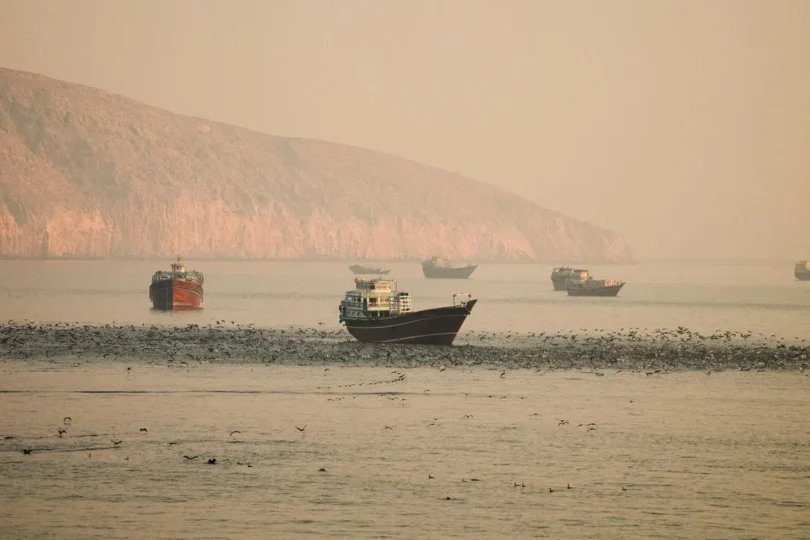
The US and Iran have committed to reopening the Strait of Hormuz, the world’s most important artery for shipping oil and natural gas, which has been largely blocked since the two countries went to war in February.
However, returning traffic in the strait to prewar levels – if that day ever comes – presents significant challenges.
The prediction market Kalshi assigns a 51 per cent probability that traffic will return to normal before Aug 1 and a 68 per cent probability before Sept 1.
Here’s a look at the main impediments:
Iran is thought to have mined what was the normal shipping channel through Hormuz, which connects the Persian Gulf to the Indian Ocean and is situated between Iran to its north and the United Arab Emirates and Oman to its south.
The threat of mines has forced ships to sail instead near Iran’s coastline or closer to Oman’s.
Use of the southern route, overseen by US forces, has already allowed oil flows to creep higher.
But the question of how much traffic the alternative routes can handle has not been fully tested.
Clearing the centre of the channel of any mines would help to get flows back to normal.
However, it is unclear who would undertake this effort and how demining ships would be protected.
The work itself could take weeks.
On top of the threat of mines, there is the risk of further violence that could affect ships and their crews.
The fragile ceasefire the US and Iran have had in place since April 8 has not stopped fighting all together.
At least 14 seafarers have died in this conflict, and there have been 46 attacks that damaged ships, according to the United Nations’ International Maritime Organization (IMO).
Merchant sailors are nervous about working in conflict zones at the best of times, so the shipping industry wants to hear unambiguous assurances from both the US and Iran that hostilities have truly ended.
Even then, several shipowners said some crews may be reluctant to return to the Persian Gulf, which could reduce the number of vessels sailing to the region to collect cargoes.
Until the war began, freedom of navigation was, with a few exceptions, taken for granted in Hormuz, just as it is in all major shipping straits.
It is not clear whether that will remain the case in the future.
Iran’s semi-official Fars New Agency reported that the future administration of “navigation services” in the strait will be determined by Iran and Oman.
Several shipowners told Bloomberg they would rather not be forced to communicate with anyone, but especially not an Iranian regime that is still under US sanctions, when sailing through waters that are meant to be subject to freedom of navigation rules.
The Baltic and International Maritime Council, the world’s top trade group for shipowners, says it must be clarified who, if anyone, will coordinate transits in the future.
It suggested that either a United Nations organisation, or a neutral state, could be involved.
It is unclear whether vessels will be charged to pass through Hormuz.
US President Donald Trump says they would not.
Iran says ships a fee-free period will end after 60 days.
The UN’s IMO said in April that there is no legal basis for charging Hormuz tolls, and the US has said in the past that paying them would be a sanctionable act.
Thus, shipowners are terrified of having to pay Iran for passage and risk getting blacklisted by US sanctions authorities.
At the same time, at least one senior US government official acknowledged that paying for transit might become a possibility.
Big energy companies are apt to object to any tolls or fees.
Chevron Corp chief executive Mike Wirth said on Bloomberg Television in May that his company would not consider paying to pass through the strait.
Stalled oil and gas production is perhaps the biggest impediment to fully normalising trade flows through the Strait of Hormuz.
Before the war, it handled around a fifth of the world’s oil and liquefied natural gas supply.
The increased use of bypass routes provoked by the war has reduced the strait’s centrality, but by only a little.
In some cases, oil and gas production was halted because, with Hormuz blocked, exports became impossible.
Shutting down a well, even voluntarily, can degrade its efficiency and cause long-term operational losses.
In other cases, war damage caused shutdowns.
Rebuilding oil and gas infrastructure in the region will cost roughly US$42 billion (S$53.8 billion), according to Rystad Energy.
While the infrastructure restarts, tankers previously serving the Persian Gulf that scattered to other routes or were demobilised will need to be repositioned.
Rystad analysts said that should take about two months.
They assess that the big increase in output from the region will come in August and September, as fields return to productivity.
Some 85 to 90 per cent of the lost volume will be recovered by early in the fourth quarter of 2026, they project, rising to 100 per cent only in January 2027. BLOOMBERG