
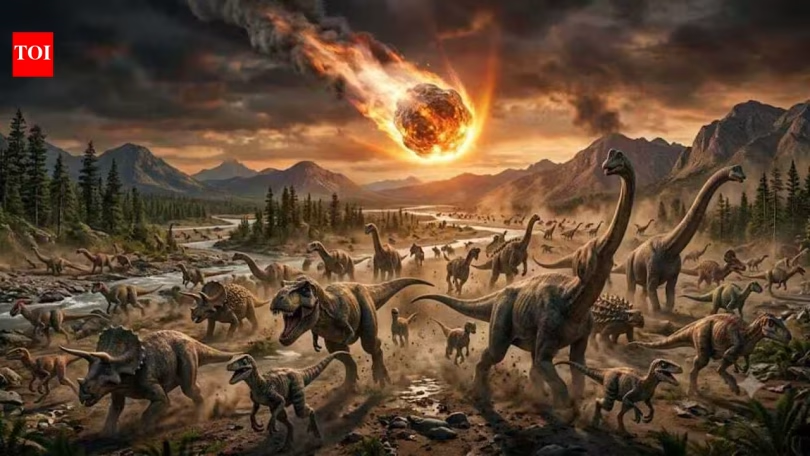
For more than 160 million years, dinosaurs dominated life on Earth. They survived shifting continents, volcanic eruptions, changing climates and countless evolutionary challenges, becoming the planet’s undisputed apex animals. Then, around 66 million years ago, their reign ended with astonishing speed in geological terms. Today, scientists overwhelmingly agree that the extinction was triggered by a colossal asteroid impact. The collision released an amount of energy almost impossible to comprehend, estimated to be more than one billion times greater than the combined force of the atomic bombs dropped on Hiroshima and Nagasaki. Rather than simply creating a massive crater, the impact transformed Earth’s atmosphere, climate and ecosystems, wiping out around 75% of all species, including every non-avian dinosaur.
How one giant asteroid struck Earth at the end of the Cretaceous Period
Richard Cowen in his book History of Life writes, the asteroid measured approximately 10 to 15 kilometres (6 to 9 miles) in diameter when it slammed into Earth near what is now Mexico’s Yucatán Peninsula.The impact created the Chicxulub crater, a structure measuring about 180 kilometres (112 miles) across, making it one of the largest confirmed impact craters on Earth.Travelling at an estimated speed of around 20 kilometres per second, the asteroid struck with unimaginable kinetic energy. Researchers estimate the explosion released roughly 100 million megatons of TNT, equivalent to more than one billion times the combined explosive force of the atomic bombs dropped on Hiroshima and Nagasaki.The impact instantly vaporised rock, blasted enormous quantities of debris into the atmosphere and generated earthquakes, shock waves and tsunamis that spread across vast regions of the planet.
The asteroid caused years of global darkness and climate collapse
The devastation did not end with the initial collision. As trillions of tonnes of dust, pulverised rock and sulphur-rich material were blasted high into the atmosphere, sunlight became severely blocked. Scientists believe Earth experienced months, or even years, of dramatically reduced sunlight, causing global temperatures to fall sharply.Without sufficient sunlight, photosynthesis declined across much of the planet. Plants struggled to survive, disrupting the food chains that depended on them. Herbivorous dinosaurs faced severe food shortages, followed by the large predators that relied on them for survival.At the same time, wildfires ignited across continents, while acid rain formed as sulphur compounds reacted with atmospheric moisture. Marine ecosystems also suffered as ocean chemistry changed, leading to the collapse of many aquatic food webs.
Why birds survived while other dinosaurs vanished
Although the asteroid caused one of Earth’s greatest mass extinctions, not every dinosaur disappeared. Modern birds are now recognised as the only surviving lineage of dinosaurs.Scientists believe several factors improved their chances of survival. Many early birds were relatively small, required less food and could exploit a wider variety of food sources, including seeds that remained available after vegetation declined. Their ability to fly also allowed them to move in search of suitable habitats more effectively than many larger land animals.Meanwhile, the giant non-avian dinosaurs, which often depended on abundant vegetation or large prey populations, were unable to adapt quickly enough to the rapidly changing environment.
The Chicxulub impact reshaped the future of life on Earth
The extinction of the non-avian dinosaurs marked the end of the Cretaceous Period and the beginning of a new chapter in Earth’s history.With the dominant reptiles gone, mammals rapidly diversified into ecological niches that had previously been occupied by dinosaurs. Over millions of years, this evolutionary expansion eventually gave rise to primates and, much later, humans.Today, evidence for the asteroid impact comes from multiple independent sources, including the Chicxulub crater itself, a worldwide layer of iridium-rich sediments, shocked quartz crystals and tiny glass spherules formed by the immense heat of the collision.Far from being a single catastrophic explosion, the asteroid triggered a chain of environmental changes that permanently altered Earth’s climate and ecosystems. The event ended one of the longest dynasties in the history of life while creating the conditions for an entirely new age of evolution, one that ultimately made our own existence possible.